
TL;DR
- Hotels that rely on static pricing set fixed rates that remain unchanged even when demand suddenly shifts, which can limit revenue during peak travel periods.
- Dynamic pricing lets hotels adjust room rates multiple times a day based on real-time demand, competitor activity, and booking trends, helping capture higher revenue and protect occupancy.
- AI-powered tools like ampliphi RMS automate these adjustments, analyze guest behavior, and provide actionable insights, allowing hotels to save time while maximizing revenue consistently.
Dynamic Pricing vs Static Pricing: Which Model Wins in 2026?

Hoteliers and revenue managers know that travel demand can shift overnight, and quick decisions often separate successful hotels from struggling ones. When occupancy trends change, hotels that can adapt pricing in real time capture more bookings and maintain steady cash flow, even when the market slows. Many teams have found that using dynamic pricing vs static pricing in hotels helps them respond to unpredictable demand while keeping revenue goals on track.
For independent hoteliers, AI dynamic pricing tools provide a significant competitive advantage, dramatically boosting overall revenue and optimizing current pricing strategies. This massive technological trend highlights the market’s direction, where independent hoteliers have increased their revenue per available room (RevPAR) by up to 35% simply by using the right hotel revenue management software (RMS).
Our detailed guide explains what dynamic pricing is, how it works, and how hoteliers can use it to drive occupancy and increase revenue in 2026.
Understanding Static Pricing in Hotels
Static pricing is a strategy in which a hotel sets a rate in advance and keeps it unchanged for an extended period, even when demand shifts. Many small, independent hotels prefer this approach because it feels simple, predictable, and easy to manage throughout the seasons.
For example, a small independent hotel may implement a two-tiered seasonal pricing strategy:
- $399 fixed standard rate for the low season (November to March)
- $799 fixed standard rate for the peak season (April to October)
Sounds easy, doesn’t it?
The challenge arises when demand suddenly shifts and those fixed prices no longer align with traveler behavior or market trends. Hotels using static pricing often lose potential revenue during high-demand weeks and risk lower occupancy when travel slows.
For example, global figures show that average daily rates (ADRs) in key markets climbed by 20% in 2024, showing demand outpaced fixed-rate plans. When a hotel resists adjusting its pricing quickly, it may miss capturing higher rates during strong demand or fail to lower rates to stimulate bookings when the market softens. Static pricing limits hotel rate flexibility and thereby can reduce responsiveness in a changing travel market.
The Rise of Dynamic Pricing
Dynamic pricing gives hotels the ability to change room rates throughout the day based on real-time market conditions. This flexible method helps hotels stay competitive as demand rises or falls, allowing them to capture more revenue at the right time.
For example, a hotel may follow this pattern:
- Offer a $189 rate in the morning when occupancy is low and demand remains weak
- Raise the rate to $239 in the evening once demand increases and fewer rooms remain available
This approach allows revenue managers to respond quickly to changes rather than waiting for weekly or seasonal adjustments. According to Hotel Tech Report (2025), hotels using adaptive pricing tools saw RevPAR 12-18% higher than those using fixed pricing models.
Many hotels now track booking pace, competitor activity, and local events to adjust prices multiple times a day. As a result, they protect occupancy during slower periods and capture stronger revenue when traveler demand peaks.
Key Differences Between Static and Dynamic Models
As we discussed earlier, hotels employ two primary pricing strategies: static and dynamic.
The difference between static and dynamic pricing models for hotels truly comes down to how each reacts to market conditions and guest behaviour.
- With a static model, a property sets fixed room rates for weekdays, weekends, and holiday seasons without adjusting for real-time shifts in market demand or competitor pricing.
- In contrast, a dynamic model adapts rates based on current demand pace, booking trends, and competitor behaviour, giving hoteliers greater flexibility to capture revenue amid changing market conditions.
Recent industry data show that luxury and upper-upscale hotels achieved about 4.2% year-on-year growth in RevPAR in early 2025, compared with only 1.9% for economy-class properties among U.S. hotels. That gap reflects how different pricing approaches affect outcomes.
The comparison below highlights key features that separate static and dynamic models and shows how the choice of model shapes hotel performance in both stable and shifting demand periods.
| Feature | Static Pricing | Dynamic Pricing |
| Rate Change Frequency | Holds a set rate for a long period, even when demand shifts | Adjusts rates frequently based on market signals, including supply, demand and competitor moves |
| Data Inputs | Uses historical seasonality and fixed assumptions to set rates | Uses live market data, booking pace, cancellations and competitor pricing to update rates |
| Risk in Low Demand | Faces a higher risk of unsold rooms when demand falls because rates cannot respond | Reacts by lowering rates to stimulate bookings and reduce unsold inventory |
| Opportunity in High Demand | Misses chances to increase revenue when demand surges because rates remain fixed | Captures higher revenue when demand rises because rates can increase to reflect scarcity |
| Complexity and Tools Required | Operates simply with minimal tools or manual rate decisions | Requires integrated technology and analysis tools to manage frequent rate changes |
Benefits of Dynamic Pricing in 2026
Hotels that adopt dynamic pricing receive measurable improvements across revenue and occupancy in competitive markets. What follows are key benefits that show clear value for hoteliers in 2026:
1. Accurate demand response
When hotels use dynamic pricing tools, they respond quickly to demand shifts and avoid pricing that lags the market. A recent study found that Marriott’s revenue strategy platform achieved a 22% increase in RevPAR in 2025 by leveraging advanced demand signals.
This approach gives your rate team real-time feedback and supports hotel rate flexibility by reacting to booking surges rather than relying on outdated rules. You can keep rates competitive while capturing high-value bookings during peak nights and special events.
2. Optimised inventory use
Dynamic pricing helps your team sell available rooms smartly when demand is high and maintain occupancy when demand is softer. Instead of holding rigid rates that underperform, hotels adjust based on real-time metrics so fewer rooms remain empty or under-priced.
For example, demand-based pricing models now process dozens of variables, so your inventory aligns with actual guest interest rather than yesterday’s forecast. This practice improves yield and makes every night count toward revenue.
3. Improved client segmentation and personalisation
Modern dynamic pricing systems segment guests by group, family, business traveller, and leisure, so your hotel can offer tailored rates and packages. The use of segmentation and rate differentiation lets you treat each guest type uniquely and capture higher value where available.
In fact, hotels that use this targeted segmentation can see meaningful improvements in both occupancy and average rate. You gain more control over who books and at what rate while offering an experience that feels custom rather than generic.
4. Lower operational load for pricing teams
When you switch from manual spreadsheets and guesswork to automated dynamic pricing, you free your revenue team to focus on strategy rather than reactive updates. The technology monitors market data, competitor moves, and demand signals, then applies your rules, freeing human effort to focus on guest experience and value creation.
According to industry reporting, the AI in the hospitality market grew from $0.15 billion in 2024 to $0.24 billion in 2025, indicating how much resource investment has moved into automation.
5. Stronger competitive positioning
Dynamic pricing gives your property a chance to respond faster than competitors who rely on static rate calendars. When you move rates in near-real-time, you capture high-value nights and manage availability more effectively at the right time.
Recent market data suggests that average price increases in major cities are forecast to reach up to 17.5% in 2025, highlighting the importance of responsiveness. Your hotel can stay ahead by making smart pricing decisions rather than waiting until the last minute.
The Role of AI and Automation in Real-Time Adjustments
Hotel pricing used to depend heavily on manual inputs and static models that rarely kept up with demand swings. Today, hotels operate in a market where pricing decisions can shift hourly based on occupancy patterns, competitor actions, and booking pace.
That’s where AI and automation redefine how you approach rate management, bringing accuracy and agility together in real time:
A. Live rate updates that move with the market

Hotel rates change faster than ever, and staying competitive means reacting at the same speed. A revenue management system like ampliphi RMS uses AI dynamic pricing to adjust room rates automatically as booking patterns, occupancy levels, and competitor activities shift throughout the day.
The system continuously monitors live market signals across multiple channels and updates your pricing in real time, eliminating the need for manual adjustments. With ampliphi RMS, your rates evolve continuously with the market, keeping your property competitive without constant intervention.
B. Smarter forecasting for better demand planning

Forecasting errors can cost thousands during high-demand weeks. ampliphi RMS eliminates that risk through predictive algorithms that analyze historical and live performance together. Its AI continuously learns from guest behavior and market inputs to refine future pricing decisions.
In fact, a recent report showed that hotels using predictive analytics improved occupancy forecasting accuracy by 33%, resulting in steadier revenue and higher conversion rates.
C. Less time adjusting, more time strategizing
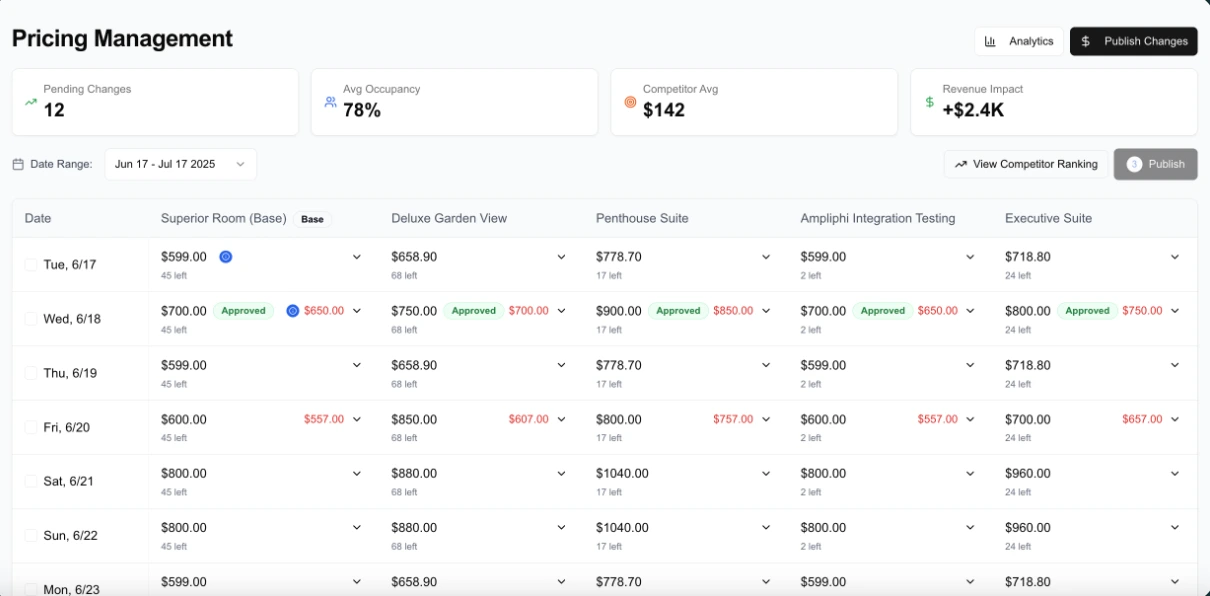
Revenue managers no longer need to spend hours changing prices manually or reviewing daily reports. ampliphi RMS automates those repetitive tasks completely while giving you complete visibility into every rate adjustment it makes.
The platform allows you to define your pricing boundaries, maintain rate hierarchies across room types, and still retain control over the final decision. This means you get more time to focus on long-term revenue strategies and guest engagement while the system handles the day-to-day pricing execution.
D. Transparent tracking and performance insights
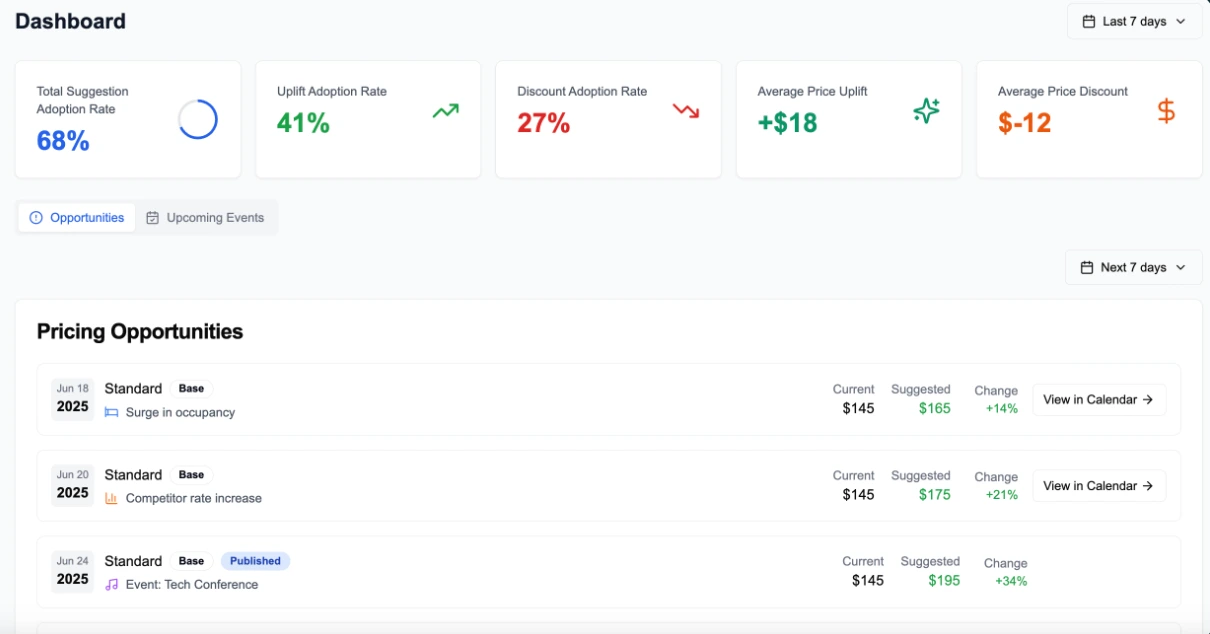
Automation becomes truly valuable when you can clearly track its results.
ampliphi RMS includes detailed dashboards and real-time reports that display how every rate change contributes to your property’s performance. The system makes it easy to measure success, compare outcomes, and make adjustments without disrupting your overall pricing logic.
With this level of visibility, your team can see the full ROI of switching to an AI revenue management system and make confident business decisions.
E. Guest data analytics for better decisions
Every price update in ampliphi RMS is supported by intelligent guest data analytics that connect traveler behavior with revenue opportunities. The platform studies booking pace, stay duration, and repeat patterns to recommend rate adjustments that appeal to different guest segments.
This insight helps you create more targeted offers and maintain hotel rate flexibility that aligns with market movements and guest preferences.
When Static Pricing Still Works
Static pricing might feel outdated in a fast-moving market, but it still holds value for certain hotel scenarios. Hoteliers can confidently use static rates in these scenarios without sacrificing profitability or guest satisfaction:
- Predictable occupancy and low competition: Static rates work effectively when your hotel faces consistent demand and competitor pricing remains stable, allowing you to maintain straightforward revenue planning without constant adjustments.
- Small boutique properties with niche clientele: Hotels that cater to loyal, repeat guests often benefit from fixed rates, as customers expect consistency and may appreciate transparency in pricing over fluctuating rates.
- Long-term contracts and group bookings: When hotels commit to large group reservations or corporate contracts, static pricing provides clear cost expectations for both the hotel and the client, avoiding misunderstandings or last-minute changes.
- Off-season periods with low demand variability: During periods of minimal market fluctuation, fixed rates reduce management overhead while still attracting steady bookings, helping staff focus on operational efficiency rather than continuous pricing updates.
- Simple pricing models for small-scale operations: Hotels operating with limited resources can maintain static pricing effectively, as it reduces the need for constant monitoring, data analysis, or investment in dynamic pricing tools.
The Final Step to Smarter Hotel Pricing
Once you decide to implement a dynamic pricing strategy, you must put in place processes that continuously maximize your hotel’s revenue. Regularly scheduling weekly or bi-weekly meetings with your staff allows you to review recent pricing changes, monitor upcoming demand, and discuss strategies for high-occupancy dates. These meetings also provide a strong foundation for establishing long-term hotel revenue management practices, which mark a key milestone for any property owner.
Using a dynamic pricing tool such as ampliphi RMS helps you:
- Automatically adjust rates according to real-time market conditions, occupancy patterns, and competitor moves, saving hours of manual work each week
- Maintain control over pricing rules while letting AI optimize rates across all room types for consistent revenue performance
- Track results with full transparency, allowing hotel managers to make informed decisions
Take control of your hotel’s revenue today and see how AI dynamic pricing can transform your profitability. Book a demo to start optimizing your rates immediately.
FAQs
What is the difference between static and dynamic pricing?
Dynamic pricing adjusts hotel room rates in real time based on factors like demand, competitor pricing, and local events. In contrast, static pricing sets fixed rates that do not change, regardless of market conditions. While static pricing offers predictability, it may lead to missed revenue opportunities during peak demand periods.
How does AI enhance dynamic pricing?
AI improves dynamic pricing by analyzing vast amounts of data, such as booking patterns and competitor rates, to predict optimal pricing strategies. This enables hotels to adjust rates swiftly and accurately, maximizing revenue and occupancy.
Should all hotels switch to dynamic pricing?
Not all hotels need to adopt dynamic pricing. For instance, ampliphi RMS offers a solution that allows hotels to implement dynamic pricing strategies tailored to their specific needs and market conditions. Each hotel needs to assess its unique circumstances before transitioning to dynamic pricing.