Part 1: Why this study
AI visibility. Mentions. Citations. Agentic stuff.
Is this something that an independent hotel owner/operator needs to worry about now?
Isn’t it enough for them to wear many hats to manage their property?
Let me elaborate.
Here's what getting a guest to book online looks like, in numbers.
| Row | Figure | Source |
|---|---|---|
| Direct share | ~51% direct, Europe, all hotels (HOTREC 2026). 37% direct for independents globally, 47% US independents (Cloudbeds 2026). | HOTREC 2026 · Cloudbeds |
| OTA share | 30% via OTAs, Europe (HOTREC 2026). 63% for independents globally, 53% US (Cloudbeds 2026). Booking Holdings + Expedia = 85.4% of OTA bookings (HOTREC 2026). | HOTREC 2026 · Cloudbeds |
| OTA commission | 15% base, ~18% Preferred, 15–25% typical effective range · Swiss Price Supervisor ruled Booking’s rates “too high” and ordered a cut of “almost a quarter” (May 2025) | Fáilte Ireland · Lighthouse via Hospitalitynet · Swiss ruling |
| Reseller undercut | 51% of hotels report OTA undercutting, 4 in 5 without consent (HOTREC 2026) · typical size 6–10% (HOTREC 2024). An OTA beats direct in 75% of Google Hotels searches (123Compare.me, H1 2025). | HOTREC 2024 PDF · 123Compare.me |
Figures are mostly European/global.
I’m not a trained revenue manager, but The billboard effect (Cornell, 2009) found that being listed on an OTA lifts direct bookings: 7.5%–26% more for the hotels studied.
Enter the AI visibility hype.
In November 2025, Google announced it was bringing agentic booking for flights and hotels to AI Mode.
May 2026, at that year’s I/O Conference, Google names hotels as the next vertical for their Universal Commerce Protocol, the system that lets AI agents complete purchases.
In early August 2026, Google confirmed a limited test in the US; later that month it rolled out with more partners: Booking.com, Expedia, Hotels.com, Priceline, Trip.com, Choice, Hilton, IHG, Marriott, Wyndham.
So my question was: in this agentic booking scenario, who wins, and how much will it cost an independent hotel (in ads, commissions, or tools that promise to fix AI visibility)?
Because if agentic booking sits on top of the discovery layer, then independent hotels will need to deal with another channel constraint:
- OTAs already pressure direct pricing.
- OTAs capture most of the visibility and the booking.
- Metasearch and resellers shape rates and traffic.
- Now agentic booking wants to be the new shiny toy.
What research has discovered
In January 2026, Rand Fishkin and Patrick O’Donnell published research showing that AI tools almost never repeat the same list of brand recommendations. They asked 600 volunteers to run 12 different prompts through ChatGPT, Claude and Google's AI Overviews, 2,961 times in total.
I knew the conclusions of the research. I was one of those 600 participants (hi Rand!).
Two of their takeaways were in my mind the moment I started to do my own research.
- “AIs rarely give the same list of brands or recommendations twice (<1 in 100 times, no matter the question)”
- “AIs almost never give the same list of brands/recs in the same order.”
I followed the same design but applied to one vertical: independent hotels.
Participation was smaller than Rand's: 23 respondents, through SurveySwap plus friends and family. Each participant ran six prompts for the same trip: Austin, 2 adults, October 16–18, 2026.
One answer = one respondent, one prompt, one engine.
Three prompts were discovery questions (“boutique hotels,” “best independent hotels near downtown,” “where should I stay, non-chain”).
Three prompts were booking questions (“book a hotel,” “show hotels I can book now,” “compare bookable boutique hotels”).
Each respondent ran the prompts on ChatGPT, Google AI Mode and one engine they picked themselves, using their normal setup. That provided four engine groups: ChatGPT, Google AI Mode, Gemini, and Other. Answers were collected between late September and early October 2026.
After cleaning out blanks, duplicates and links, 330 answers from 23 respondents named at least one hotel. In total, 60 distinct properties or chain brands appeared.
For the analysis, I used Claude (Opus 5.5) to parse and clean the data, run the numbers, and build visuals adapted from Rand Fishkin and Patrick O’Donnell’s research.
The hotel matching itself is rule-based, a fixed list of names applied the same way to every answer, so no AI decided which hotels counted. I made the method calls and checked the output.
Part 2: The Findings
1. Ask twice, get a different list
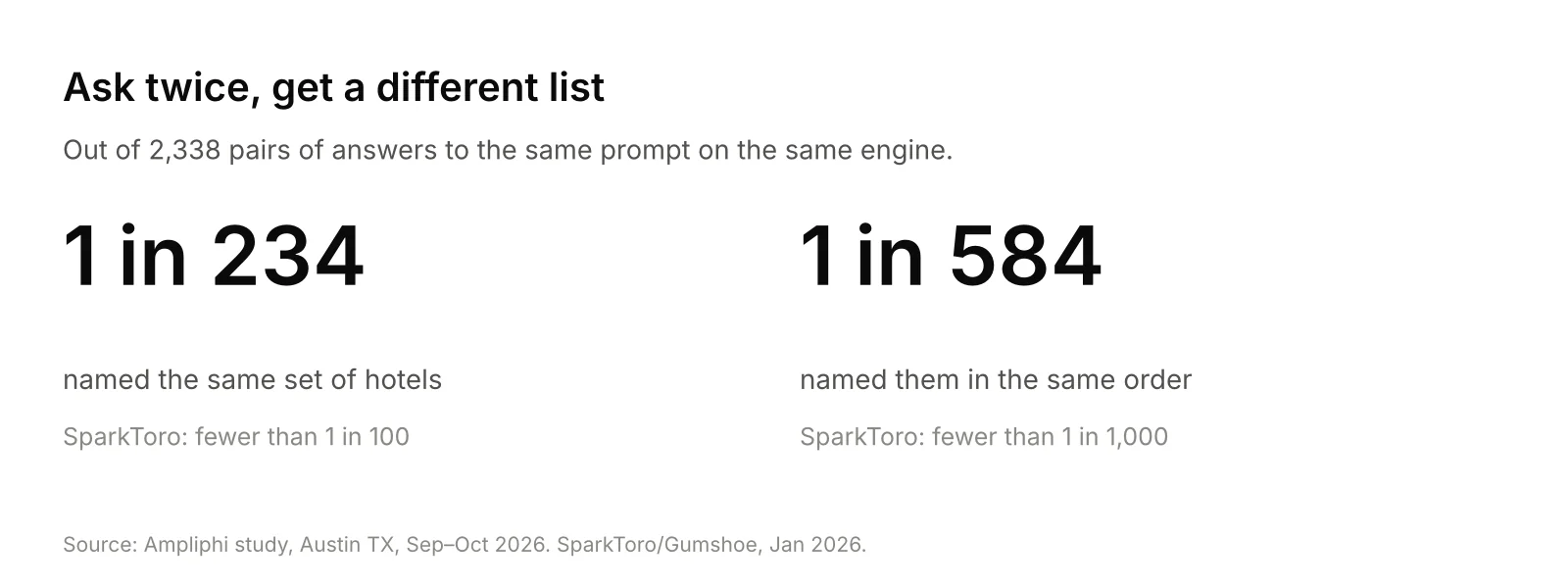
Out of 2,338 pairs of answers, 10 named the same hotels and only 4 in the same order.
Within each prompt and engine, answers almost never matched: about 1 in 234 pairs named the same hotels, and 1 in 584 in the same order.
That’s consistent with SparkToro’s finding of less than 1 in 100 for the same set and less than 1 in 1,000 for the same order.
When answers did repeat, it was most often Gemini: 5 of the 10 matching pairs, and all 4 in the same order. Google AI Mode had 3, two of them seven-hotel lists.
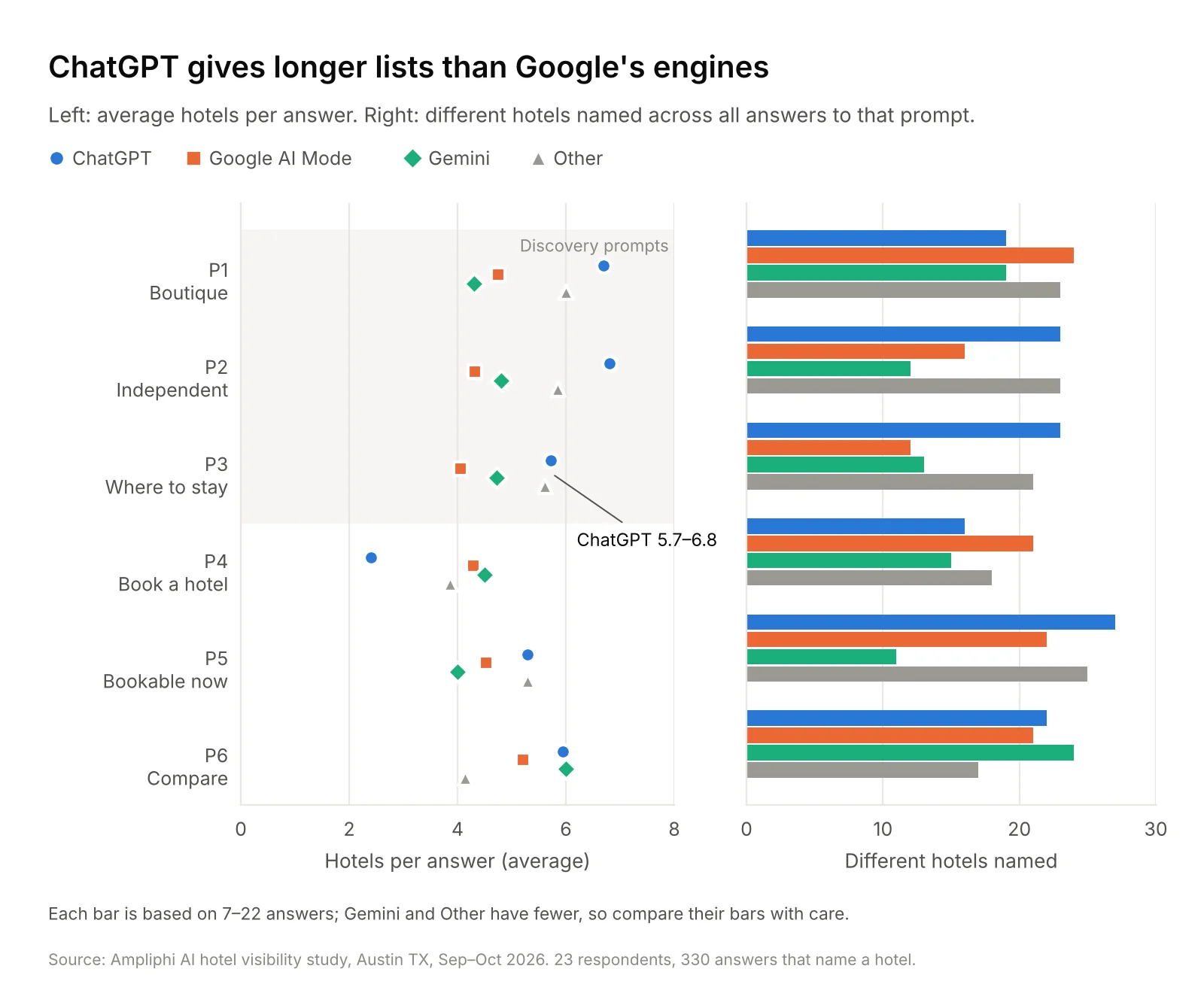
On the discovery prompts, Google AI Mode and Gemini name the fewest hotels per answer (about 4.1–4.8). ChatGPT names the most (5.7–6.8).
2. Each engine has its own favorites
A few hotels show up again and again, but which ones depends on the engine.
Within each prompt and engine, a few hotels appear in most answers, the same way SparkToro saw a stable core in tight categories like ‘cloud computing providers’ and ‘LA Volvo dealers’ .
On the discovery prompts, the most-mentioned hotel in a cell appears in 62–90% of its answers. Five properties make up the pooled core: The Frances Modern Inn, Carpenter Hotel, Hotel San José, Heywood Hotel and Hotel Saint Cecilia.
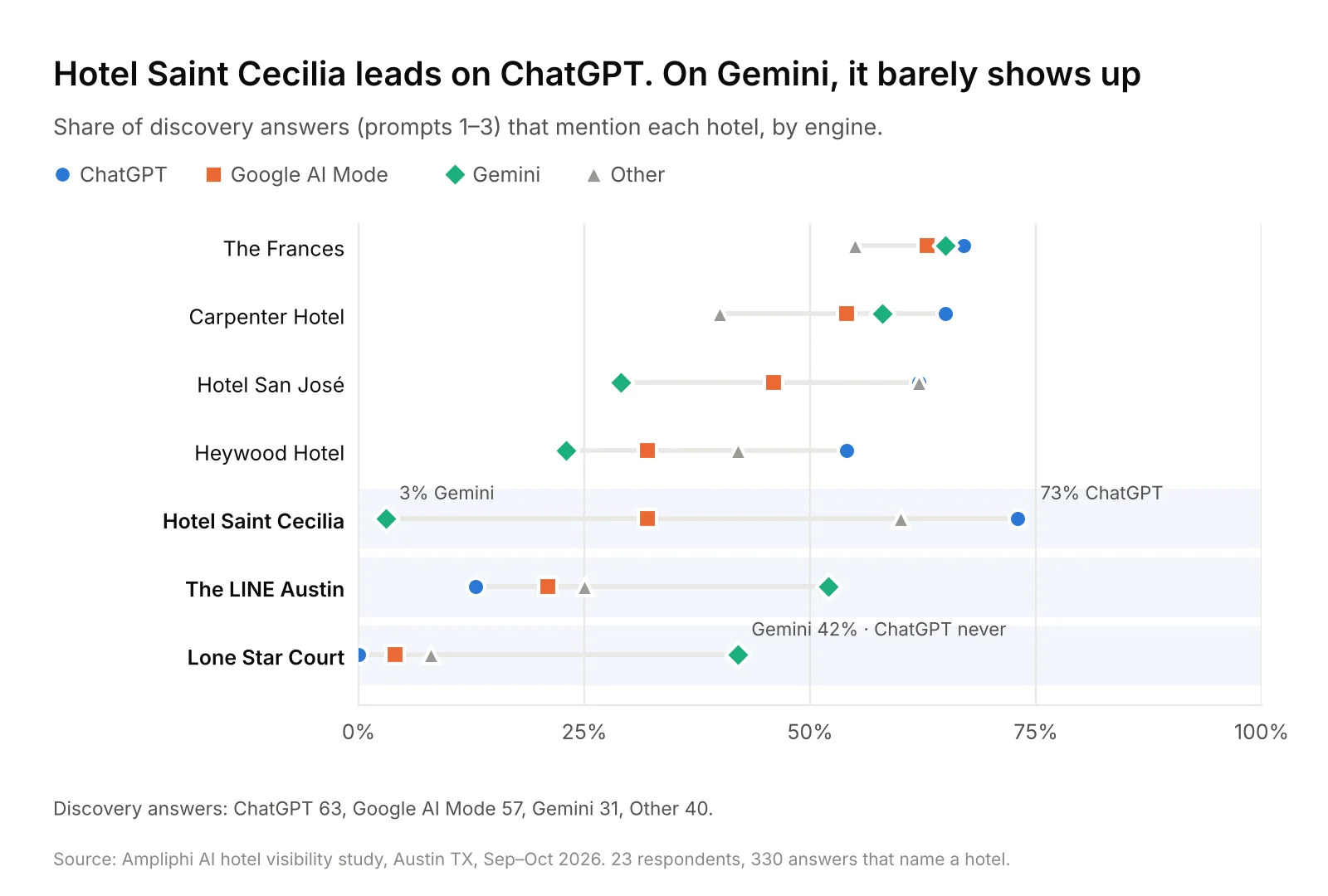
Looking at Gemini on its own, it’s clear the engines don’t share one core.
Hotel Saint Cecilia appears in 73% of ChatGPT’s discovery answers but in 3% of Gemini’s.
Gemini leans instead on The LINE Austin, which it names first in 39% of its discovery answers (ChatGPT never does), and Lone Star Court, which ChatGPT never mentions at all.
Count of answers mentioning the hotel, out of all answers in that cell. Chain hotels are grouped by parent brand.
3. Visibility is not ranking, and double-check your travel plan
The Frances appears in half the answers but is named first in fewer than 1 in 10, and some booking answers send people out of the city.
SparkToro’s clearest example was City of Hope, which appeared in almost every ChatGPT answer but was named first in only about a third of them. My hotel version shows the same gap, only wider, and no hotel comes close to City of Hope’s 97%.
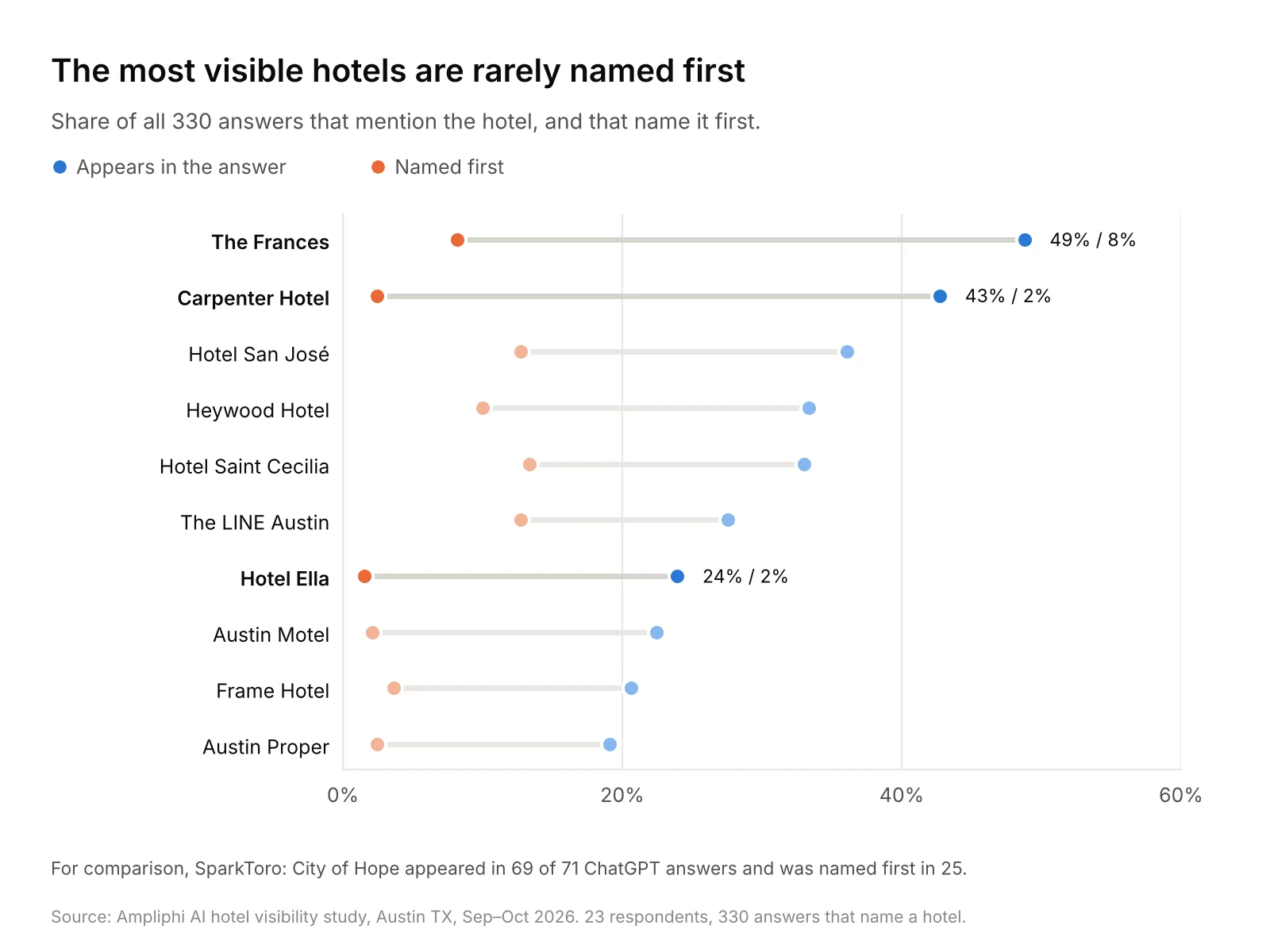
Carpenter Hotel appears in 43% of answers but leads only 2% of them. Hotel Ella appears in almost a quarter of answers and is named first in 2% of them (5 times).
Even The Frances Modern Inn, the most visible hotel at 49%, is named first in only 8%. A hotel tracking its “AI rank” would see noise. A hotel tracking its visibility would see a fairly stable signal.
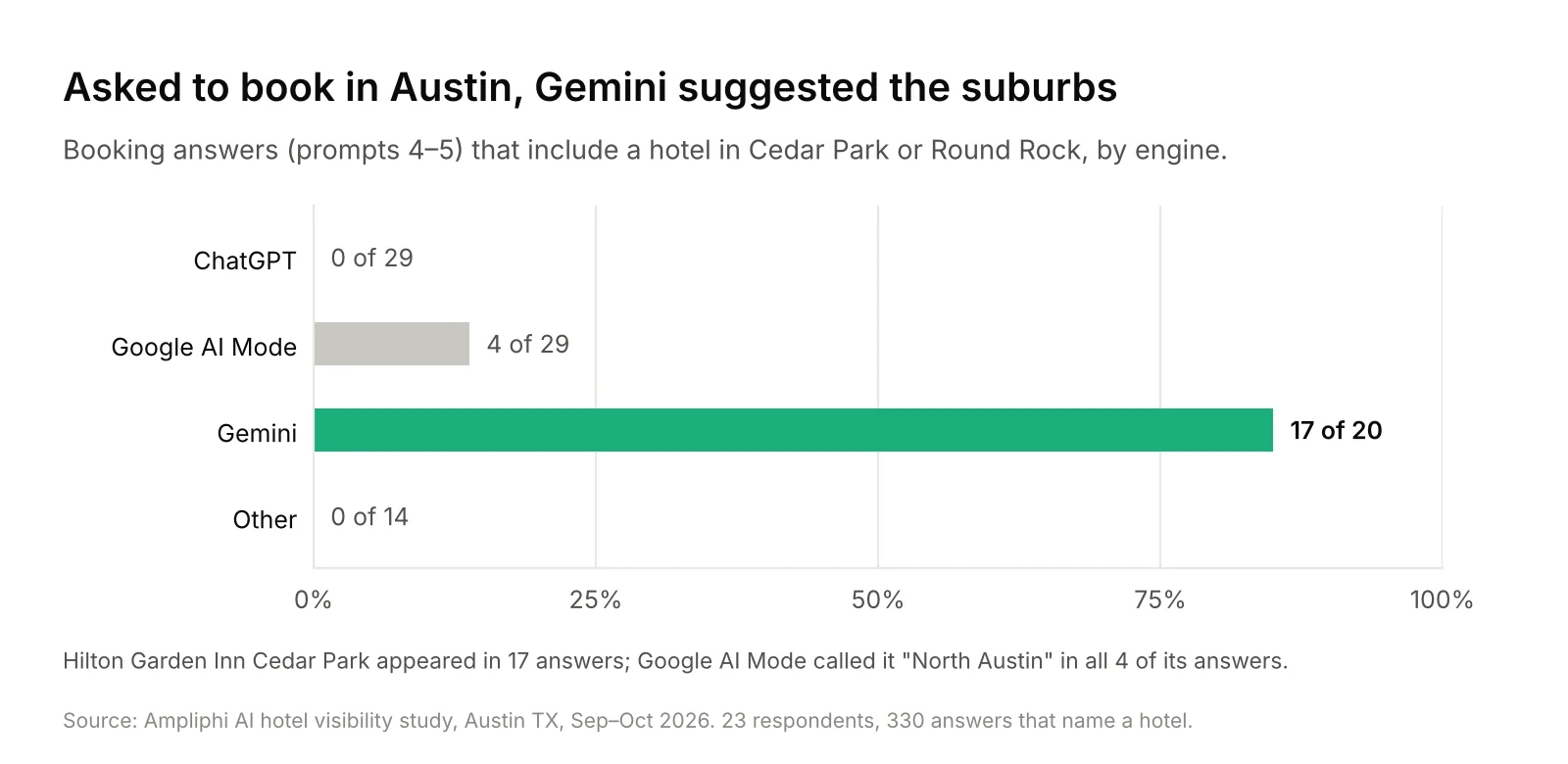
My assumption going in was that a trip to Austin would bring up Austin hotels.
Mostly it did, until people asked to book. Then 21 answers included a hotel in Cedar Park or Round Rock, two separate cities north of downtown. Gemini did it in 17 of its 20 booking answers. Some answers went further and described them as “North Austin”.
When a recommendation gets the city wrong, it’s harder to trust the rest of the list.
4. What changes the list is the ask, not the wording
SparkToro found that 142 very differently worded headphone prompts still converged on the same brands.
I used fixed prompts, but my three discovery prompts are worded around different ideas. One asks about boutique hotels, one about independent hotels near downtown, and one about where to stay. They still produce nearly the same visibility profile.
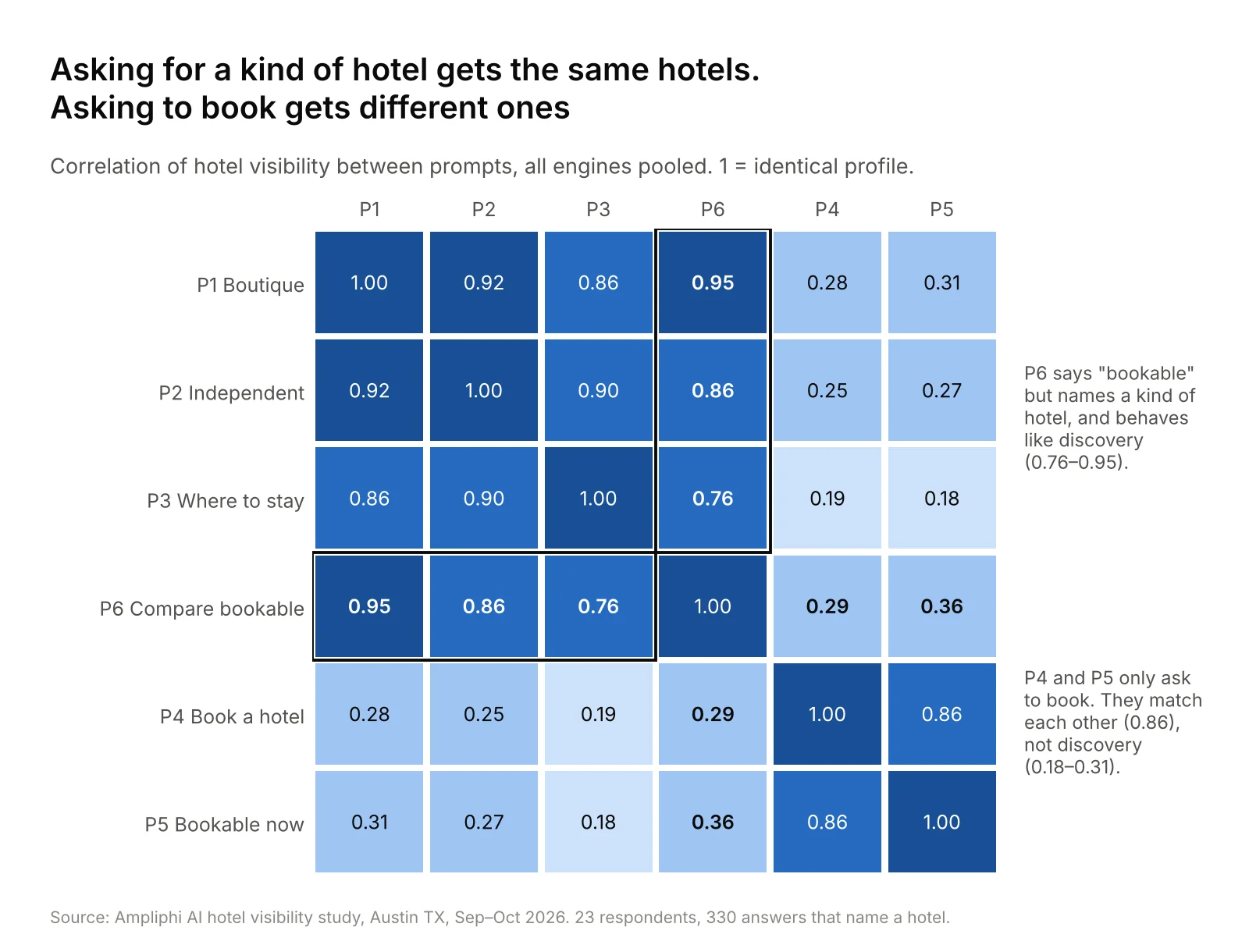
The three discovery prompts correlate at 0.86–0.92.
The two prompts that ask only to book (“book a hotel,” “show hotels I can book now”) correlate with each other at 0.86 but with the discovery prompts at only 0.18–0.31.
The third booking prompt is the interesting one. It asks to compare bookable boutique hotels, and it behaves like a discovery prompt (0.76–0.95).
Saying what kind of hotel you want matters more than saying you want to book.
5. If AI visibility is bad, booking is its meaner big brother
This is the part where the AI visibility starts screwing up an independent’s revenue plan.
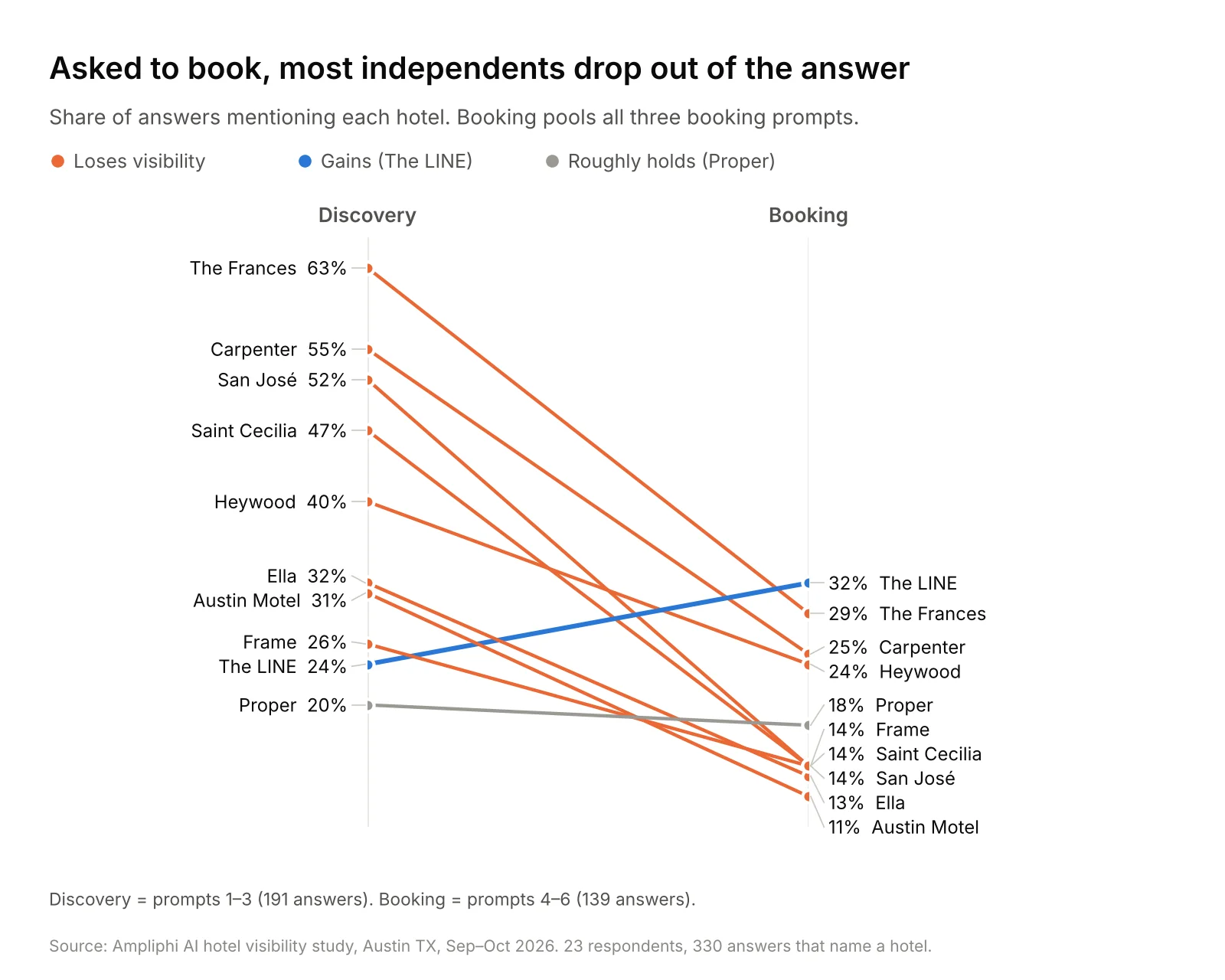
Once a prompt asks to book, four things happen.
Most independents lose visibility
Hotel San José (-73%) and Hotel Saint Cecilia (-70%) lose nearly three-quarters of their discovery visibility.
The Frances (−54%) and Carpenter (−55%) lose about half, and Heywood about 40%.
The LINE Austin is the exception and gains (24% to 32%), and Austin Proper roughly holds (20% to 18%).
Chains move in
Hyatt acquired Bunkhouse (2018), the group behind Saint Cecilia, San José and Austin Motel, and 26 answers mention Bunkhouse and Hyatt together, 8 of them with a hyatt.com booking link.
Chain hotels appear in 53% of booking answers vs 7% of discovery answers.
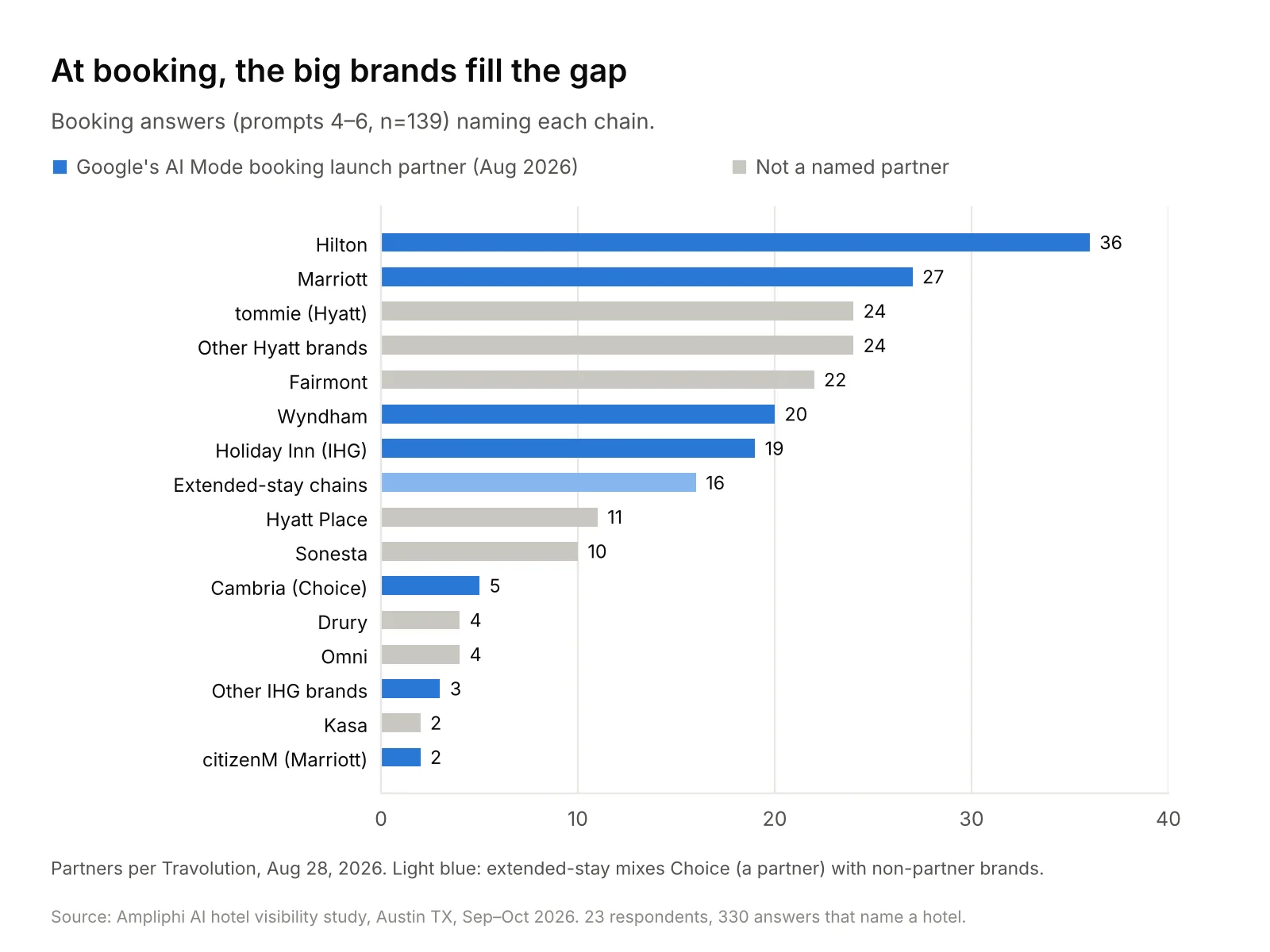
Gemini is the most extreme: 80% of its booking answers name a chain; its top picks are extended-stay, Wyndham and Hilton brands. Google AI Mode follows at 58%, ChatGPT at 36%.
OTAs appear at the moment of intent
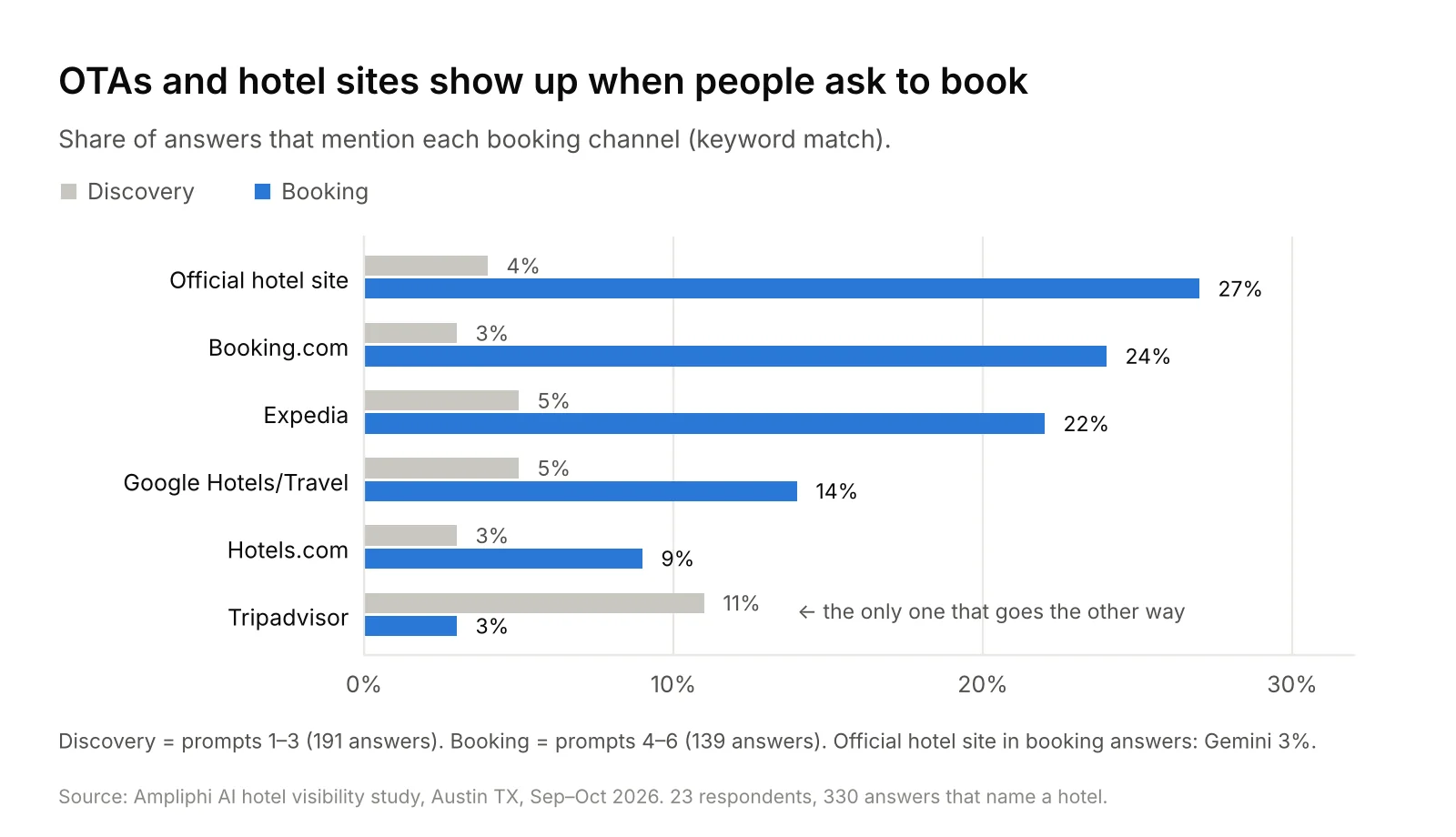
Booking.com and Expedia are almost absent from discovery answers (3–5%) and appear in a quarter of booking answers.
Google AI Mode’s booking answers show side-by-side rates from Hotels.com (28%), Expedia (16%), Booking.com (28%), Super.com (9%) and Priceline (5%), so any rate gap between the OTAs and the hotel is right in front of the guest.
Official hotel sites are mentioned in 27% of booking answers, by every engine except Gemini (3%). Tripadvisor goes the other way: it’s a discovery source (11%) more than a booking one (3%).
Booking answers agree with each other less, except on Gemini
On the two pure booking prompts, the average overlap between two answers drops from 0.30–0.34 to 0.12–0.13 for ChatGPT, from 0.24–0.29 to 0.13–0.15 for Google AI Mode, and to about 0.1 for the Other engines. Gemini’s overlap stays at 0.32–0.34, because its booking answers converge on the same chain brands rather than on boutique hotels.
And that’s before the ads. In 11 of Google AI Mode’s 43 booking answers, a Sponsored block followed, mostly from OTAs. We didn’t count those as recommendations.
Part 3: What the listed hotels have in common (and what they don't)
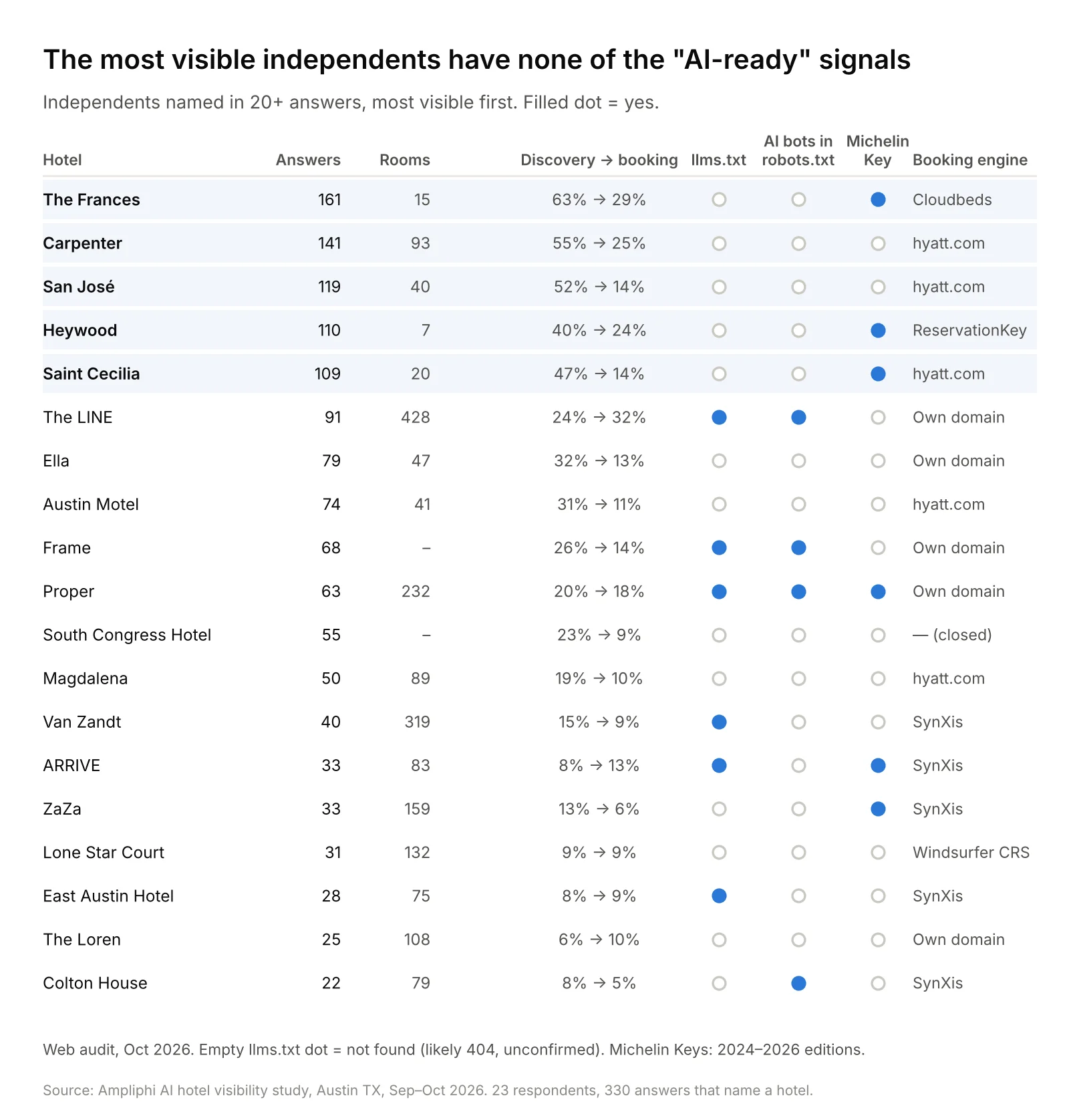
None of the five most visible independents has an llms.txt or names AI bots in its robots.txt.
I was not trying to find if specific schemas or booking engine tech influence the AI visibility for hotels. I was just curious to see how this would turn out for independent hotels.
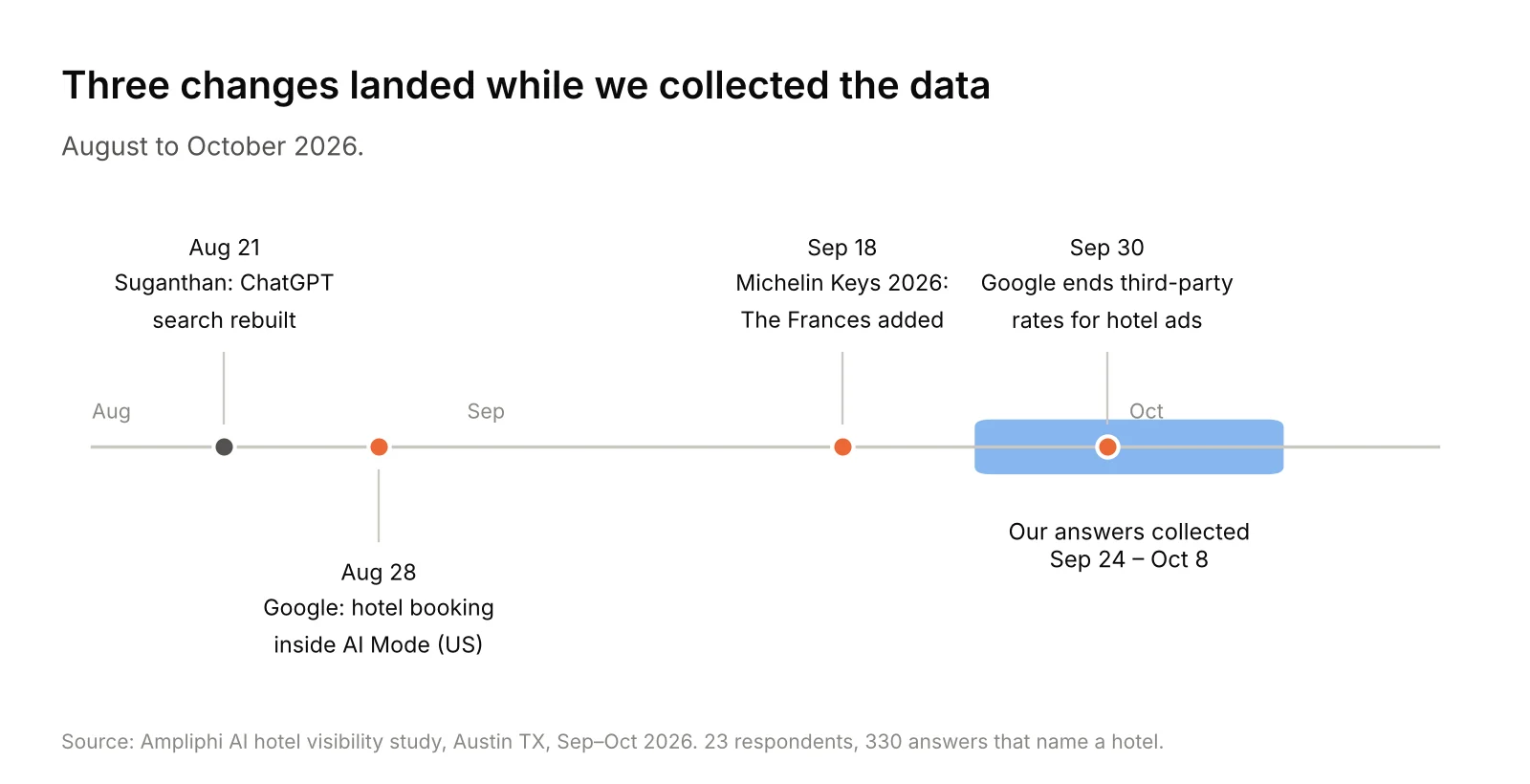
To my surprise, two things changed while I was running the study.
ChatGPT's new search tool and Google's booking inside AI Mode
Now, this is where it gets interesting.
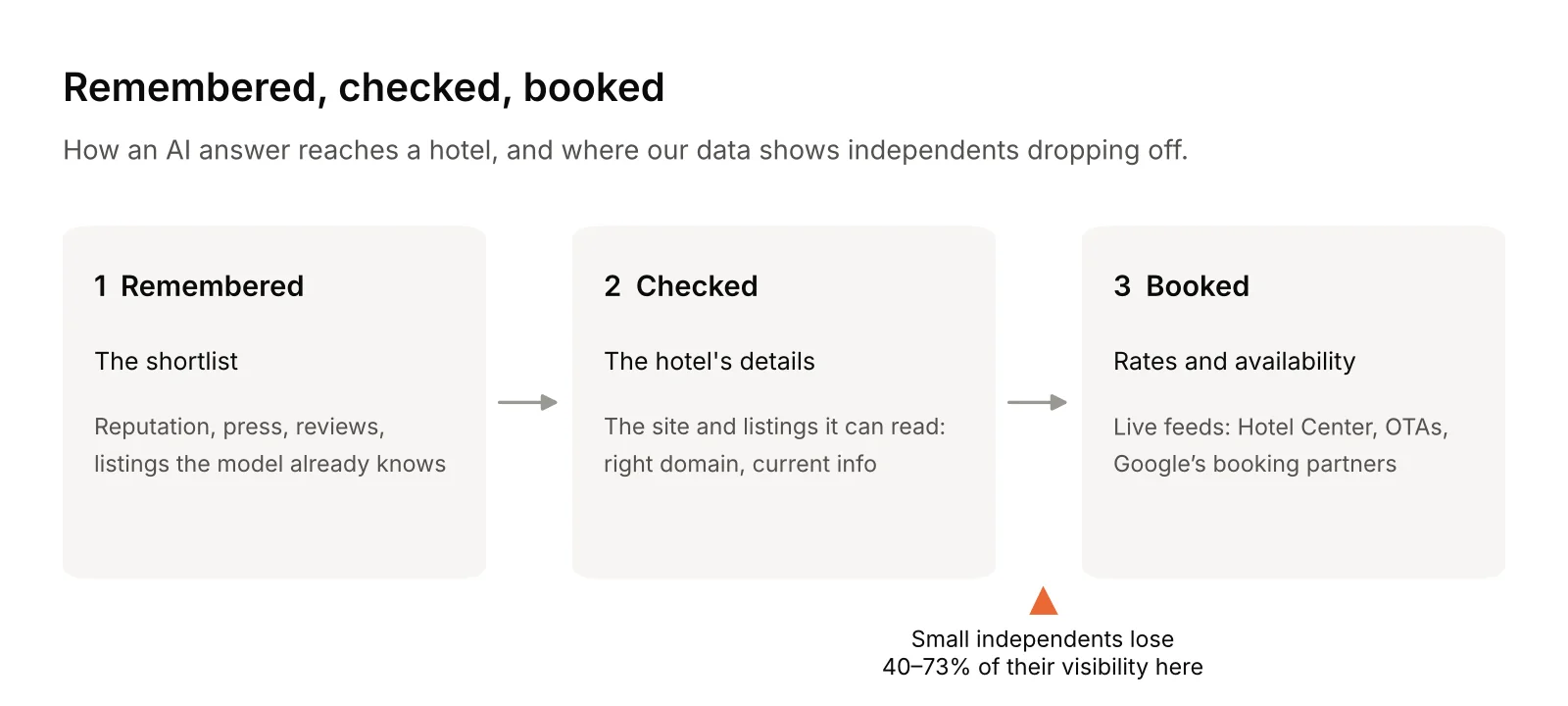
Suganthan Mohanadasan published in August an article on how OpenAI rebuilt ChatGPT’s search tool. What he observed, based on his own tests (one account, eight questions), was that the model starts with a shortlist from memory, then searches to check it.
So if discovery runs on memory and reputation decides who gets shortlisted, what decides the booking? Availability, rates and distribution all need live data.
That's where the line between discovery and booking runs: from the hotel's website to the booking engine's, often a subdomain or folder on the vendor's site (for example,hotels.cloudbeds.com/reservation/… for The Frances).
But if the vendor is blocking LLMs, does this mean that you are out of the game by default?
Do you need now to replatform when there’s a new shiny AI feature that gives you an edge?
Will that new tool earn its keep until a new model is released?
Or does control pass to the OTAs, or to Google, which now takes bookings inside AI Mode?
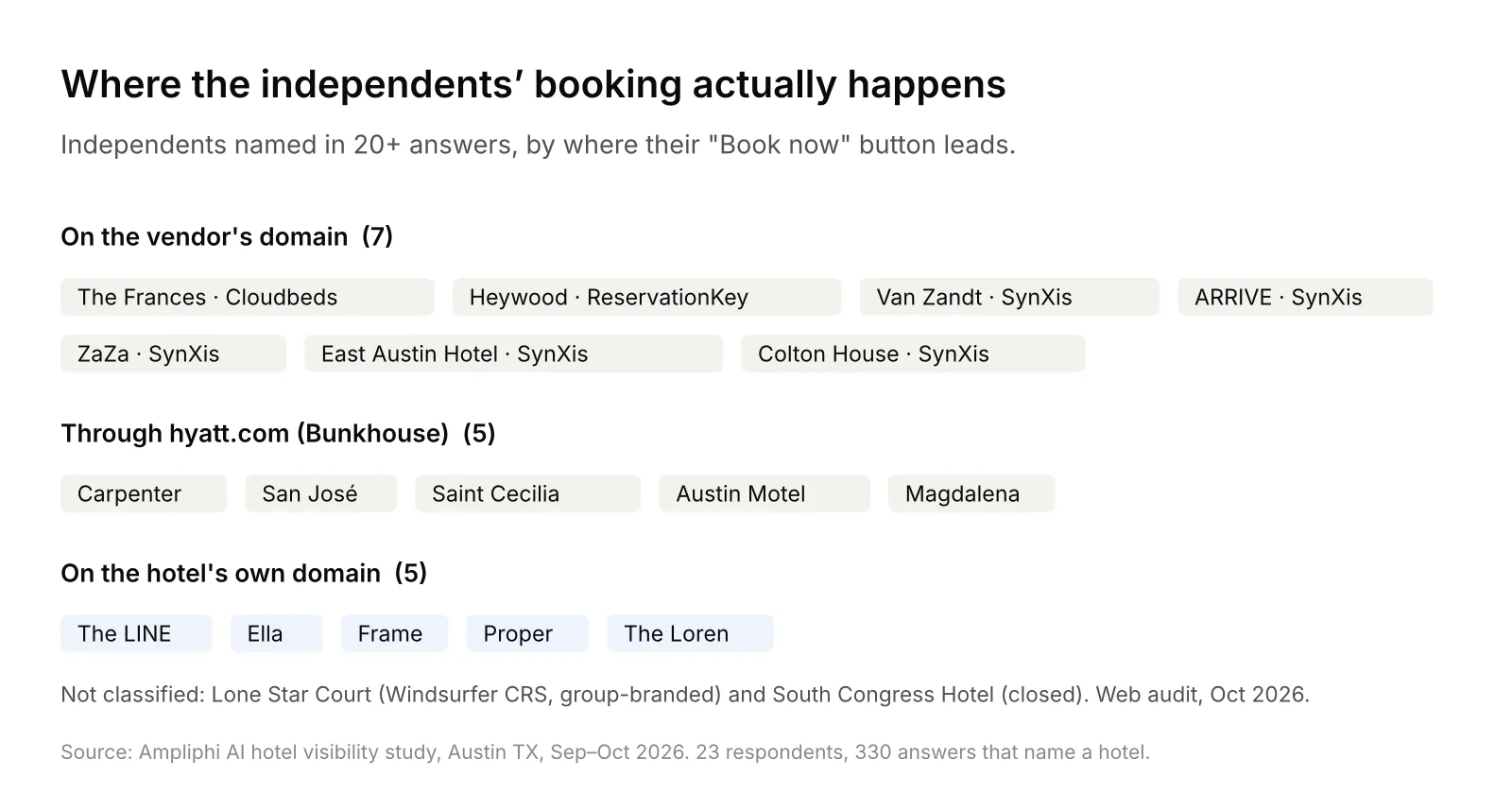
Google ending third-party support for hotel rates
After September 30, Google stopped finding rates on a hotel’s behalf for its hotel ads, for hotels advertising without their own price feed. To keep running those ads, a hotel now needs to send its own prices through Hotel Center, usually via its booking engine or channel manager.
So the question isn’t only whether an AI can read your booking engine. It’s whether your rates are in the feeds Google and the AIs read, and that depends on your booking engine sending them.
When I looked at each hotel’s website this is what stood out
No AI answer linked to a booking engine. Only 45 of 330 answers kept their links when pasted. Of those, not one points to Cloudbeds, SynXis, ReservationKey or any other engine. They link hotel homepages (Frances 13, Proper 7, Heywood 6), hyatt.com and OTAs.
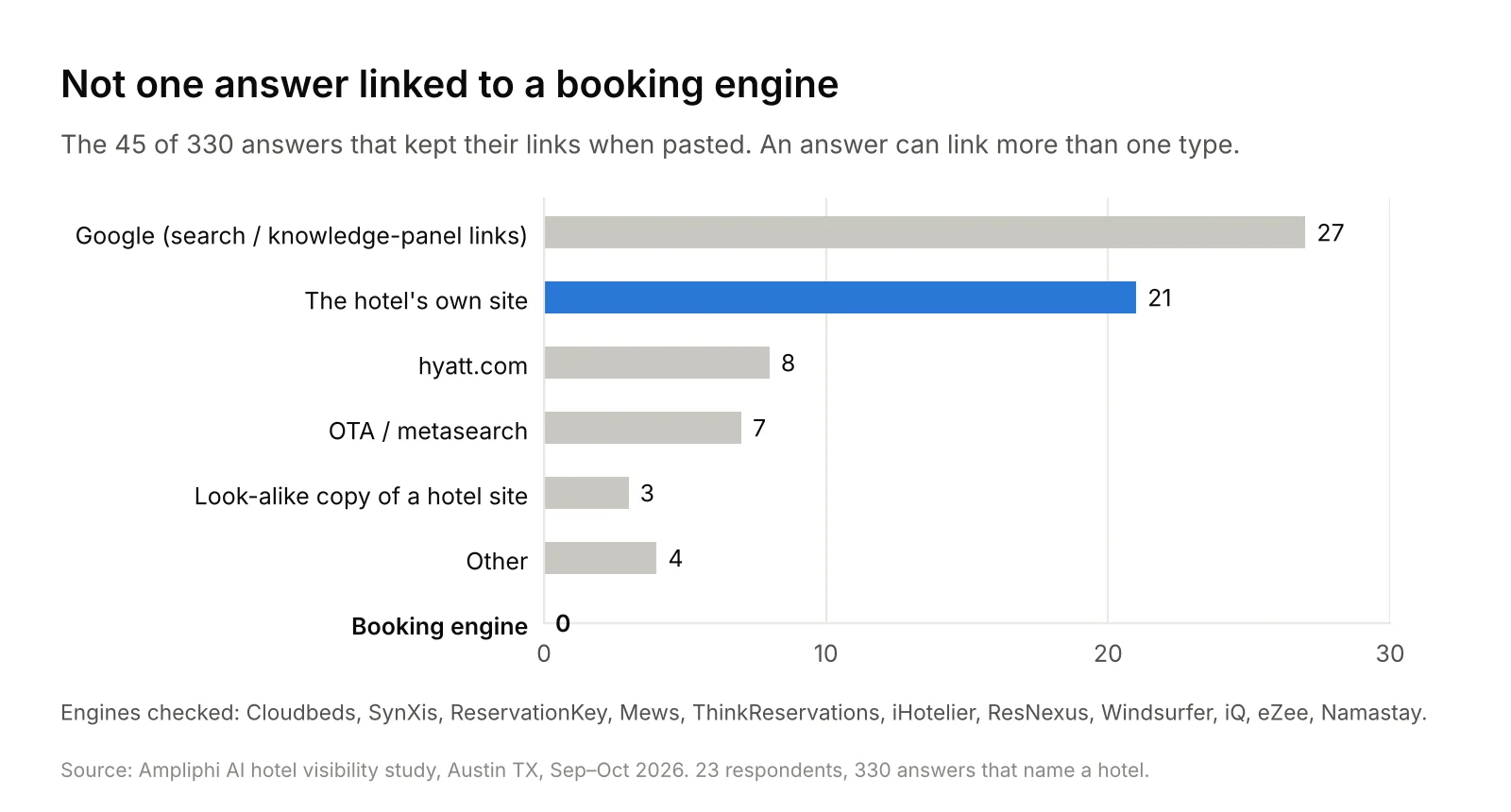
Booking pages are closed to all bots anyway, by design. Cloudbeds blocks its booking-flow pages for every bot. Hyatt does the same for /book/ and /reservation/, but lets Google’s hotel-ads checker in. Rates reach Google through feeds, not by crawling the booking engine.
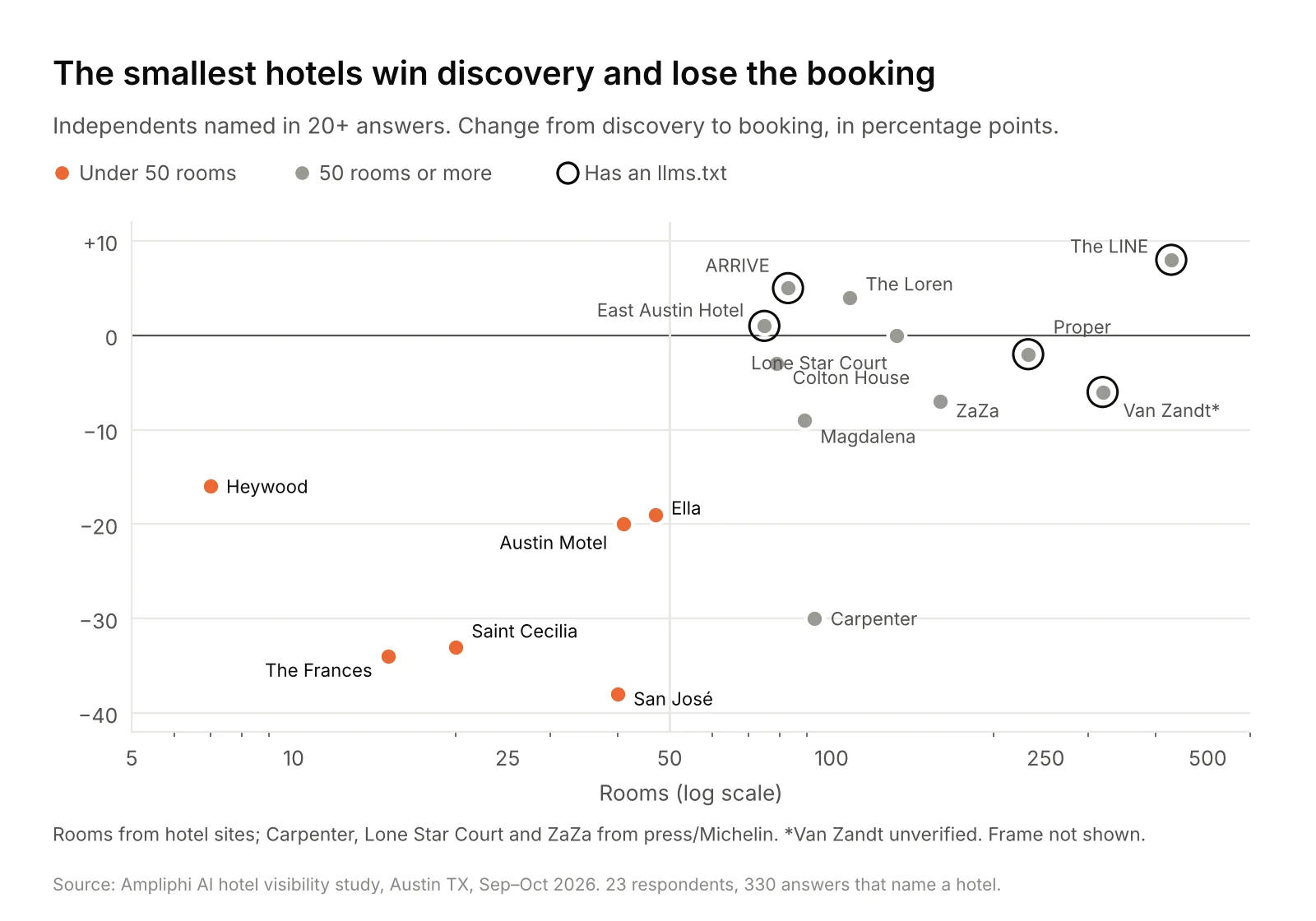
Blocking didn’t stop two hotels. SynXis and Mews both refused my AI fetcher. Yet ARRIVE and East Austin Hotel, both on SynXis, held their visibility at the booking stage.
All six under 50 rooms lost 40% or more of their visibility once people asked to book. Every independent that held on has 75 rooms or more.
Recreating Suganthan’s fan-out check
I wanted to see how ChatGPT’s search worked. One run per prompt, logged in, October 15.
And well, surprise, surprise.
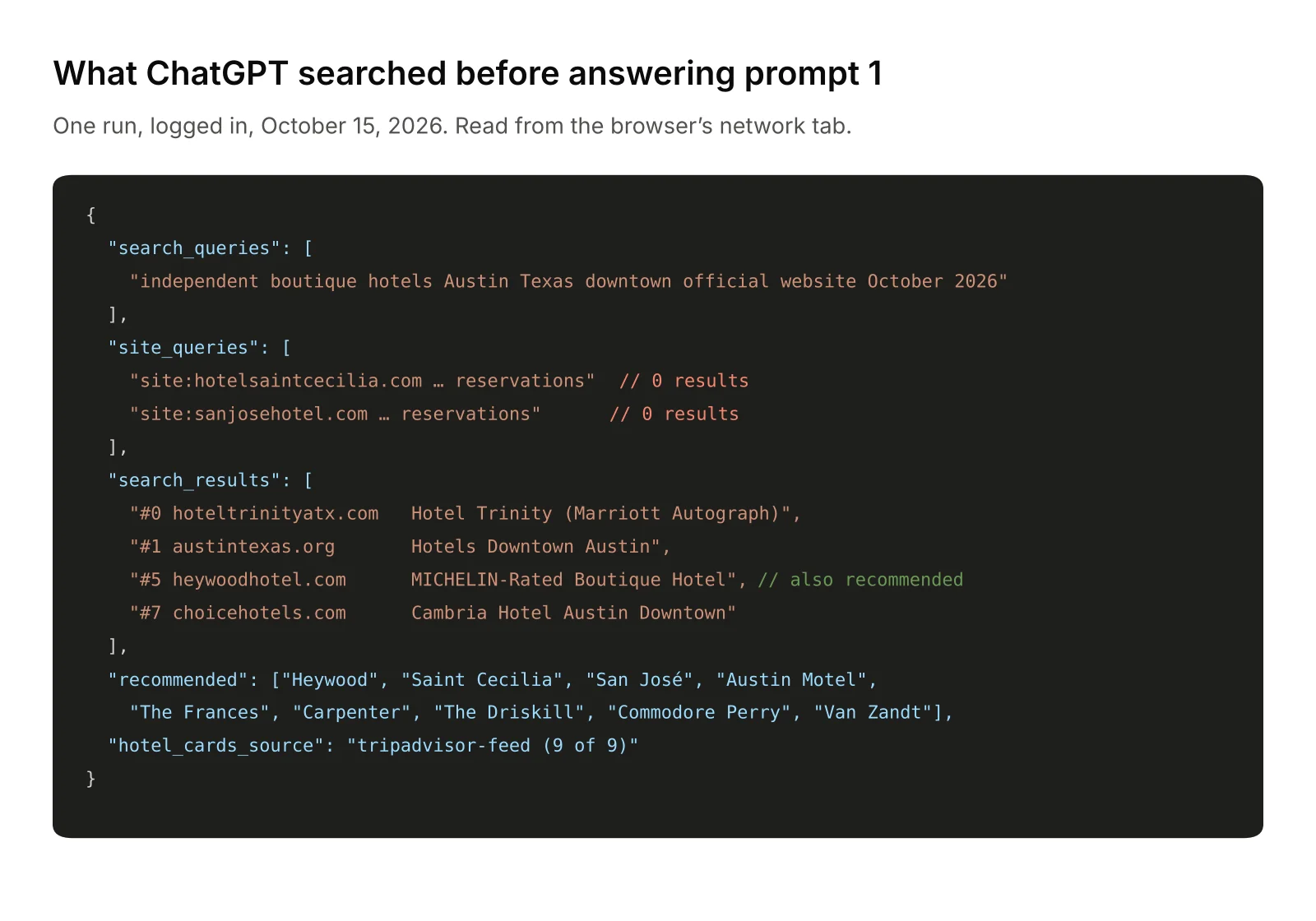
First it ran a web search
“independent boutique hotels Austin Texas downtown official website October 2026”.
It added ‘independent’, ‘downtown’ and ‘official website’ on its own; the prompt only said boutique.
Then two site-specific searches.
site:hotelsaintcecilia.com and site:sanjosehotel.com.
Both are old domains that now redirect to Bunkhouse's site, and neither search returned anything. The same old domains sit on their Tripadvisor listings, which is where ChatGPT's hotel cards come from. Memory or listing, the address was out of date.
Nine hotels were recommended, and every one came from the places lookup, with Tripadvisor data: Heywood, Saint Cecilia, San José, Austin Motel, The Frances, Carpenter, The Driskill, Commodore Perry and Van Zandt.
Only Heywood showed up in both the web results and the recommendations. The top web result, Hotel Trinity, a Marriott Autograph Collection hotel, wasn’t recommended at all. I ran the same prompt twice. The first run gave six hotels, the second nine, with four in common.
Who was left out from the recommendation?
From here, I just enjoy going down the rabbit hole. Checking the answers against Google Maps
AI answers only show who got in. To see who didn’t, I pulled Google Maps’ listings for “hotel” in Austin (322 results, October 16) and compared them with the hotels named in the 330 answers.
A quick note on the data: a Maps search is not a census. Some listings were junk, and a few hotels the AIs did name weren’t in the pull at all. So I kept only established listings, the ones with 20 or more Google reviews.
Who got left out
That left 248 established hotels in Austin. 46 are independents.
The AIs named 33 of them at least once. 13 never came up.
The two groups don’t look alike:
| Named (33) | Left Out (13) | |
|---|---|---|
| Median Google reviews | 451 | 85 |
| Median rating | 4.6 | 3.8 |
| Median distance from downtown | 1.4 miles | 5.5 miles |
| Google listing claimed | 33 of 33 | 8 of 13 |
| Shows a direct rate on Google | 24 of 33 | 2 of 13 |
Most of the left-out hotels are budget motels far from downtown, which isn’t what anyone asked for. But a few would fit a boutique search: Holly House (5.0 rating, 44 reviews), The Inn at Jennifer’s Gardens (4.5, 57) and Casa DeLa Rosa (5.0, 24). Small, well rated, few reviews, and no direct rate on Google.
That lines up with the rest of the study.
What got a hotel into the answer wasn’t AI tech. It was being well reviewed, close to downtown, and easy to find and check.
How far the recommendations went
When the AIs picked independents, they stayed close. The typical named independent is 1.4 miles from the Capitol, and 94% of their mentions are within 2 miles. The farthest ones, Lone Star Court and Archer, are both at The Domain, about 8–9 miles north.
The exception is the booking prompts. The Cedar Park and Round Rock hotels from Part 2 are about 16–17 miles from the Capitol, roughly twice as far as the farthest independent named. And some answers still called them “North Austin”.
Austin’s chain hotels sit further out than its independents (a median of 4.9 miles vs 1.75). When an answer swaps independents for chains at the booking stage, it doesn’t just swap brands. It moves the traveler away from downtown.
A hotel that closed in May
South Congress Hotel came up in 55 answers. Only 11 mentioned it was closed.
It closed on May 31 for renovation and will reopen in spring 2027 as The Standard, a Hyatt brand. On October 16, its Google listing still wasn’t marked as closed. It just showed no rates.
If the listing says open, it’s hard to blame the AI for saying so too.
Conclusions
My first conclusion is the same as Rand and Patrick's: we need more data. In this small sample, AI visibility behaves the way their study found.
The booking part looks like the piece someone can control, but it isn't clear who. Will the big OTAs gain even more say over a channel where they already squeeze independents? Or will tech vendors, like many AI-visibility tools today, try to own agentic booking?
The lists change every time, but a core is real.
About 1 in 234 pairs of answers named the same hotels. Still, five independents show up again and again, and which five depends on the engine. To stay true to the billboard effect, tracking how often they appear, might seem like a good indicator for reputation. But not the rank, and most definitely not the ‘bookability”.
What got hotels picked wasn’t AI tech.
None of the top five independents has an llms.txt. ChatGPT built its hotel cards from Tripadvisor data, and 4 of 11 cards linked to an out-of-date website. What a hotel can still control is its listings and its rate feeds.
Asking to book changes who wins.
Small independents lose 40–73% of their visibility. Chains go from 7% to 53% of answers, and OTAs from 3–5% to 22–24%. It’s unclear if the protocol for agentic will change things at the vendor side, or if there’s a specific deal that will put the two OTAs at an exclusivity for a period of time. One thing is for sure for the independents, direct booking just got harder to play.

Hector Crosswell leads growth and go-to-market at Ampliphi, the revenue management system for independent hotels. Over a decade in B2B SaaS demand generation, RevOps, and marketing technology, now working directly with the independent operators who run Ampliphi.
View full profile →