

TL;DR
|
In 2026, hotels face unprecedented pressure on revenue and profitability because travel patterns, consumer behavior, and booking windows shift faster than ever. Traditional pricing methods fail to keep pace with market demand that changes from day to day or even hour to hour. Hoteliers no longer succeed with manual spreadsheets or static seasonal charts. They now need systems that think for them, respond instantly, and help them capitalize on even minor demand surges.
The best hotel dynamic pricing software interprets competitor pricing, predicts future demand, and adjusts room prices in real time. In fact, hotels that use AI-driven pricing systems report revenue increases of up to 35% compared to traditional methods, indicating that responsive pricing drives measurable gains.s
This guide explains what dynamic pricing software is and why it matters right now for independent hotels, large groups, owners, and revenue managers. Plus, we’ll evaluate the 10 best dynamic pricing software tools for hotels in 2026, selected for their reputation, capabilities, user feedback, and proven return on investment.

What is Dynamic Pricing in Hotel Management?
Dynamic pricing refers to changing room rates based on real market signals. Hotels adjust prices in real time so they earn more during peaks and fill rooms during lows.
Studies show hotels using dynamic pricing systems often increase revenue per available room by 15 to 25%. This boost happens because rates react instantly to real demand and occupancy patterns.
Instead of using fixed rates for seasons or manually updating prices each week, dynamic pricing uses algorithms to react instantly. These algorithms analyze market data and guest behavior every minute to adjust prices based on real market signals. Some systems combine machine learning (ML) and artificial intelligence (AI) to forecast demand more accurately.
Several factors influence dynamic pricing, including:
- Occupancy rates: Prices rise when many rooms have already booked and fall when many rooms remain open. This helps hotels maximize their revenue as availability changes. Hotels using AI-powered dynamic pricing tools see occupancy increases by 5-10% compared to static pricing.
- Competitor rates: Hotels monitor nearby properties and adjust their prices in response to market changes. This real-time comparison ensures they do not lag behind rivals and helps them attract guests when competitors lower rates.
- Demand trends: Events like the World Expo in Osaka 2025 pushed local hotel rates up by 32% compared to 2024 levels because millions of visitors booked rooms early. Hotels respond to these market signals by adjusting prices to reflect surging demand.
- Booking patterns: Revenue managers study historical booking timing and guest behavior to predict future demand patterns and adjust prices accordingly. Advanced algorithms use past data to shape future pricing rules that increase revenue. This helps hotels better forecast demand peaks and troughs.
📌Suggested read: Dynamic Pricing Vs Static Pricing: Which Model Wins In 2026?
How Hotel Dynamic Pricing Software Works
Understanding how dynamic pricing software functions sets the foundation for choosing the right platform. Let’s see how!
1. Data collection
A modern revenue management system captures data from varied sources. These include your property management system (PMS), channel manager, booking engine, competitor rates, and external signals such as events or flight data. This intake mirrors the airline industry’s practice of live pricing updates based on supply, demand, and competitive action.
Better inputs mean stronger outputs. If your system pulls real-time market data correctly, it can detect early signs of demand shifts and help your hotel respond before competitors do.
2. Demand forecasting
Once data flows in, the analytics engine creates a demand forecast. It compares current bookings, historical data, cancellations, lead times, and booking trends. Advanced systems use machine learning algorithms to identify patterns invisible to humans.
These models continuously refine forecasts in minutes, not months. Hotels using AI-driven forecasting report up to a 15% increase in ADR and notable occupancy growth over traditional approaches.
3. Rate optimization logic
Forecasts lead to pricing recommendations. Basic rule-based systems follow set triggers like minimum occupancy or competitor deltas. Advanced systems use intelligent logic to test thousands of scenarios, then propose optimal prices that balance occupancy and revenue targets.
These systems can enforce custom pricing rules set by revenue teams to protect brand standards, margin goals, or strategic business rules.
4. Automated price recommendations and execution
After generating pricing suggestions, the system can automatically implement changes across all booking channels. Some systems allow managers to approve recommendations, while best-in-class platforms push updates in real time.
Hotels can choose full automation or a hybrid approach that combines human oversight with software speed. This flexibility allows hotels to adopt dynamic pricing confidently and maintain control over strategic decisions.
5. Continuous learning and re-forecasting
The software does not stop after a single decision. It evaluates outcomes and re-forecasts continuously. When every new booking, cancellation, or competitor rate update arrives, the system recalibrates its strategy.
This cycle is why dynamic pricing automation outperforms manual pricing throughout their whole operational lifetime.
How We Evaluated the Best Hotel Dynamic Pricing Software
To identify the best hotel dynamic pricing software, we followed a structured evaluation process. Our approach focused on practical capabilities, usability, and overall value so managers can make informed decisions. By testing and comparing software across multiple dimensions, we could highlight the platforms that truly excel at driving revenue and efficiency.
Our evaluation criteria included:
- AI & machine learning capabilities: Tools that use AI and machine learning algorithms scored highest because they adapt faster, optimize rates better, and predict demand more accurately than static rule engines.
- Real-time market data usage: We examined whether platforms pull live data from competitors, channels, and external signals, and how quickly they act on those insights.
- Forecasting accuracy: We tested each platform’s ability to forecast occupancy, booking pace, and cancellations. Accurate forecasts drive stronger revenue decisions.
- Ease of use & automation level: Complex systems will underperform if teams cannot adopt them. We favored solutions that balance power with usability, allowing hoteliers to manage pricing strategies without constant manual work.
- PMS & channel manager integrations: We checked compatibility with common property management systems and distribution channels to ensure seamless operations.
- Scalability (small → enterprise): We evaluated whether the software performs consistently across single-property hotels and multi-property enterprises.
- Reporting & insights: Rich analytics help teams see performance trends, uncover revenue opportunities, and make informed pricing decisions.
- Value for money: Cost matters, but ROI matters more. We evaluated platforms based on value delivered, not just price tags.
📌Also read: Hotel Guest Data Analytics: How To Leverage Insights To Boost Revenue
Best Hotel Dynamic Pricing Software in 2026: A Side-by-Side Comparison
Before diving into detailed reviews of each dynamic pricing software, let’s compare them side by side on key features, strengths, weaknesses, and ideal use cases.
| Tool Name | Best For | Key Features | Pros | Cons | G2 Rating |
| ampliphi RMS | Independent hotels & multi‑property groups | AI‑powered pricing intelligence, real‑time demand tracking, competitor benchmarking, automated rate updates | Strong AI pricing insights, automated updates, and PMS integrations | Advanced features may require training | 4.5 |
| IDeaS Revenue Solutions | Large hotel chains and enterprise portfolios | Machine learning forecasting, automated pricing optimization, group pricing tools, deep analytics | Excellent forecasting accuracy, scalable for enterprise | Complex UI, training required | 4.8 |
| Atomize | Mid‑market & independent hotels | Real‑time AI pricing, competitor analysis, dynamic recommendations, scenario planning | Quick setup, strong automation, useful dashboards | Can feel dense to new users | N/A |
| Duetto | Luxury, resorts, boutique collections | Open pricing model, demand forecasting, scenario modeling, and real‑time rate control | Very flexible pricing rules, strong integration set | Steep learning curve, costlier | N/A |
| FLYR Hospitality | AI‑driven revenue strategy and forecasting | AI decision intelligence, real‑time pricing, deep analytics, customizable dashboards | Strong AI and business intelligence, real‑time insights | Can be complex to learn, and it has a higher cost | 4.6 |
| Wheelhouse | Smaller hotels & mixed properties | Dynamic pricing, competitor insights (especially for rentals) | Simple dynamic pricing tools | Less hotel‑specific advanced reporting | 4.9 |
| PriceLabs | Flexible pricing for small to mid-sized hotels & rentals | Demand‑based pricing, seasonality & event pricing, custom rules | Good value, flexible rules | Limited enterprise features | 4.5 |
| Beyond Pricing | Independent hotels & vacation rentals | Revenue‑linked dynamic pricing, marketplace integrations | Maximized bookings, multi‑platform support | Pricing tied to revenue share (can be costly) | 4.7 |
| Little Hotelier | Small hotels & B&Bs starting dynamic pricing | Built‑in pricing guidance tools, simple yield principles | Easy for small businesses | Not a full dynamic pricing engine | 4.5 |
Best Hotel Dynamic Pricing Software in 2026 (Full Comparison)
With countless tools on the market, finding the right one can feel overwhelming. That’s why we’ve curated the top-rated options to help you choose the solution that delivers real results for your property.
1. ampliphi RMS
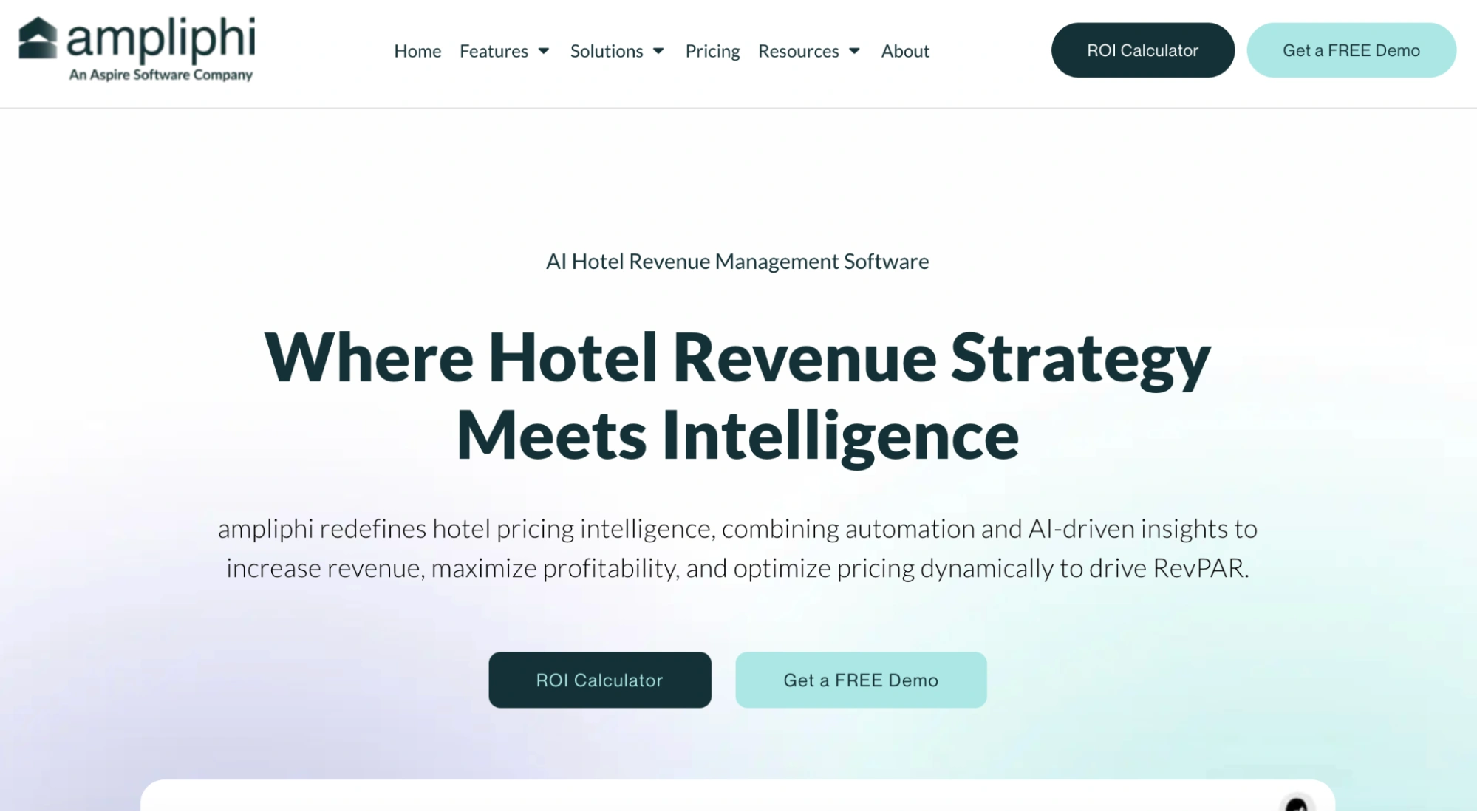
ampliphi RMS is an AI-driven revenue management platform that automates hotel pricing so rates evolve in real time with booking patterns, pace, and market performance. By removing the need for constant manual adjustments, the system frees revenue teams to focus on strategy while ensuring pricing remains optimized across all room types.
The platform continuously updates rates based on live data, occupancy trends, and competitor moves, while respecting your rules and pricing hierarchy. Its AI engine learns from property-specific patterns, refining strategies over time to maximize revenue and enhance decision-making. ampliphi also provides market intelligence, monitoring demand drivers and local events to help hotels anticipate changes before they happen.
Whether managing a single property or a multi-hotel portfolio, ampliphi maintains consistency and control. Tools like an intuitive rate calendar, competition monitoring, and real-time optimization give revenue teams complete visibility into pricing trends and occupancy, allowing them to respond instantly to market shifts. The result is less manual work, improved RevPAR by up to 35%, stronger execution of revenue strategies, and more time for high-level planning. Hotels using ampliphi gain confidence in their pricing, achieve measurable performance improvements, and capture the right guests at the right price, every day.
Pros
- Automate rate updates in real time using AI and live market data
- Adjust pricing based on occupancy, booking pace, and competitor activity
- Maintain pricing hierarchy across all room types while following rules
- Leverage AI optimization that learns and refines strategies over time
- Access market intelligence and demand-driven insights for proactive decisions
- Monitor competitor rates and respond instantly to market changes
- Support single properties or multi-hotel portfolios with consistent control
- Visualize trends and occupancy with an intuitive rate calendar
- Capture the right guests at the right price with smarter, data-driven pricing
Cons
- The pricing isn’t mentioned
- It involves a learning curve for beginners, and because of its rich feature set
Pricing
- Available in Acoustic, Amplified & Headliner: Custom pricing
2. IDeaS Revenue Solutions
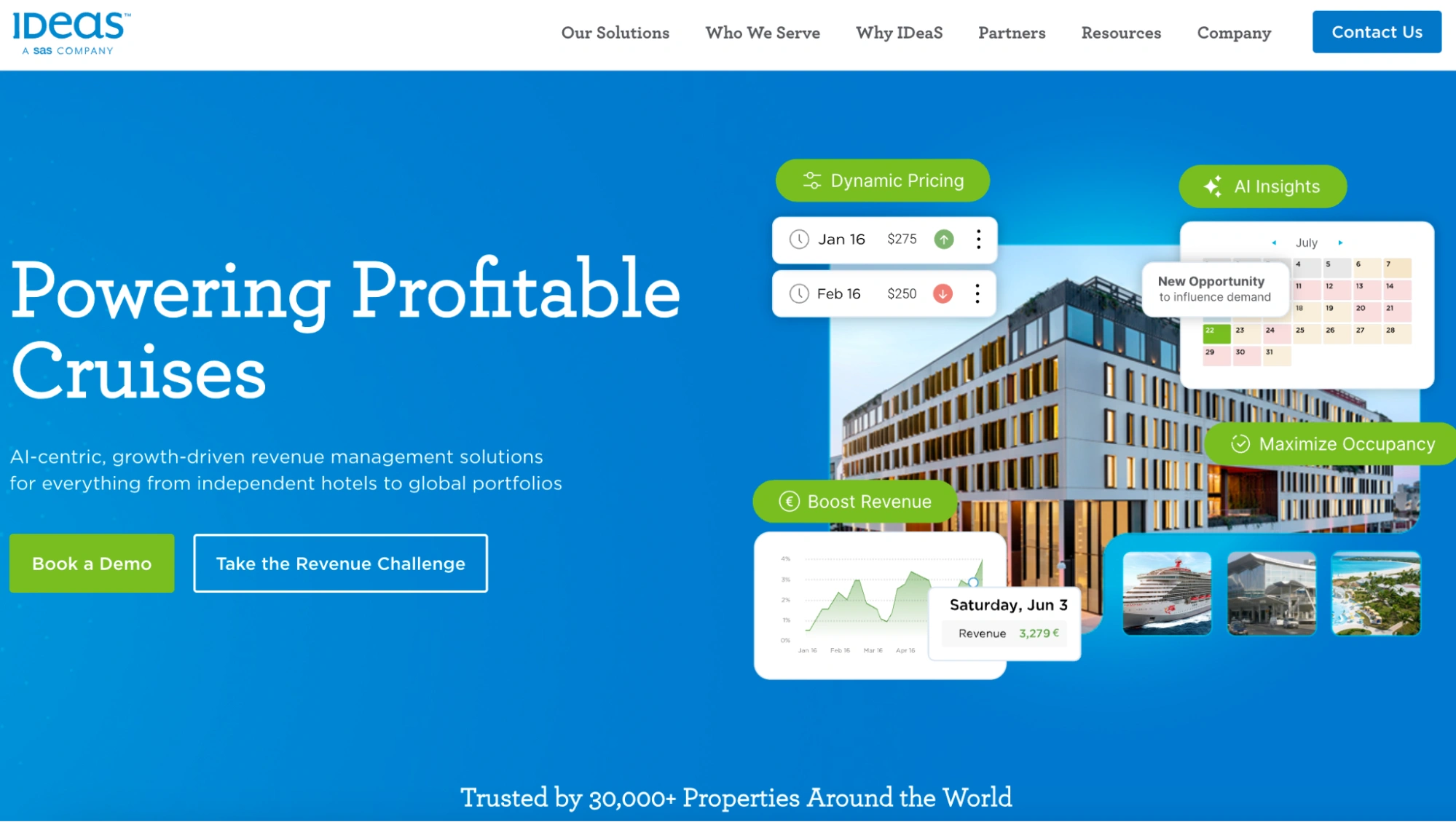
IDeaS offers advanced hotel revenue management software designed to make pricing decisions smarter and more data-driven. With over 30 years of experience, the platform helps hotels automate room rates by analyzing demand, booking trends, and market fluctuations.
By reducing manual work through automation, IDeaS empowers revenue managers to make faster, more accurate pricing decisions. The software also includes tools for managing group bookings, enabling hotels to set competitive group rates and streamline large reservations efficiently.
Pros
- Automate room pricing based on demand, booking pace, and market trends
- Analyze real-time data to make smarter revenue decisions
- Reduce manual work through built-in automation
- Set and evaluate competitive group rates efficiently
Cons
- The initial setup can be time-consuming for new hoteliers
- Manual training is lengthy
Pricing
- Custom pricing
3. Atomize
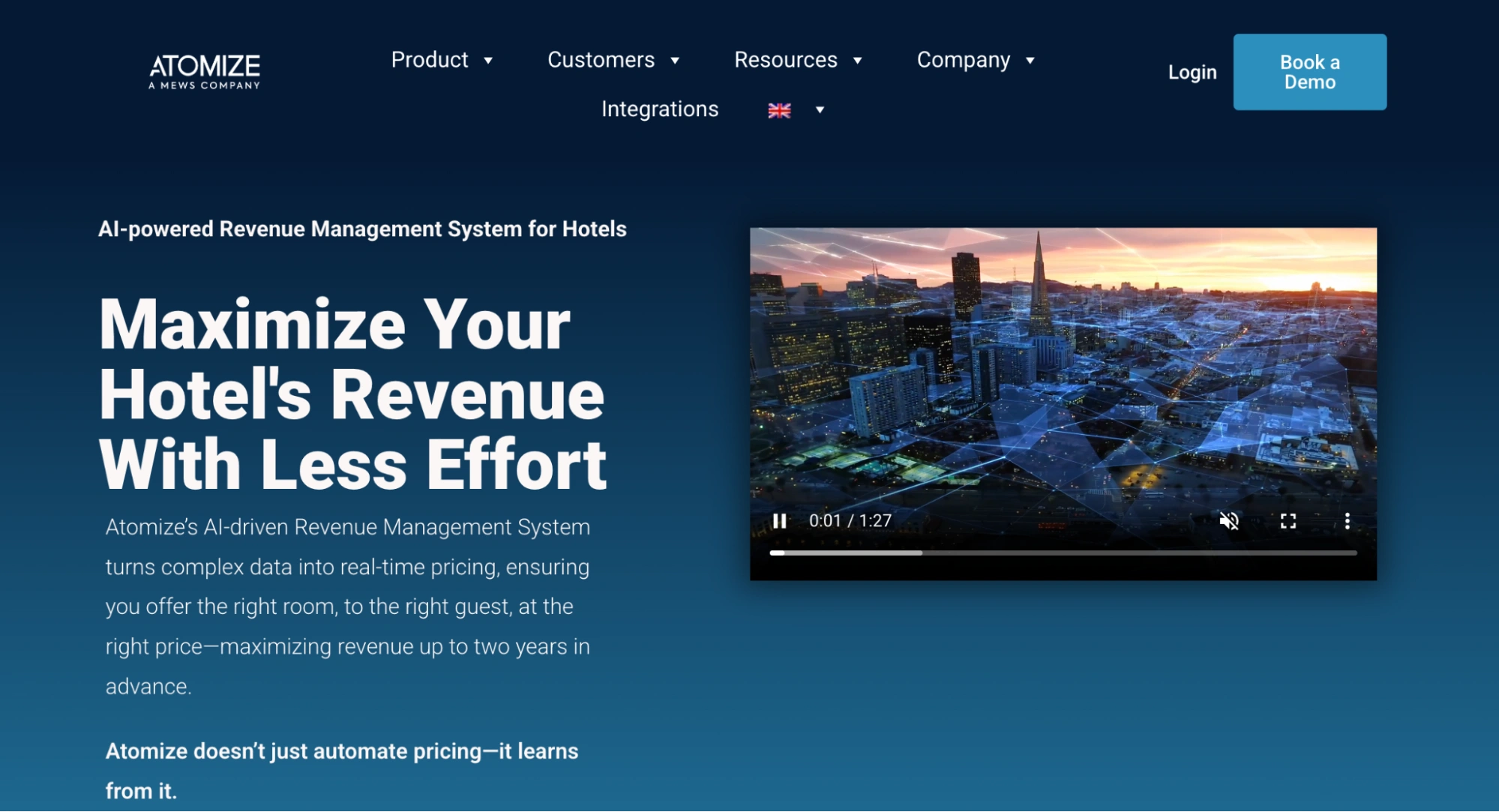
Atomize helps hotels get better room rates with real data and constant price checks that react to demand and competitor moves every day. The system pulls information about future bookings, local demand shifts, and past guest behavior to suggest prices that will help you sell more rooms with confidence.
You can see pricing suggestions that reflect real demand and past booking patterns as you compare rates across multiple properties in real time. The software stores pricing history to track how your choices perform over time and adjust tactics based on what you learn.
Pros
- Use real demand data to set smarter room rates
- Get constant pricing suggestions based on competitor rates
- View future booking patterns with easy forecasting tools
- Manage pricing across many properties from one dashboard
Cons
- The platform doesn’t offer complete automation
- Some users say the reports need improvements to be able to add more variables
Pricing
- Custom pricing
4. Duetto
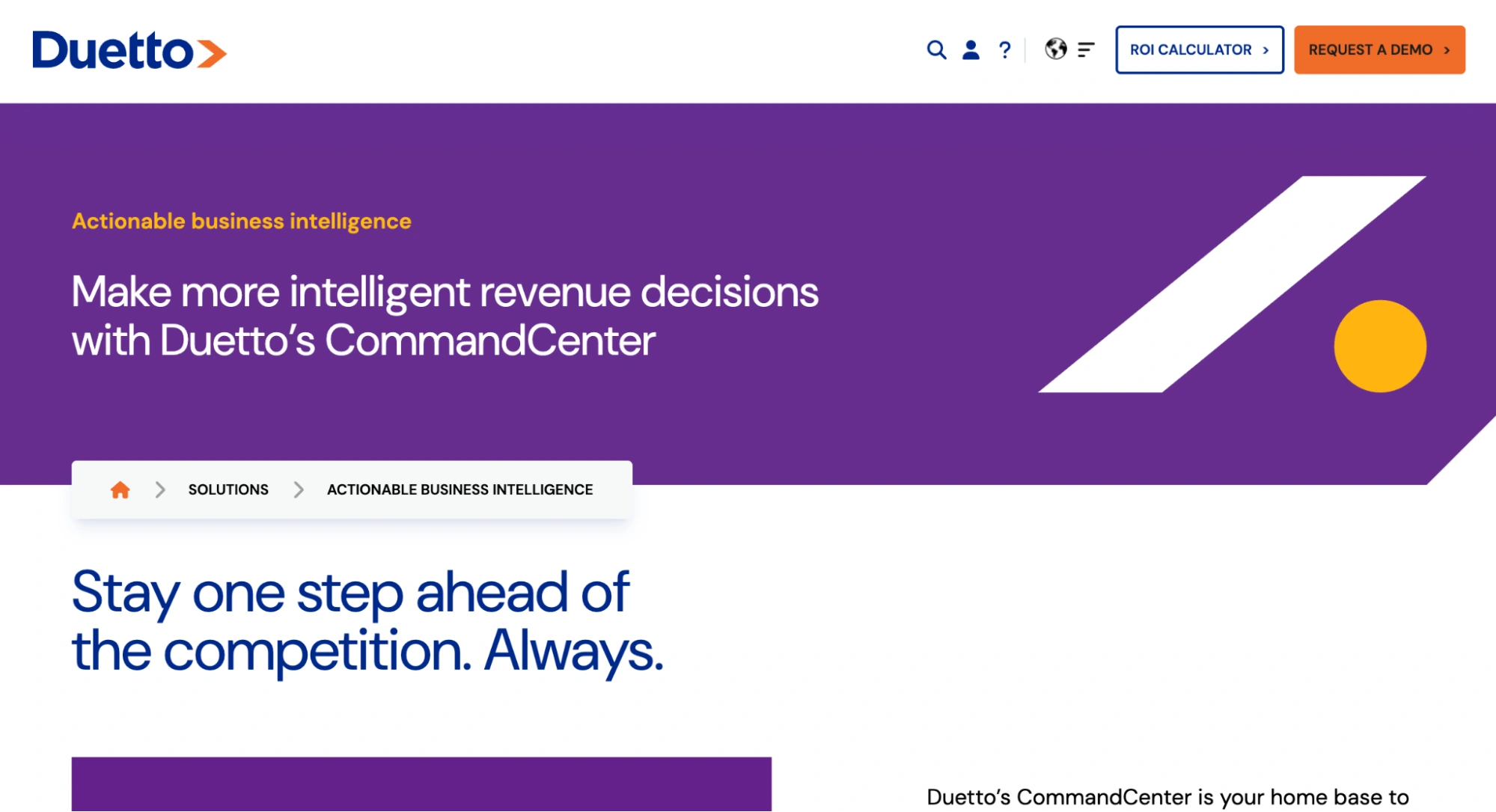
Using an Open Pricing methodology, Duetto allows revenue teams to adjust rates in real time, responding to market demand and ensuring rooms remain available even on peak nights. Instead of closing inventory when demand surges, discounts can be flexed to zero, keeping hotels “always open, always selling.”
The system optimizes pricing for each day, guest segment, and room type, driving higher room rates and overall profitability. Hotels can offer unlimited incremental price points, capturing revenue opportunities across the demand curve. Duetto also streamlines group business, forecasts, and reporting through interactive dashboards, while tools like Advance, ScoreBoard, BlockBuster, and OpenSpace provide data-driven insights, strategic analysis, and booking efficiency.
Pros
- Adapt rates dynamically to market demand in real time.
- Boost function space profitability and booking efficiency
- Flex discounts to zero on high-demand nights to stay open and selling
- Increase total revenue across transient and group business with BlockBuster & GameChanger
Cons
- The rate shopper view for competitor comparison requires clarity
- Limited AI capabilities and automation features compared to other tools in the list
Pricing
- Custom pricing
5. FLYR Hospitality
Formerly called Pace Revenue, FLYR Hospitality is an AI-driven platform designed to optimize hotel revenue. It automates pricing, inventory management, and group booking strategies, updating rates every hour based on live PMS data, competitor pricing, and local events. Users can establish seasonal or event-based rules while maintaining manual control when necessary.
The platform helps prevent low-value bookings during peak demand periods and applies length-of-stay restrictions to safeguard revenue. For group reservations, it streamlines the quoting process with intelligent price recommendations and displacement analysis.
Pros
- Automate hotel pricing, inventory, and group booking strategies with AI
- Update rates hourly using live PMS data, competitor pricing, and local events
- Set seasonal or event-based pricing rules while retaining manual control
- Prevent low-value bookings during high-demand periods
Cons
- It is expensive with a high pricing ranking
- The software has a slight learning curve
Pricing
- Custom pricing
6. Wheelhouse
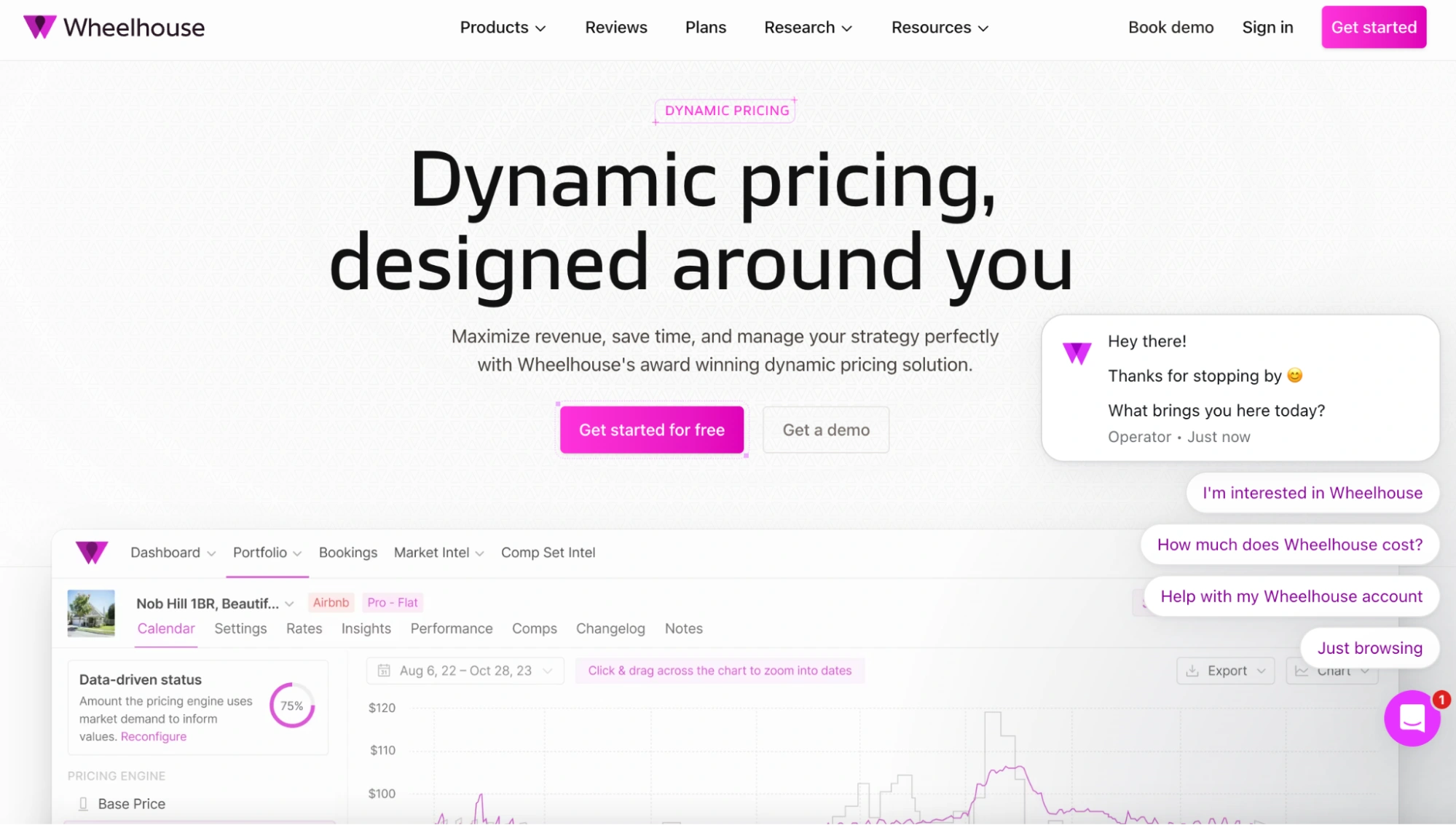
Wheelhouse is an award-winning dynamic pricing platform designed to help short-term rental managers maximize revenue, save time, and take full control of their pricing strategy. The platform combines data-driven insights with customizable rules, giving managers the flexibility to automate rates or adjust them manually.
The pricing engine incorporates seasonality, occupancy trends, booking lead time, competitor activity, and local demand factors to generate precise nightly rates. Users can fine-tune strategies with minimum and maximum prices, minimum stays, last-minute adjustments, long-term booking incentives, and granular day-specific controls. Bulk tools make it easy to apply strategy across multiple listings, while contextual insights and visual analytics show how pricing compares to competitors, market demand, and past performance.
Pros
- Apply granular day-specific rules, last-minute adjustments, and long-term booking incentives
- Set minimum and maximum prices, minimum stays, and other custom boundaries
- Use bulk tools to modify strategies or rates across multiple listings quickly
- Gain contextual insights into market demand, competitor pricing, and historical performance
Cons
- The user interface is complex
- It doesn’t offer a mobile app version to control and manage your account
Pricing
- Wheelhouse Pro:
-
- Pro Flex: 1% of the revenue
- Pro Flat: $19.99/month/listing
- Enterprise: Custom pricing
7. PriceLabs
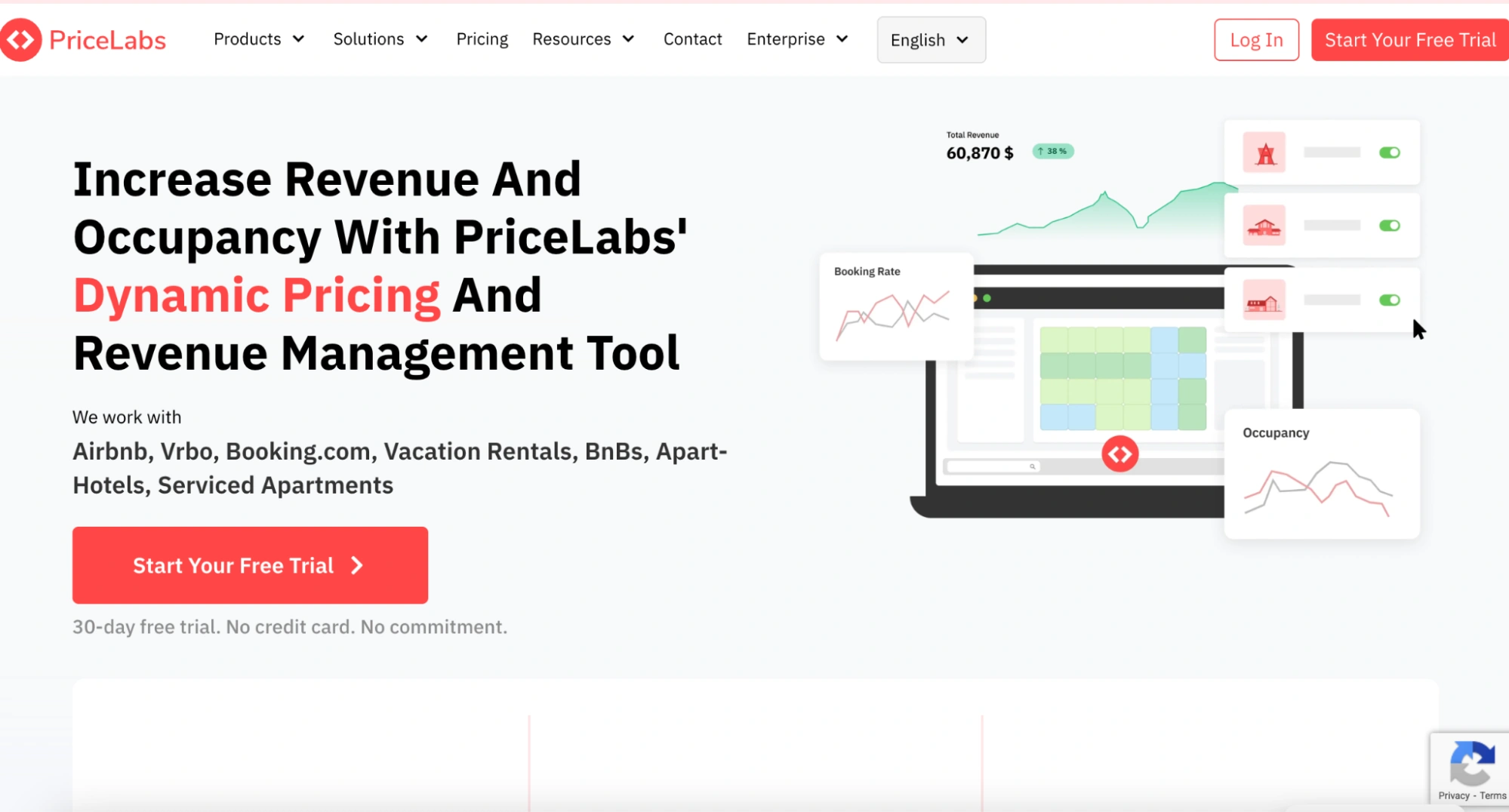
PriceLabs monitors live market data and current booking trends to adjust your room rates automatically every day. The platform analyzes local factors, including seasonal changes, nearby events, and booking pace, to generate nightly rates that fit your property’s unique demand. It combines your historical performance with upcoming reservations to deliver precise pricing recommendations for each night.
You can set custom pricing rules to align with your business strategy, while the system automatically updates rates across all channels and booking platforms. This allows your team to focus on operations while PriceLabs continuously works to increase your revenue by optimizing rates without requiring manual adjustments or constant oversight.
Pros
- Automatically update nightly rates based on live market data and booking trends
- Analyze local events, seasonal changes, and occupancy patterns for precise pricing
- Combine historical performance with upcoming reservations to optimize rates
- Apply custom pricing rules aligned with your business strategy
Cons
- The user interface appears clunky to some users
- It is expensive for small, independent hotels
Pricing
- Portfolio Analytics: $0/month
- Dynamic Pricing: Starts at $19.99/month/listing
8. Beyond Pricing
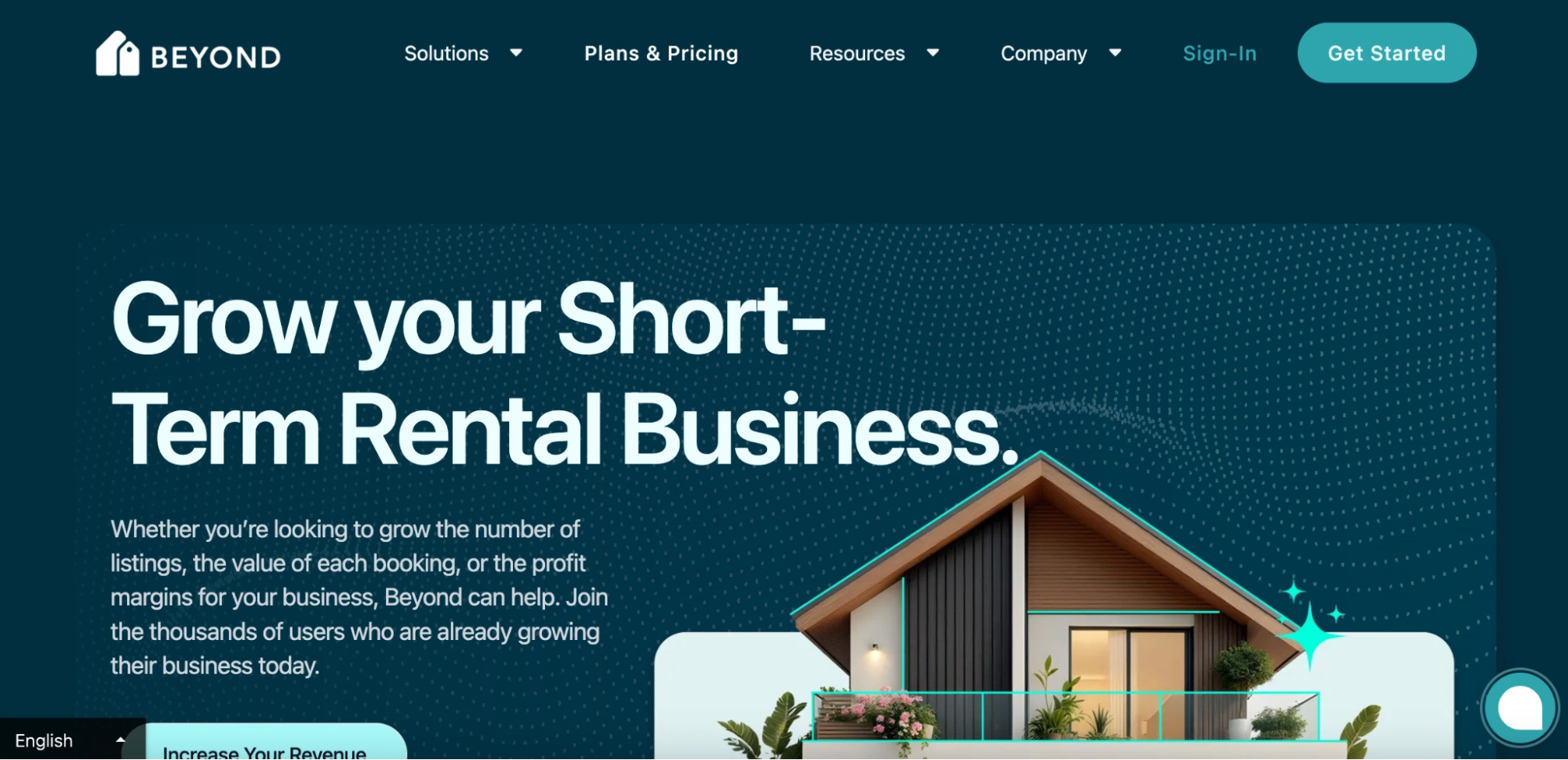
Beyond is an intelligent pricing platform that adjusts short-term rental rates in real time using live demand data and booking trends. The system combines historical performance with current market conditions to generate precise pricing recommendations and sends daily updates to guide smarter decisions.
With customizable pricing rules, managers can align automation with their business strategy while Beyond automatically updates rates across multiple platforms. This reduces manual effort, saves time, and ensures bookings remain profitable, allowing managers to focus on growing their business while the platform continuously optimizes pricing.
Pros
- Automatically adjust rental rates in real time based on demand and booking trends
- Respond instantly to changes in seasonality and market conditions
- Combine historical data with current trends for accurate pricing recommendations
- Apply custom pricing rules to align with your business strategy
Cons
- Sometimes, the UI and functionalities are limited for the mobile version
- It is sometimes expensive
Pricing
- Custom pricing
9. Little Hotelier
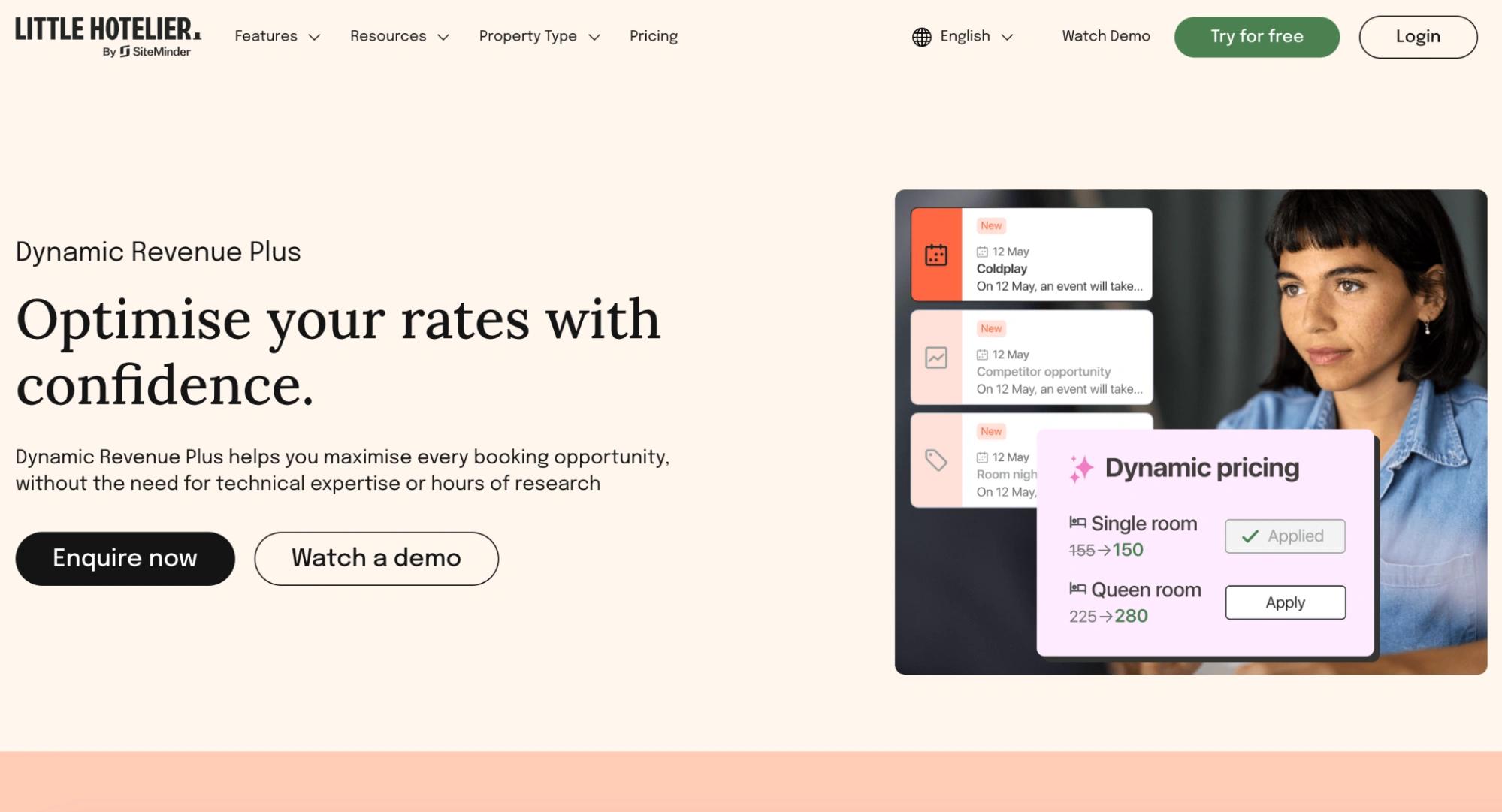
Little Hotelier serves small accommodation owners with a cloud‑based platform that brings property management, pricing, bookings, and reporting into a single dashboard that works on phones and computers. With its Dynamic Revenue Plus feature, you can sync room rates and availability across major channels and update prices in real time, keeping your listings accurate everywhere at once.
It also gives you insights into pricing performance and competitor rates, so you can make decisions that drive more bookings and better revenue. The platform also includes a booking engine for direct reservations and tools to manage guest communication, payments, and daily tasks in one place.
Pros
- Automate rate and availability management across channels
- Access real‑time competitor pricing insights
- Manage bookings and guests from a central dashboard
- Accept direct bookings from your own website
Cons
- The initial set up is confusing when it comes to confirming room types
- It is expensive
Pricing
- Pro: $119/month (for 5 rooms)
- Revenue Optimizer: From $119/month (for 5 rooms)
Feature Comparison: What the Best Dynamic Pricing Software Has
The most effective dynamic pricing platforms combine advanced AI, real-time market intelligence, and robust automation to optimize revenue while giving managers full control. Here’s what top solutions offer, broken into key areas:
- AI & Machine Learning: The best software uses AI and machine learning to continuously learn from your property’s historical performance, booking trends, and unique patterns. Over time, it refines pricing strategies, enabling predictive and adaptive pricing that goes beyond static rules.
- Real-time market & competitor data: Top platforms track live market conditions, competitor pricing, and local events to respond instantly to changing demand.
- Demand forecasting accuracy: Leading solutions provide highly accurate forecasts of occupancy, booking pace, and revenue potential. They account for seasonal trends, last-minute demand, and lead-time patterns to make data-driven decisions and confidently maximize revenue for every night.
- PMS & channel manager integrations: Seamless integration with your property management system and distribution channels ensures that rates are updated automatically across all platforms.
- Automation vs manual control: The best dynamic pricing software balances smart automation with manual oversight. You can rely on automated rate updates while still setting custom rules, making overrides, or adjusting strategies portfolio-wide or property-specific.
- Reporting & revenue insights: Top platforms provide actionable dashboards, forecasts, and analytics that highlight market trends, competitor moves, and past performance. Exportable and auditable data allows your team to evaluate results, refine strategy, and collaborate effectively.
Benefits of Using Hotel Dynamic Pricing Software
Hotels that adopt dynamic pricing systems gain key benefits such as:
- They respond instantly to demand fluctuations instead of reacting too late
- They usually outperform non-automated peers in ADR and RevPAR
- Automation frees revenue teams to focus on strategy, not manual rate patches
- Tools that detect micro-trends help hotels balance occupancy with rate strength
- Integrated systems support more revenue streams beyond rooms, contributing to overall profitability
How to Choose the Right Dynamic Pricing Software for Your Hotel
Before you make the final decision, it helps to understand what features and capabilities will actually impact your hotel’s revenue and make day-to-day pricing easier for your team.
Step 1: Identify your property’s revenue goals and pricing challenges
Before evaluating any software, you need to clearly define the revenue targets you want to hit and the pricing challenges that slow your growth. Consider whether your priority is maximizing occupancy, boosting average daily rate, or managing group bookings more efficiently.
Understanding these goals will help you focus on software features that directly support your hotel’s objectives.
Step 2: Check integration with your PMS and booking channels
Dynamic pricing tools work best when they can access live data from your property management system and distribution channels.
Make sure the software connects seamlessly with the systems you already use so rate updates happen automatically without manual work.
Step 3: Evaluate forecasting and AI capabilities
Look for software that uses accurate demand forecasting and AI-powered analytics to suggest optimized rates.
Platforms that continuously learn from past bookings and market trends help you make smarter pricing decisions every day.
Step 4: Assess automation versus manual control
Decide how much control your team wants over pricing adjustments.
Some tools fully automate updates while others allow you to approve recommendations, giving flexibility depending on your hotel’s strategy.
Step 5: Compare reporting, insights, and usability
The best software provides clear dashboards, actionable insights, and easy-to-understand reports so your team can respond to market changes quickly without spending hours analyzing data.
Step 6: Consider scalability and support
Choose a solution that can grow with your property and provides responsive customer support. You want software that works equally well for a small hotel today and a multi-property group tomorrow.
Common Mistakes Hotels Make When Choosing Pricing Software
Choosing the wrong pricing software can directly impact revenue, operational efficiency, and your team’s ability to respond to market changes.
To prevent this, let’s take a look at some of the common challenges hoteliers face when choosing the software:
- Focusing on cost over capability: Selecting a cheap tool often limits features and prevents your hotel from reacting effectively to fluctuating demand. Hence, prioritize software that provides the features and automation your hotel actually needs to drive revenue and save time.
- Neglecting system integration: When software does not connect seamlessly with your PMS, channel manager, and booking engines, it creates extra work and slows rate updates. Therefore, look for platforms that automate updates across all systems without manual intervention.
- Relying solely on automation: Fully automated systems without manual controls can produce pricing that does not reflect your hotel’s unique strategy, leaving revenue exposed to market changes. Choose solutions that allow flexibility, so your team can make adjustments when needed.
- Assuming all AI performs the same: Not all forecasting engines predict demand accurately, which can result in missed revenue opportunities. Evaluate AI performance through trials, case studies, and real-time simulations before committing.
- Underestimating the learning curve: Complex platforms require time and training, and teams may struggle if they do not understand all features. Allocate sufficient resources for onboarding so staff can use the software effectively from day one.
- Ignoring scalability and support: Choosing a platform that cannot grow with your property or lacks responsive support creates long-term operational challenges. Pick software that adapts as your business expands while offering reliable customer service.
The Future of Hotel Dynamic Pricing Software (2026 & Beyond)
Hotel pricing software is evolving rapidly, driven by advances in AI and machine learning. Future platforms will detect subtle market shifts and forecast trends with greater precision, enabling hotels to make smarter, faster pricing decisions.
Emerging solutions are also expected to leverage sentiment analysis, using real-time guest feedback from reviews and social media to fine-tune rates based on brand perception and customer sentiment.
Predictive analytics will continue to advance, enabling hotels to anticipate demand not only for major events but also for smaller, localized factors like corporate meetings, niche festivals, or regional events.
Choosing a Dynamic Pricing Platform That Grows With You
In 2026, the hospitality industry operates in a world where rates change by the minute, demand accelerates unpredictably, and guest expectations evolve in real time. The best hotel dynamic pricing software equips hoteliers to meet that reality with confidence.
For example, ampliphi RMS helps you adjust rates automatically based on real-time demand, booking behavior, and competitor changes. It connects directly with your PMS and channel manage, so you can manage pricing without extra steps. With its Auto Pilot, Ampliphi updates rates throughout the day based on live data. You can set your own rules, stay in control, and make manual changes whenever needed.
Whether you lead a boutique property or a multi-property group, choosing a strong dynamic pricing partner means your revenue performance keeps pace with the future, not the past.
So, what are you waiting for? Book a demo today and start optimizing!
FAQs
What is the best hotel dynamic pricing software?
The answer depends on your property size, tech integration needs, and revenue goals. Tools like ampliphi RMS excel in automation and AI forecasting, while others like PriceLabs suit smaller operations.
Which dynamic pricing software is best for small hotels?
Affordable, easy-to-implement solutions with strong automation and seamless channel integration usually perform best, and ampliphi RMS is a top choice for properties of all sizes, even for smaller properties.
How does hotel dynamic pricing software work?
It collects data from your PMS, competitors, and market trends, forecasts demand, generates optimized rate recommendations, and then either suggests or automatically applies pricing updates across all booking channels.
Is AI-based pricing better than manual pricing?
Yes. AI analyzes more data faster than humans and continuously adapts rates to real-time market signals, boosting revenue and occupancy.
What features should hotel pricing software have?
Look for automated pricing, real-time access to market data, accurate demand forecasting, PMS and channel integrations, detailed reporting, and scalability for future growth.
What’s the difference between RMS and pricing tools?
A revenue management system (RMS) covers broader revenue strategy and forecasting, while standalone pricing tools focus mainly on rate adjustments and optimization.