

TL;DR
|
Airlines use it. Online retailers rely on it. Even cab apps adjust fares as demand shifts. Hotel pricing cannot stay static in a market that changes by the hour, can it?
Guests book at different times, demand rises and falls, and expectations keep evolving. In moments like these, a fixed rate simply cannot keep up. A dynamic pricing strategy in hotels helps adjust room rates in real time based on demand, season, and guest behavior.
When demand picks up, prices rise. When it slows down, rates follow. This approach helps hotels remain competitive, attract the right guests, and make better use of every room, every night, without overcomplicating the process.
In this guide, you will learn what a dynamic pricing strategy is, how it works in hotels, the benefits of dynamic pricing, and how to implement it effectively using real-world examples and modern tools.

What is a Dynamic Pricing Strategy in Hotels?
Also called surge pricing or time-based costing, a dynamic pricing strategy is a pricing method in which hotels adjust room rates based on current market demand, seasonality, booking patterns, and external factors. Hotels use this strategy to align prices with real-time conditions rather than stick to fixed rates.
For example, imagine a hotel with standard room rates at $150 per night. On a regular weekday with low demand, the hotel might keep the rate at $150 to attract bookings. But if a major concert is happening nearby, demand surges. Using dynamic pricing, the hotel might raise the same room rate to $300 per night because more guests are competing for a limited number of rooms. After the event, the rate could drop back to $150 or lower to fill unsold rooms.
In fact, hotels that implement a dynamic pricing strategy see up to a 35% increase in revenue per available room (RevPAR), showing how impactful real-time pricing can be.
Dynamic pricing relies on algorithms and analytics to predict trends and make instant adjustments. Hotels also use multiple approaches within this system, including:
- Demand-based pricing, which adjusts rates according to demand levels.
- Time-based pricing, which changes rates depending on when a room is booked or used.
- Competitor-based pricing, which monitors competitors’ rates to maintain market positioning.
Together, these form the foundation of effective dynamic pricing systems, allowing hotels to respond in real time to market shifts.
Why Dynamic Pricing Matters for Hotels
As travelers, we see dynamic pricing all around us. For example, airline tickets change by the hour, concert tickets spike when the show is near, and online stores adjust prices throughout the day. Rideshare apps like Uber, Lyft, and Curb do the same, raising fares when demand is high and lowering them when demand is low. Hotels face the same reality.
A dynamic pricing strategy in hotels lets room rates move with supply and demand. During busy weekends or city events, rates can rise to reflect high demand. On slower nights, prices can drop to keep rooms filled and revenue steady. It also gives hotels a window into guest behavior, booking patterns, and trends, helping them make smarter pricing choices.
For example, during the World Expo 2025 in Osaka, Japan, hotels raised room rates sharply compared to the year before. The average nightly rates climbed from about $119 in 2024 to $159 during the expo period, a roughly 32% increase as demand surged. During the opening week, hotels pushed rates even higher, with rates up almost 47% year‑over‑year. Because the event lasted six months, with multiple waves of arrivals, hotels that tracked bookings, competitor rates, and adjusted prices in real time were able to balance occupancy and maximize revenue throughout the entire period.
Keeping rates flexible means hotels can stay competitive, respond to the market, and make every booking count. Small changes in price can make a big difference in occupancy and revenue.
Static Pricing vs Dynamic Pricing
Hotels have a choice in how they price their rooms, and that choice can make a big difference in revenue:
- Static rates follow a set schedule. For example, weekdays stay the same, weekends go up, peak seasons climb higher, and nothing reacts to sudden changes in market conditions or customer demand. As a result, you can miss out on opportunities when demand spikes or slow nights linger.
- Dynamic rates, on the other hand, move with the market. They use real-time data, predictive revenue management, and AI price optimization to adjust prices based on customer behavior, competitor rates, and variable pricing patterns. This allows hotels to respond quickly to market shifts and tailor offerings to individual guests.
The results speak for themselves. For example, luxury and upper-upscale hotels grew RevPAR by 4.2% in early 2025, while economy-class properties grew by only 1.9%. That gap shows how a thoughtful approach to dynamic pricing versus static pricing can directly impact revenue.
Hotels that embrace dynamic rates stay competitive, keep rooms filled, and make smarter decisions in real time. Every adjustment, even small, reflects what guests actually want and how they behave, turning insights into real revenue.
What Factors Influence Dynamic Pricing in Hotels?

Not long ago, adjusting hotel rates was mostly guesswork. Hoteliers would set a price for a weekend or a holiday and hope it matched guest demand.
Today, that’s no longer the case. With access to real-time pricing data, predictive revenue management, and AI price optimization tools, hotels can understand exactly what drives bookings and revenue.
1. Market demand
Demand drives nearly everything in hotel pricing. Different types of guests respond differently to rates. Business travelers, families, or leisure travelers all have varying levels of price sensitivity.
During high-demand periods, hotels can raise rates because customers are willing to pay more. Understanding price elasticity helps hotels know how far they can adjust rates without losing bookings, keeping occupancy steady and revenue strong.
2. Seasonal trends
Summer in beach towns or winter in ski resorts brings more visitors, while off-peak months see slower bookings.
Historical occupancy trends can guide hotels in setting rates early, so rooms are priced to match expected demand.
3. Competitor pricing
Hotels never operate in isolation. Competitor rates influence what guests expect to pay.
Tools like rate shopping software and revenue management systems (RMS) make it easy to track what nearby hotels charge. Adjusting rates to stay competitive helps capture bookings, while ignoring competitors can leave rooms empty.
4. Booking patterns
Guests don’t book evenly across the week. Weekends tend to fill faster and command higher rates. Midweek stays may be slower, offering opportunities for dynamic pricing to keep rooms occupied.
Local events, holidays, or business conferences create predictable waves of demand that hotels can anticipate and react to in real time.
5. External factors
Sometimes the market throws surprises. Weather changes, economic trends, or sudden events can spike or drop demand.
Hotels that monitor these signals can adjust prices quickly to reflect real-time market conditions, maintaining a competitive advantage and staying relevant.
Common Dynamic Pricing Strategies Hotels Use
You cannot achieve a successful dynamic pricing strategy with a single approach. Hotels use multiple pricing strategies together to respond to demand, adjust rates in real time, and boost both occupancy and revenue.
Below are some of the most important strategies to get started with:
1. Last-minute pricing
Hotels often tweak rates right before check-in to account for last-minute demand. If rooms remain unbooked, prices can drop to attract spontaneous travelers.
On the other hand, when demand is high and rooms are scarce, rates rise to reflect urgency. This is especially common in urban or business hotels, where sudden meetings or local events drive last-minute bookings. Revenue management systems help automate these adjustments.
For instance, Marriott’s platform dynamically applies last-minute pricing and saw a 22% increase in RevPAR in 2025 by leveraging advanced demand signals.
2. Demand-based pricing
Demand-based pricing reacts to signals like booking velocity, search trends on booking platforms, and upcoming events. Hotels raise rates during concerts, conferences, or holidays when interest peaks, and lower rates during slower periods to fill rooms.
However, accurate forecasting is essential here, as misjudging trends can either scare off guests with rates that are too high or fail to capture the full value of a booking with rates that are too low.
3. Length-of-stay adjustments
How long a guest stays also affects rates. Extended-stay discounts encourage longer bookings during midweek or off-peak periods, keeping occupancy steady.
During busy periods, hotels might require a minimum stay of two or three nights to maximize revenue and prioritize longer bookings.
4. Geo-pricing and device-based pricing
Some hotels tailor rates based on a guest’s location or device. For example, searches from higher-income countries may see slightly higher rates, while mobile users might receive exclusive offers to encourage on-the-go bookings.
In fact, B&Bs and Inns and hotel groups often use this strategy to target specific segments. The key is balancing personalization with fairness, as guests notice inconsistent pricing and expect transparency.
How Dynamic Pricing Works in Real Hotel Scenarios
Dynamic pricing becomes really clear when you look at real hotel situations. Take a city hotel near a convention center, for example.
On a typical week, weekday occupancy is moderate, and rates stay steady. But when a large conference is in town, rooms fill fast. The hotel raises rates to reflect high demand. If some rooms remain unsold as the event approaches, the hotel might slightly lower rates to avoid empty rooms while maintaining strong revenue.
Big sporting events show the power of dynamic pricing on a larger scale.
During the FIFA Club World Cup in the USA from June 15 to July 13, 2025, 32 teams played matches across 11 U.S. cities, creating waves of demand for rooms. Hotels in these cities could adjust rates daily, capturing early bookings and then raising prices as fixtures were confirmed, taking advantage of the two major waves of fan demand:
- Initial excitement around the event
- Last-minute bookings for knockout-stage matches
Looking at demand trends, Seattle saw daily rates rise as much as 61% year-over-year, Cincinnati jumped 62%, and Philadelphia climbed 74% during June and July. In both Philadelphia and Seattle, match days became the most expensive nights of 2025, with rates peaking at $320 and $310 per night.
Best Practices for Implementing Dynamic Pricing
Implementing dynamic pricing works best when you approach it thoughtfully. Hotels that react too slowly or without a clear strategy often miss opportunities, while those that pay attention to the details can boost occupancy and ADR without frustrating guests.
Here are a few best practices to do that:
1. Know your market inside out
Do you know when your busiest and slowest periods happen throughout the year? Peak seasons, shoulder periods, and slower months all have their patterns.
Tracking these trends helps you spot opportunities to raise rates when demand is high and adjust for quieter periods.
2. Understand your guests
Guests aren’t all the same. Some book early, some last-minute, and each segment has different sensitivities to price.
Watching booking behavior, search trends, and preferences lets you tailor pricing without turning off loyal guests.
3. Mind the challenges
Even with the best intentions, dynamic pricing can backfire if guests feel rates are unfair.
So, keep an eye on loyalty programs and repeat customers. Small missteps can affect long-term relationships, so balancing profitability with perceived fairness is key.
4. Use the right technology
Handling dynamic pricing across multiple properties is impossible without the right tools. A platform that integrates demand forecasting, competitor insights, and real-time data makes it manageable.
Hotel groups that invest in enterprise-ready hotel dynamic pricing solutions gain both speed and accuracy, letting them implement a pricing strategy at scale.
Common Mistakes Hotels Make with Dynamic Pricing
Dynamic pricing can do a lot of good for hotels, but it isn’t without its challenges. It works best when you understand where things can go wrong and take steps to avoid them.
-
- Over-reliance on automation: Sure, technology makes dynamic pricing easier, but it can also become a challenge. If a hotel depends entirely on an automated system without oversight, it might set rates too low and miss out on revenue. Or, it could push rates too high and result in revenue losses. The key is to use automation as a tool, not a replacement for human judgment.
- Ignoring customer perception: Guests notice pricing, especially when rates shift frequently. If customers feel prices are unfair or unpredictable, it can harm loyalty. Hotels need to strike a balance between reacting to demand and keeping guests feeling valued.
- Frequent price fluctuations: While frequent changes in room rates can help a hotel earn more, they can also make guests hesitate to book. If a traveler sees a room priced at $99 in the morning and $104 just a few hours later, it can feel inconsistent or unfair. When prices shift constantly, especially over short periods, some guests might decide it’s simpler to book with a competitor instead.
- Poor data integration: Dynamic pricing relies on accurate, real-time data. If your systems can’t pull information from bookings, competitor rates, and market trends seamlessly, you could end up with misleading signals. That can lead to pricing decisions that don’t reflect reality.
- Price wars: Aggressive pricing strategies can trigger competition. If nearby hotels respond with discounts, it can quickly turn into a race to the bottom. Rates drop, margins shrink, and everyone loses out. Staying aware of competitor behavior while keeping long-term revenue in mind helps avoid this trap.
How ampliphi Supports Hotel Dynamic Pricing
We’ve used FIFA as an example, but you don’t need a special event to start pricing smarter. You should regularly update your room rates and stay rules to take advantage of both busy periods and quieter times.
So, how can you watch competitors, track market trends, and adjust rates constantly?
That’s where ampliphi comes in. As an AI-powered revenue management system, it takes the guesswork out of pricing. ampliphi combines automation with AI-driven insights to adjust rates in real time, helping hotels boost revenue, maximize profitability, and keep RevPAR moving in the right direction.
Here’s how ampliphi RMS helps you do that in your day-to-day work:
A. Dashboard with backward and forward-looking insights
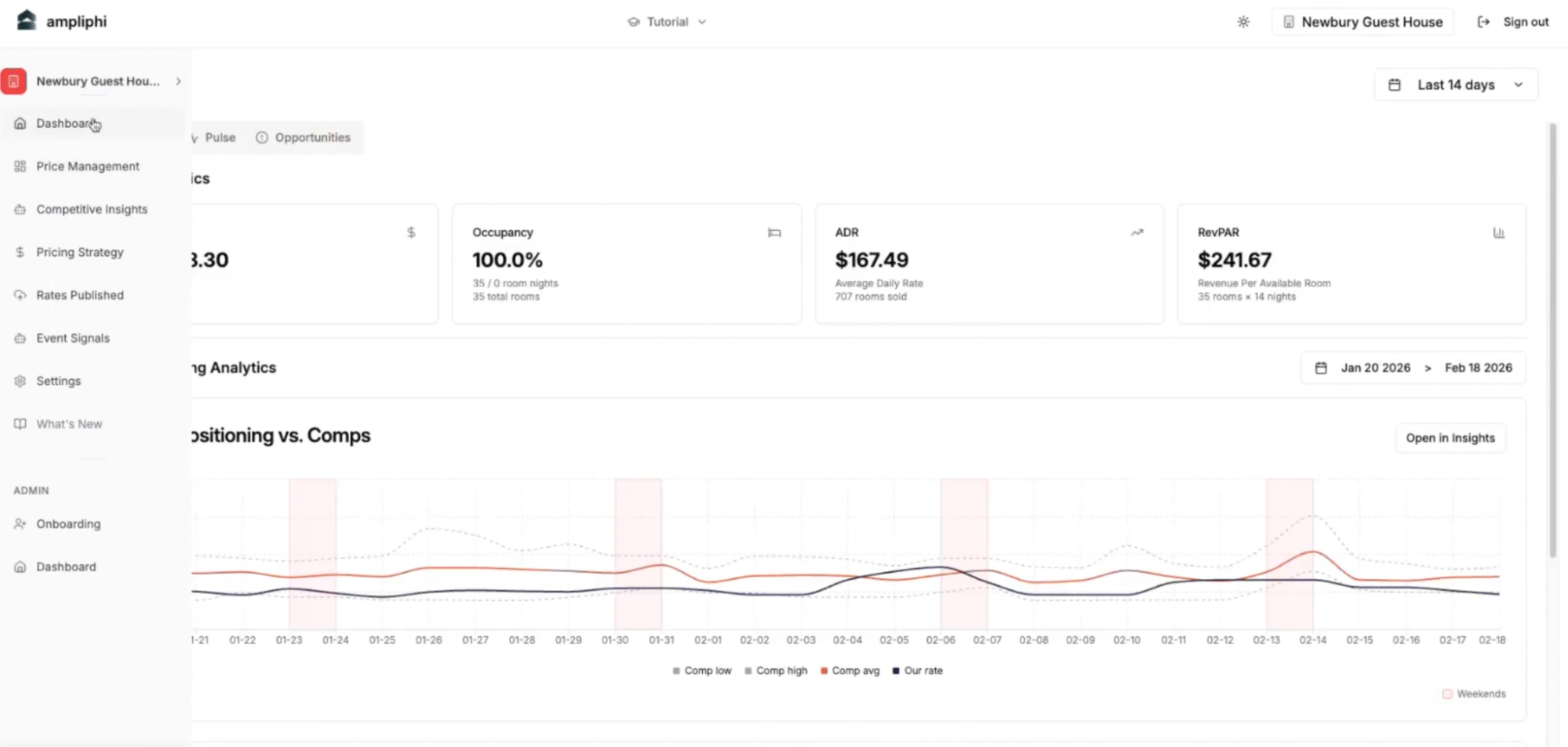
It starts with visibility. On the dashboard, you see your key metrics like revenue, occupancy, ADR, and RevPAR in one place.
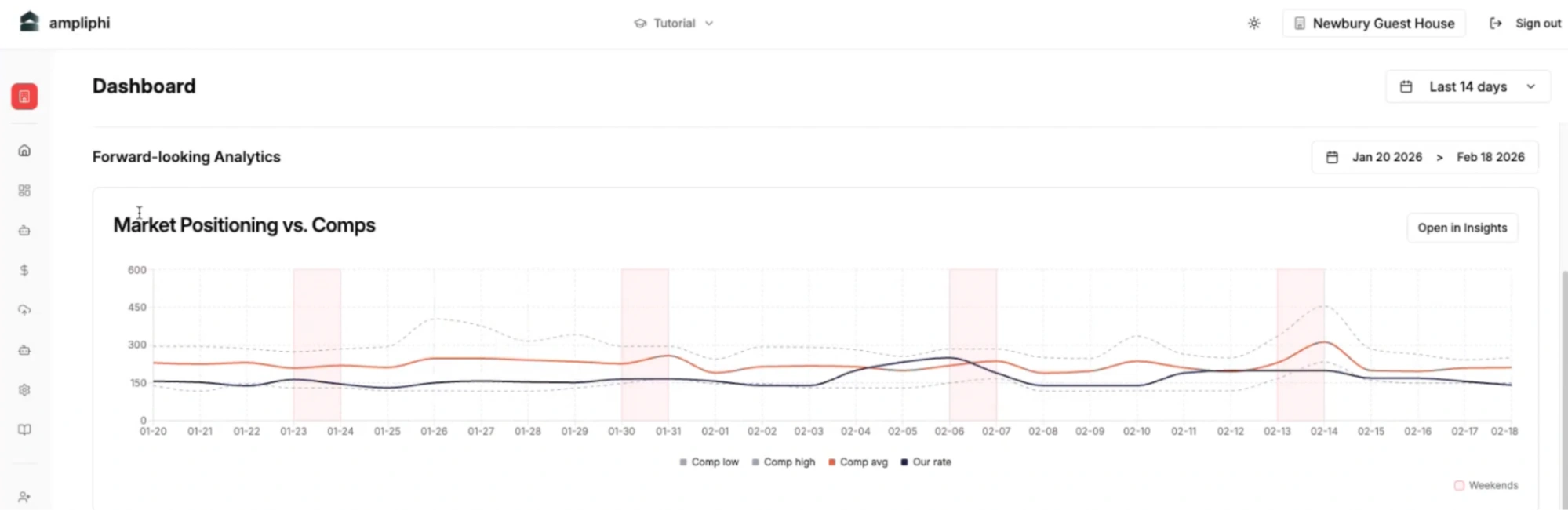
But more importantly, you also see what is coming next. The forward-looking view shows how your occupancy is trending and where your pricing stands against competitors, so you are not making decisions based only on past data.
B. Competitor insights with multi-day view and price range analysis
From there, you move into competitor insights. Instead of checking rates manually, ampliphi shows you exactly where you sit between the lowest and highest priced competitors.
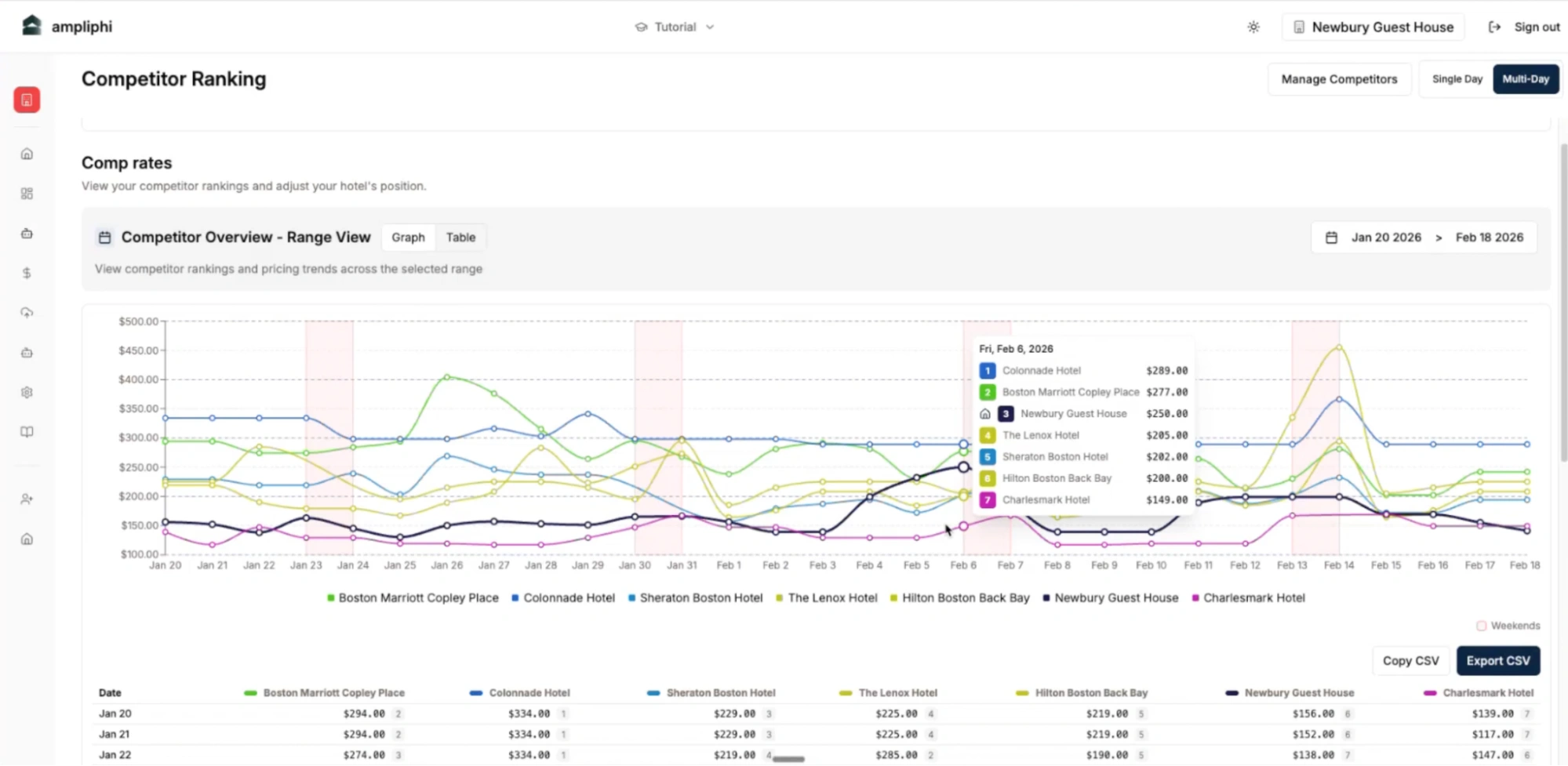
When you switch to a multi-day view, like a 30-day window, patterns become much clearer. You can see how pricing shifts over weekends or around certain dates, and understand how the market is reacting over time.
This makes patterns much easier to catch. You begin to notice how pricing shifts over weekends, how certain dates trigger changes across multiple properties, and how the market responds as a whole. In some cases, these patterns even point to demand drivers, such as an event influencing pricing, before it becomes obvious in bookings.
C. Pulse view with market snapshots and smart alerts
If something changes suddenly, you do not have to go looking for it. The Pulse view highlights market snapshots and uses smart alerts to flag major price movements.
Additionally, if a competitor drops their rate significantly, you see it immediately and can respond at the right moment.
D. Events module with demand impact and day at a glance summary
ampliphi also helps you connect pricing decisions to real demand. In the Events module, you can view upcoming events and their expected impact on room nights and revenue. Instead of reacting after bookings increase, you adjust your rates earlier while demand is still building.
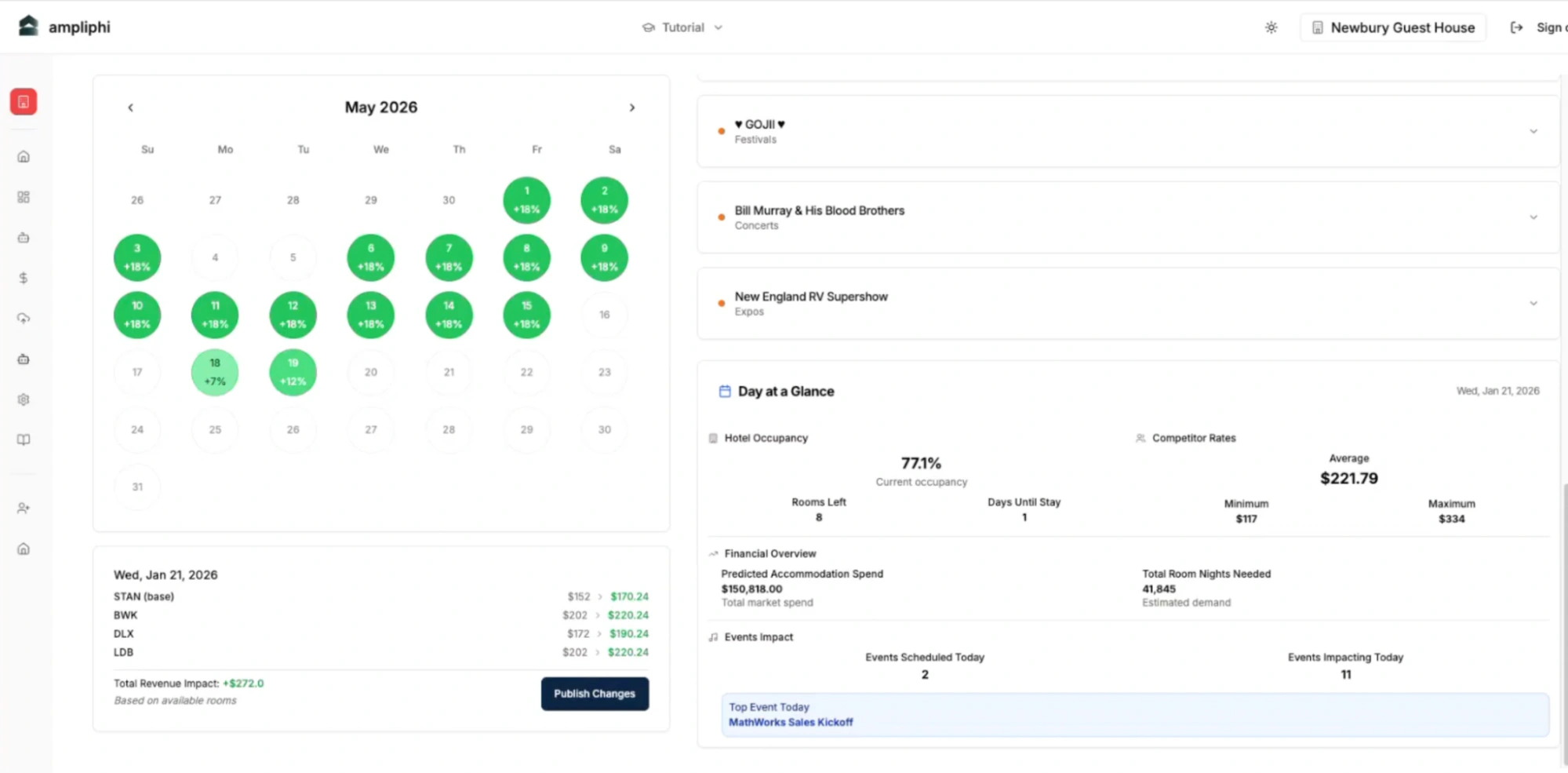
The Day at a Glance view brings all of this together into a simple summary, so you can quickly understand the total demand impact for a given day.
E. Opportunities view for high-impact pricing recommendations
When it comes to execution, ampliphi keeps things focused. It highlights pricing opportunities that actually matter, so you are not distracted by constant small changes.
And because it connects with your PMS (such as roommaster!), your pricing updates stay aligned with your system, making the entire process smoother and more reliable.
Start Maximizing Revenue with Dynamic Pricing
A strong dynamic pricing strategy in hotels is no longer optional. It helps you respond to demand, optimize revenue, and stay ahead of competitors.
With ampliphi, you don’t have to track trends or competitors manually. The system handles the heavy lifting, giving you insights and automation that help your hotel make smarter pricing decisions every day.
Ready to see how AI-powered dynamic pricing can work for your property? Connect with our team today and discover how we can help you keep rates competitive, boost profitability, and keep your rooms filled.
FAQs
What is dynamic pricing hotel AI?
Dynamic pricing hotel AI uses algorithms and real-time data to adjust room rates automatically. It analyzes demand patterns, competitor pricing, and booking trends to make pricing decisions. This helps hotels optimize revenue and respond quickly to market changes.
What are the 4 pricing strategies?
The four common pricing strategies are cost-plus pricing, value-based pricing, competitor-based pricing, and dynamic pricing. Each method serves different goals. Hotels often combine these approaches to create flexible pricing strategies that match demand and customer expectations.