For years, hotel pricing decisions depended heavily on instinct and past experience. However, as travel demand continues to fluctuate, intuition alone no longer keeps occupancy or average daily rate steady. When hospitality teams apply structured hotel competition monitoring, they identify pricing gaps, understand local demand fluctuations, and respond to competitor strategies with greater precision.
For example, a report from India’s branded-hotel segment shows occupancy rose to 67.8% and average daily rate (ADR) increased to $102 in FY 2024-25, while revenue per available room (RevPAR) grew 5.7%. This steady performance reflects how data-backed insights help properties maintain strong results even in unpredictable markets. With consistent hotel benchmarking, hoteliers gain a clear view of their market position and can adjust rates or promotions before losing traction.
In the long run, such awareness helps hotels attract the right guests, fill more rooms, and improve year-round revenue stability.
Why Competitor Monitoring Matters for Revenue Growth
Every hotel operates in a competitive ecosystem where guests constantly compare rates, reviews, and value across multiple properties before booking. Understanding what your competitors are doing, including how they price, when they adjust, and where they position themselves, provides critical context for your own revenue strategy.
To understand its impact, let’s look at three core advantages of systematic competition monitoring:
1. Stay ahead of market trends
The hotel industry moves fast, wherein demand fluctuates daily based on seasonality, local events, traveler behavior, and even weather patterns. Without consistent competitor rate tracking, your pricing strategy lags behind real-time market shifts. Monitoring competitor rates helps you spot emerging demand spikes, respond to sudden drops, and identify when your competitors are raising prices or selling out.
Aligning your rates with current market conditions helps you stay competitive and capture maximum revenue. Staying informed means you can adjust dynamically, capitalizing on demand instead of chasing it.
2. Benchmark performance effectively
Hotel benchmarking turns raw market data into actionable insight. It allows you to compare your property’s key performance indicators, such as occupancy, ADR, and RevPAR, against similar hotels in your area or category.
Benchmarking provides the context necessary to understand why your numbers look the way they do. Maybe your ADR is high, but occupancy is low compared to peers. Or perhaps a nearby competitor consistently achieves higher RevPAR despite offering lower rates. These comparisons reveal both your strengths and gaps.
A structured benchmarking approach answers critical questions that drive growth:
- Are my rates aligned with the market average, or am I underpricing potential revenue?
- Which competitors are consistently capturing higher occupancy, and why?
- Where can I fine-tune pricing or promotions to maximize both profitability and market share?
3. Informed decision-making to avoid missed revenue opportunities
When rate changes are made on instinct rather than insight, the result is often lost income caused by underpricing or missed opportunities during peak demand. Without competitor context, hotels may drop rates unnecessarily to fill rooms or fail to adjust quickly enough when the market moves upward.
Competition monitoring minimizes this guesswork. By basing every rate adjustment on accurate, up-to-date market data, revenue managers can identify exactly where to optimize pricing to drive both occupancy and ADR. Over time, this leads to higher profit margins, stronger forecasting accuracy, and a more resilient pricing strategy.
📌Also read: How To Calculate The ROI Of Switching To AI Revenue Management Software
How AI Tracks Competitor Rates in Real Time
Many hotels still rely on manual tasks to check competitor pricing and market shifts, which leaves gaps and wasted hours. The good news is that modern revenue management systems like the ampliphi RMS handle the heavy lifting and bring immediate clarity to pricing decisions:
A. Automated competitor rate tracking
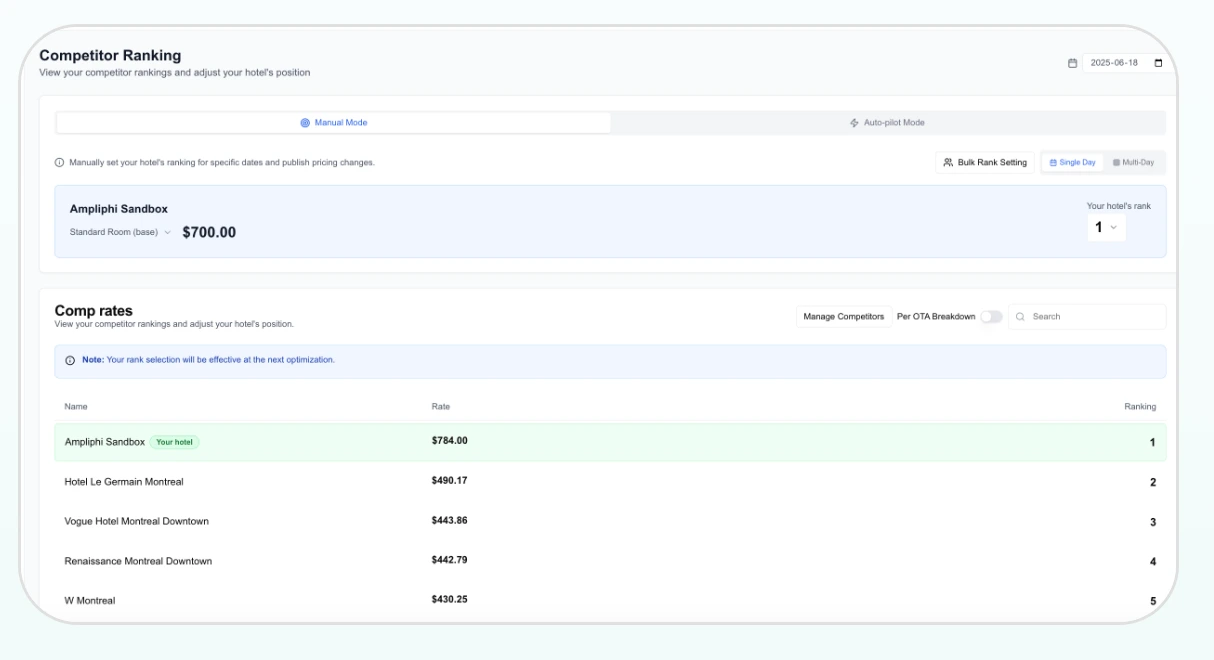
Manual rate checks take hours and often result in errors. ampliphi RMS replaces this process with automated, AI-powered competitor monitoring. The system scrapes competitor websites, OTAs, and global distribution systems to deliver up-to-date pricing information directly to your dashboard.
The competitor monitoring engine continuously tracks:
- Room rates across different channels
- Special promotions and packages
- Length-of-stay restrictions and cancellation policies
B. Dynamic rate adjustment recommendations
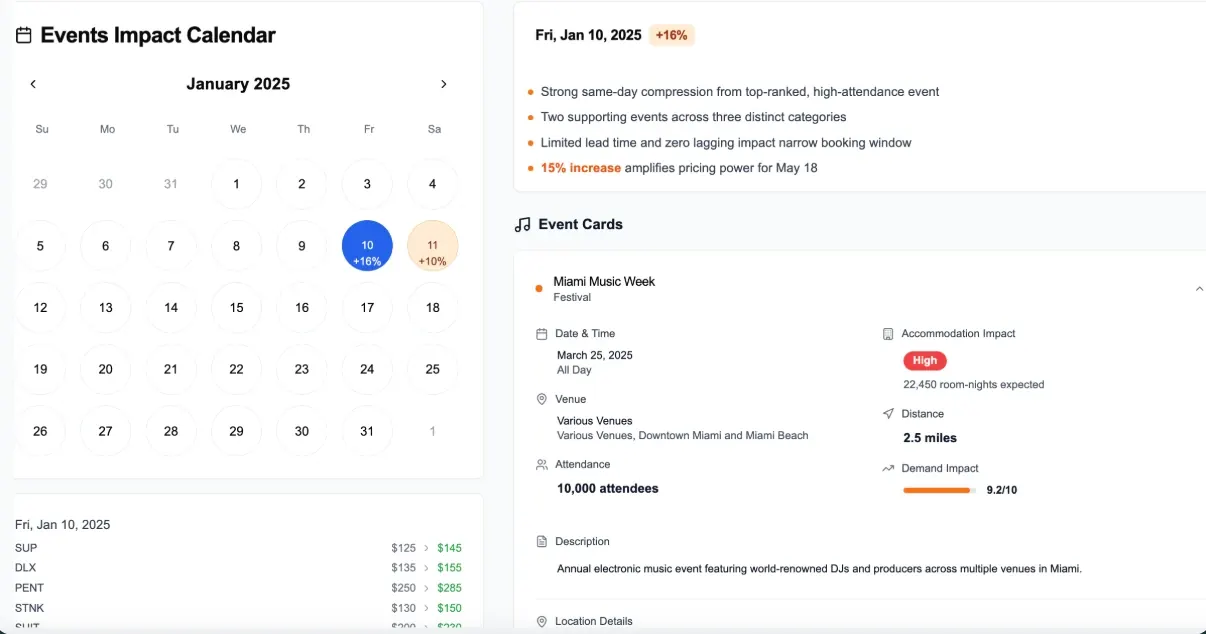
Modern AI tools collect data and turn it into actionable pricing decisions. ampliphi RMS analyzes competitor behavior, historical occupancy, and current market trends to produce dynamic rate recommendations.
In turn, revenue managers can:
- Adjust rates instantly during high-demand periods
- Launch promotions when competitor occupancy drops
- Optimize pricing for profitability instead of merely matching the market
C. Predictive insights for future planning
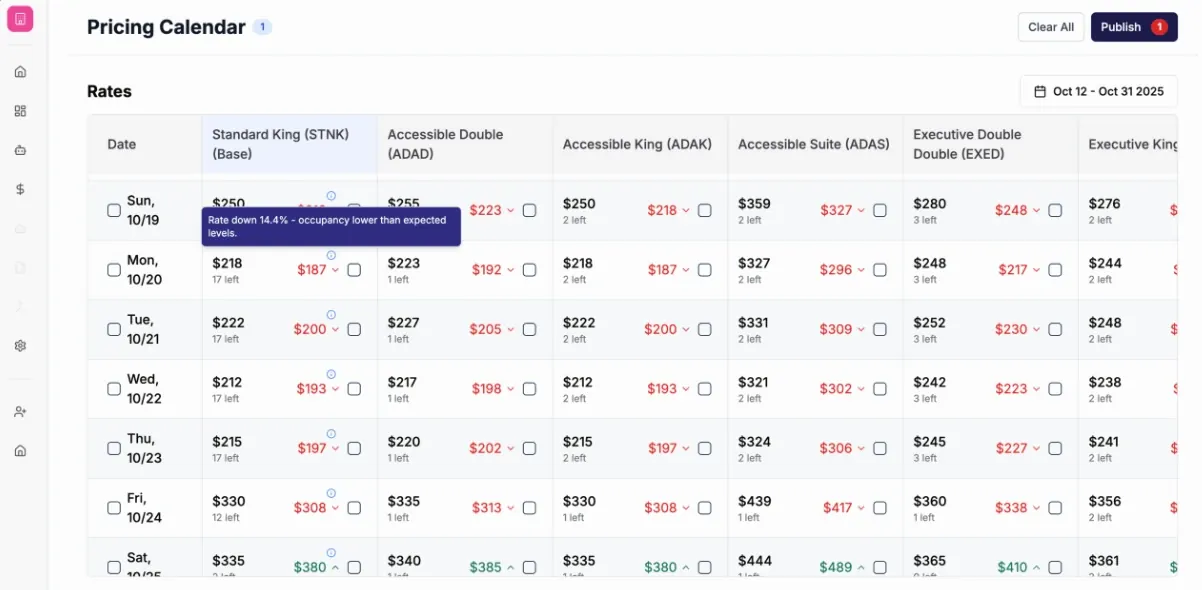
AI extends beyond real-time tracking by forecasting future market conditions. ampliphi RMS uses predictive models to identify upcoming trends in occupancy and ADR. For example, if competitor ADR trends upward before a local event, your hotel can proactively adjust rates to capture revenue without losing bookings.
The platform combines market intelligence, dynamic pricing, and AI optimization to anticipate demand shifts. Revenue managers gain early visibility into:
- Local events driving spikes in demand
- Seasonal changes affecting booking patterns
- Competitor pricing strategies that could impact market share
D. Smarter revenue decisions
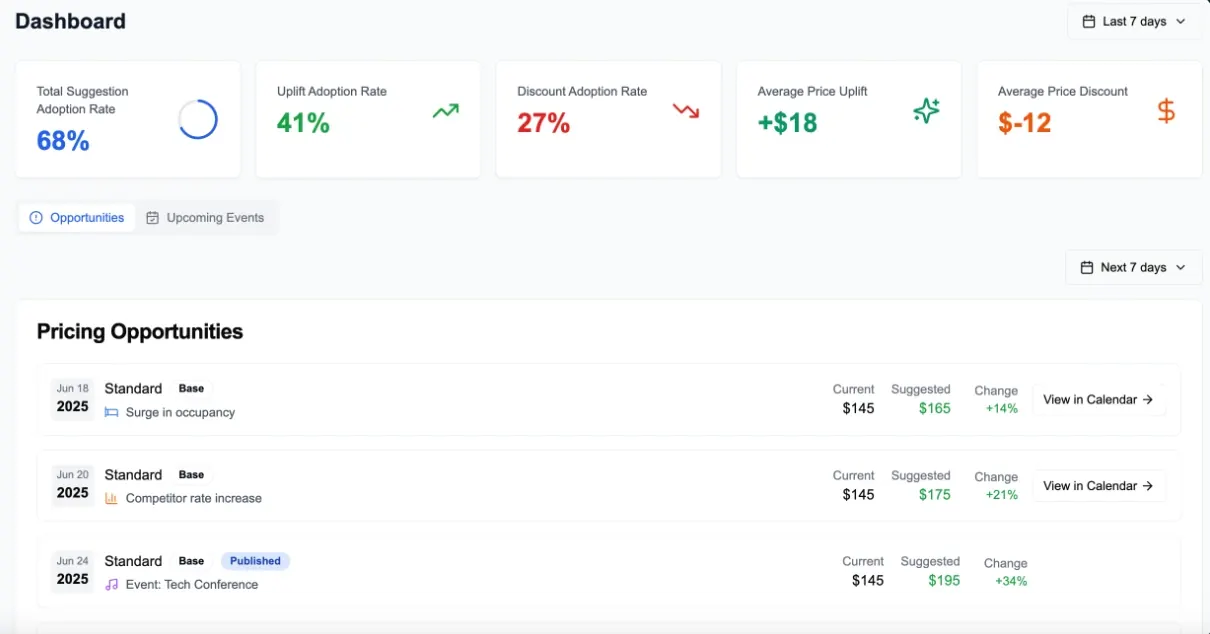
Monitoring competitor rates in real time gives hotels a clear picture of where they stand in the market. When you know which competitors are raising or lowering prices, offering promotions, or adjusting restrictions, you can react strategically instead of guessing. This insight helps revenue managers:
- Protect rate premiums while staying competitive
- Identify opportunities to capture demand when competitors underperform
- Adjust pricing quickly to maximize occupancy and ADR
📌Related read: How To Choose The Right AI Revenue Management Software For Your Hotel
Translating Competitor Insights into Actionable Pricing
Competitor monitoring only creates value if you turn insights into decisions that drive revenue. Understanding how your market behaves allows you to implement pricing strategies that capture demand, maximize occupancy, and protect your rate integrity.
The process begins with identifying actionable opportunities across segments, channels, and time periods:
1. Segmented rate strategies
Not all rooms or guest segments respond the same way to pricing changes. Combining competitor insights with your own booking data allows hotels to tailor rates strategically:
- Channel-specific pricing: Adjust rates across OTAs, direct bookings, and corporate partners to optimize revenue without undercutting your value.
- Length-of-stay pricing: Increase profitability by differentiating weekend vs. weekday rates or incentivizing multi-night stays.
- Package and add-on strategies: Bundle services or offer exclusive packages to stand out from competitors and capture higher per-stay revenue.
Using ampliphi RMS, these segmented strategies become automated. Real-time pricing updates respond to market changes instantly, freeing revenue managers from manual adjustments while ensuring every room and segment is priced to perform.
2. Optimizing distribution channels
Competition monitoring reveals which channels competitors dominate and where gaps exist. Hotels can prioritize high-performing channels and avoid oversaturating those where competitors already hold strong positions.
For instance, according to CBRE, the U.S. lodging industry is forecast to achieve only a 1.3% increase in RevPAR in 2025, with a modest rise in occupancy (14 basis points) and ADR up by about 1.2%, showing how careful channel management and strategic pricing are crucial even in slow-growth markets. ampliphi RMS centralizes this data in a single dashboard, so managers can see channel-level performance at a glance and act confidently without relying on spreadsheets or manual checks.
3. Seasonal and event-based adjustments
Market demand often spikes around holidays, local events, and seasonal trends. Monitoring competitor rates in real time enables proactive adjustments, allowing hotels to maximize revenue per available room before rates climb or occupancy fills up.
In Spain, the hotel sector achieved an 11.5% year‑on‑year increase in RevPAR in 2024 (to €118.30), driven by both higher occupancy (74.6%, +2.4%) and higher ADR (average €158.40, +8.9%), highlighting how timely adjustments for seasonal and event-based demand can directly impact revenue. With ampliphi RMS, predictive insights and AI-driven recommendations identify these opportunities automatically, helping hotels capture more value from every booking.
4. Maximizing revenue, time, and control
Turning competitor insights into pricing actions impacts more than revenue:
- Increase RevPAR by up to 35%: Real-time, dynamic adjustments help you capture the full market value.
- Gain back hours every week: Automated rate updates and simplified workflows reduce manual work, giving staff more time for guest experience and strategy.
- Stay informed and in charge: You can let the AI optimize rates automatically or intervene whenever you choose, maintaining complete visibility and control over pricing decisions.
Benefits: Improved ADR and Occupancy
Hotels often face a dilemma: Should they prioritize occupancy or maximize ADR?
Raising rates can scare off price-sensitive guests and reduce bookings, while lowering rates might boost occupancy but erode revenue per available room. This tension is where predictive, AI-driven pricing becomes a game-changer.
Imagine a mid-size city hotel during a busy weekend. ADR peaks at $180 with 85% occupancy. Competitor monitoring shows rival properties raising rates slightly for the exact dates. Without timely insight, a revenue manager might stick to current pricing, missing the opportunity to capture higher ADR. With ampliphi RMS, AI forecasts demand, analyzes competitor rates, and recommends the optimal price that balances occupancy and revenue. In this case, a $10 increase could lift total revenue by 3–5% without reducing bookings.
During slower periods, hotels can leverage competitor insights to strategically adjust rates. Key approaches include:
- Targeted promotions or packages: Multi-night or bundled offerings that attract guests without causing revenue loss.
- Segmented rate adjustments: Adjusting rates for specific channels or guest types based on competitor behavior.
- Dynamic timing: Shifting rates proactively before market changes impact occupancy.
AI-powered automation also saves time and reduces errors. Revenue managers no longer spend hours checking competitor OTAs or calculating manual adjustments. Instead, ampliphi RMS continuously monitors competitor rates, booking pace, and market trends, updating rates in real time. This ensures hotels capture every revenue opportunity while staying competitive across channels.
Common Mistakes in Competitor Benchmarking
Now that we are aware of the benefits of competitor monitoring, let’s look at some of the common mistakes hoteliers make:
- Tracking too few competitors: Monitoring just one or two competitors gives an incomplete picture of the market. Effective benchmarking requires a diverse set of comparable hotels across price points, locations, and amenities.
- Ignoring channel differences: Competitor rates vary by booking channel. Tracking only website rates without considering OTAs or corporate agreements can lead to inaccurate conclusions.
- Reacting instead of strategizing: Simply copying competitor rates is a reactive approach that can erode margins. Instead, combine AI insights with your unique property strengths to set strategic rates.
- Overlooking ancillary revenue: Focusing solely on room rates misses additional revenue streams. Monitor competitor packages, add-ons, and promotions to optimize total revenue per guest.
Take Control of Your Hotel’s Revenue Today
Hotels operate in a fast-moving market where every booking counts. With ampliphi RMS, you gain real-time insights into competitor rates, occupancy trends, and market shifts, empowering your team to price with confidence and optimize revenue.
Additionally, hotels using AI-powered competitor monitoring report measurable improvements in both ADR and occupancy, capturing more value from every booking while maintaining rate integrity. You no longer guess at pricing or react after the market moves. Instead, you make proactive, data-driven decisions that maximize profitability in both peak and off-peak periods.
Book a demo today to learn more!
FAQs
1. What is competition monitoring in hotels?
Competition monitoring is the process of tracking and analyzing competitors’ room rates, occupancy trends, and pricing strategies to inform your hotel’s pricing and revenue decisions.
2. How does AI track competitor rates?
AI scrapes competitor websites, OTAs, and distribution systems in real time, analyzing trends, promotions, and occupancy signals. Advanced tools such as ampliphi RMS provide predictive insights and rate recommendations.
3. How can rate intelligence improve occupancy?
Rate intelligence helps hotels adjust pricing strategically based on market conditions. By offering competitive rates during low-demand periods and optimizing ADR during high-demand periods, hotels can maximize both occupancy and revenue.
Written by the team at Ampliphi, the revenue management system for independent hotels.
View full profile →Estimate what slow rate updates cost you in a year. Prefer someone to look at it with you? The revenue audit is free, and if your pricing is broadly right, we will say so.