

Strategy
7 Proven Strategies to Increase RevPAR at Your Hotel
RevPAR is the most important metric in hotel revenue management. Here are seven strategies that actually work.
6 min read
Price
Watch
By property
Learn
Combine historical data, booking pace, segment trends, and event signals, the modern playbook for accurate occupancy forecasts.
Number crunching supports how to forecast hotel occupancy, but forecasting helps hotels make stronger decisions. Accurate predictions of future demand guide pricing, inventory, and promotions that maximize revenue throughout the year.
Hotels also face varied global occupancy patterns, such as the United States, which is projected to record 63.4% occupancy in 2025 as travel demand normalizes, highlighting why historical data and current travel behavior are critical to effective forecasting.
To make these forecasts work for your business, you must combine a structured approach with technology such as a modern property management system that feeds real-time information into your models and integrates with revenue tools. Alongside reliable data and tools, a focus on revenue management practices and on tracking industry market trends ensures that decisions are rooted in context rather than intuition.
In this guide, we walk through the essential steps to build robust occupancy forecasts, from analyzing key data sources to leveraging advanced tools, including AI and automation. Whether planning for a busy holiday weekend or shaping your annual strategy, these steps will help you forecast with confidence and drive stronger business outcomes.
Hotel occupancy forecasting is the structured process of predicting future room demand using reliable data.
It guides pricing strategies, operations, and marketing by helping leaders clearly understand demand patterns. This understanding supports the hotel industry as it works to improve planning and performance. The process then links daily decisions to long-term goals through one clear system.
You can see its value in many areas. For example:
| Forecasting Type | Key Uses | Basis for Predictions | Best For | Real-Life Example 2025 |
|---|---|---|---|---|
| Short-Term Forecasting (Days to a Few Months) | Adjusting daily room rates, managing staff schedules, and controlling inventory. | Real-time bookings, competitor pricing, and last-minute demand fluctuations. | Hotels with seasonal spikes or unpredictable short-term demand. | Marriott uses AI-driven dashboards to optimize daily rates and staff allocation. |
| Long-Term Forecasting (6+ Months to Years) | Guiding strategic planning, marketing campaigns, capital projects, and expansion decisions. | Historical occupancy, industry trends, and economic forecasts. | Budgeting, long-term pricing strategies, and growth planning. | Accor Hotels uses multi-year forecasts to plan expansions in the Asia-Pacific and Middle East, focusing over 60 % of its planned openings in these regions. |
Property managers achieve precise occupancy forecasting by combining historical data, market trends, and external economic indicators. Below is a breakdown of the key performance indicators (KPIs) that drive an accurate forecast:
Hotels rely on multiple data sources to accurately forecast future demand, including:
Hotels study past occupancy rates to project future room nights sold. This method helps hotels set realistic baselines for planning staff and inventory.
However, relying only on history can miss rapid market shifts and changing traveler behavior, so modern teams pair this with newer models.
Revenue managers calculate averages over recent periods to smooth fluctuations in bookings. This approach identifies consistent demand patterns amid seasonal demand fluctuations.
It matters because it provides a clearer picture of occupancy trends, helping hotels adjust marketing and pricing strategies in advance.
Hotels track how reservations accumulate over time to predict final occupancy. This approach reveals booking momentum and helps adjust rates or staff levels as the date approaches.
Additionally, it reflects real booking behavior, enabling better operational planning and dynamic pricing.
Properties divide demand into segments such as corporate, leisure, group, or OTA channels. Segment forecasts show patterns hidden in total occupancy data.
Additionally, it guides marketing strategies, resource allocation, and tailored guest experiences, improving guest satisfaction.
Hotels use statistical forecasting models to link demand with seasonality, events, and economic conditions.
This technique quantifies external drivers affecting bookings. As a result, hotels can adjust pricing, staffing, and inventory proactively based on projected changes in demand.
AI analyzes large datasets, including bookings, search trends, and real-time data, to predict demand. Machine learning models capture complex patterns that traditional methods miss.
Meanwhile, AI improves forecast accuracy, helping hotels optimize competitor pricing trends, room availability, and operational efficiency. Recent research on transformer‑based forecasting models has shown they outperform older statistical methods by capturing complex, multi‑seasonal patterns in hotel demand that ARIMA and exponential‑smoothing approaches typically miss.
Boosting hotel occupancy takes time, but you can use proven strategies to grow it steadily. You can:
Start by collecting your past occupancy data. Be very specific about the period you’re forecasting for. Are you focusing on a single night, an entire month, or the full year? This makes your forecast concrete and actionable instead of vague.
For example, instead of saying “next month,” say “October.” This allows you to compare apples to apples with previous Octobers. Pull data from multiple years if you can, as patterns from the past will guide your forecast for the future.
Look for trends such as which days of the week fill faster, which types of rooms get booked first, and whether there’s a pattern around holidays or local events. Historical data gives you the backbone of a forecast you can trust.
Once you have your historical data, look at how quickly your bookings are coming in. Booking pace tracks how reservations accumulate over time, while pickup trends show which periods are filling fastest.
For instance, you might notice that business travelers book at the last minute, while families plan months. By understanding these patterns, you can predict when rooms are likely to be taken and adjust your staffing, promotions, or pricing accordingly.
The key is to catch trends early, so your forecast isn’t just reactive but proactive.
Not all bookings are equal. Break down your occupancy by source:
Direct bookings might spike after a marketing campaign, OTAs might react to price changes, and corporate accounts could be steady but predictable. Understanding the composition of your demand helps you spot vulnerabilities and opportunities.
For example, if your OTA bookings drop, you might need to run a promotion, but if direct bookings are strong, you can lean on them instead.
Seasonality can dramatically affect occupancy, and ignoring it is a common mistake. Hence, consider:
Your forecast doesn’t exist in a vacuum. Check what’s happening in your market:
Cancellations and no-shows are inevitable, and they can throw off your forecast if you ignore them. Look at historical cancellation rates by booking source, day of the week, or season.
For instance, OTA bookings might have higher cancellation rates than direct bookings. Consider these in your forecast to get a more realistic view of how many rooms will actually be occupied. This is essential for planning revenue, staffing, and housekeeping schedules.
Now it’s time to turn insights into numbers. Choose forecasting methods that fit your property’s size, complexity, and available data. Simple techniques, such as moving or weighted averages, work well for smaller properties.
You can calculate the weighted average as:
Weighted Average = (Sum of the Products of Values and Weights)/Sum of All Weights
For example, if you consider the last three months’ occupied rooms as 80, 75, and 70, with weights 3, 2, and 1:
Weighted Average = [(80×3)+(75×2)+(70×1)]/3+2+1 = 76.7
To calculate the moving average,
Moving Average = (80+75+70)/3 = 75
Once you have your forecasted occupied rooms, turn them into a percentage:
Forecasted Occupancy Rate (%) = [Forecasted Occupied Rooms/Total Available Rooms]*100
So, if the total number of available rooms is 100, your forecasted occupancy rate stands at 76.7%.
On the other hand, larger hotels might use regression analysis or exponential smoothing. The formula you choose should combine historical performance, current booking trends, seasonality, and market insights. The goal is to have a reproducible, data-driven process rather than guesswork.
Don’t just trust your forecast blindly. Compare it with recent data to see if it holds up:
Finally, let technology help. Revenue management systems (RMS) can automate large portions of your forecasting process. They can process historical data, identify trends, and adjust predictions in real time. Automation reduces human error, saves time, and lets you focus on strategy.
To make your life easier, you can use RMS tools, such as the ampliphi RMS, to supplement your expertise. The combination of data, human insight, and automation creates the most reliable forecasts.
Once you understand the basics, it helps to see practical examples. These examples show how to turn your data into actionable forecasts.
Pickup forecasting predicts how many additional rooms will be booked leading up to a specific date. To calculate:
Forecasted Pickup = Current Bookings + Expected New Bookings
If,
This formula helps estimate your revenue potential. You can calculate it as:
Forecasted Revenue = Forecasted Occupancy × ADR
For example, if:
This is a simple way to see how occupancy and pricing combine to drive revenue.
Different booking segments behave differently, including corporate, OTA, group, or direct. Segmenting helps you forecast more accurately.
Here’s how you can do it:
As forecasting becomes more complex, relying solely on historical data and manual calculations is no longer enough. Modern hotels are turning to revenue management systems like ampliphi RMS to make faster, smarter, and more profitable decisions.
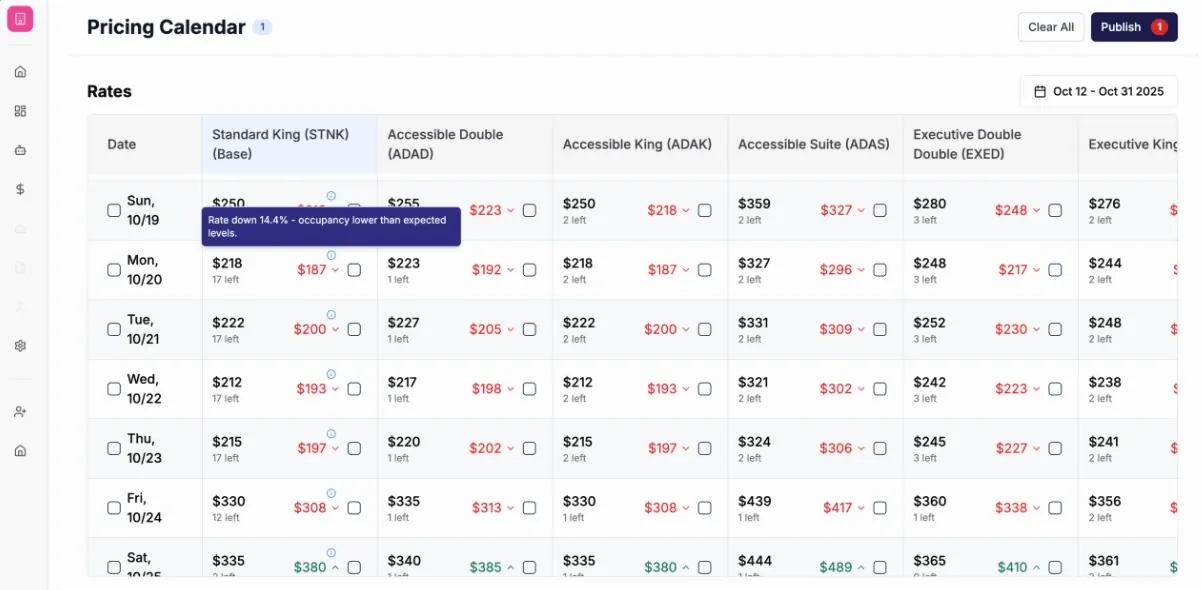
Artificial intelligence (AI) is transforming how hotels approach revenue management. It turns complex data into actionable insights that actually make sense. For example, ampliphi RMS uses predictive forecasting and demand intelligence to improve occupancy forecasts and revenue consistency.
Here’s what AI does:
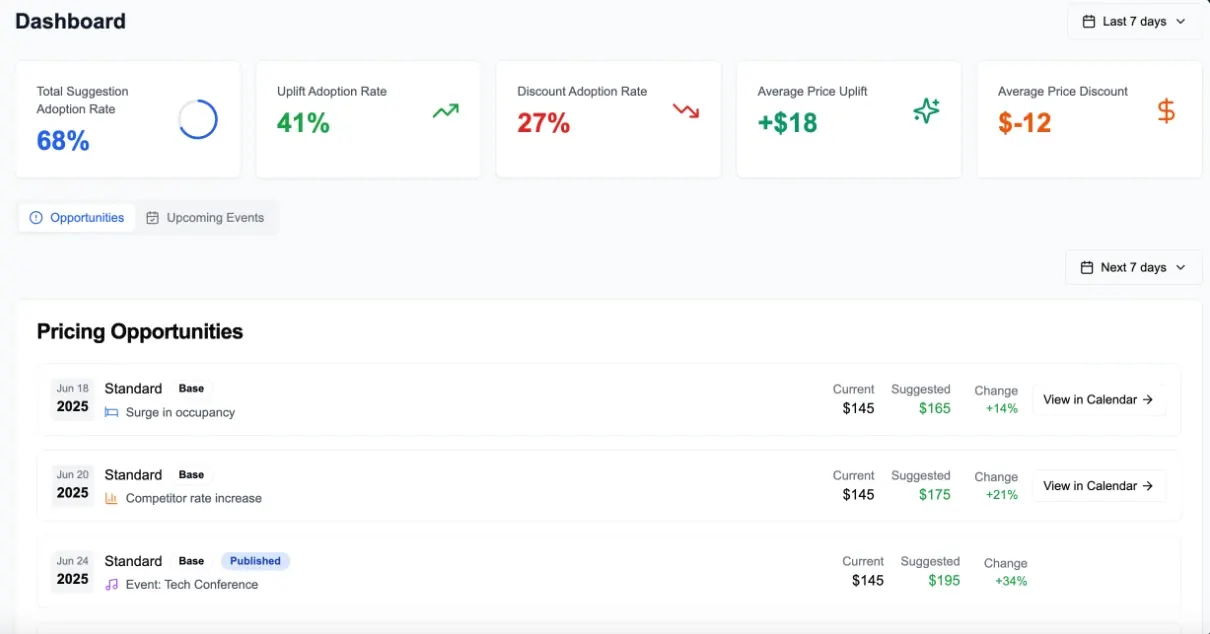
Spreadsheets are fine… until the market shifts overnight. Hotels that rely on static data can’t monitor local events, competitor activity, or sudden demand spikes as effectively as larger chains.
With ampliphi RMS, hotels can:
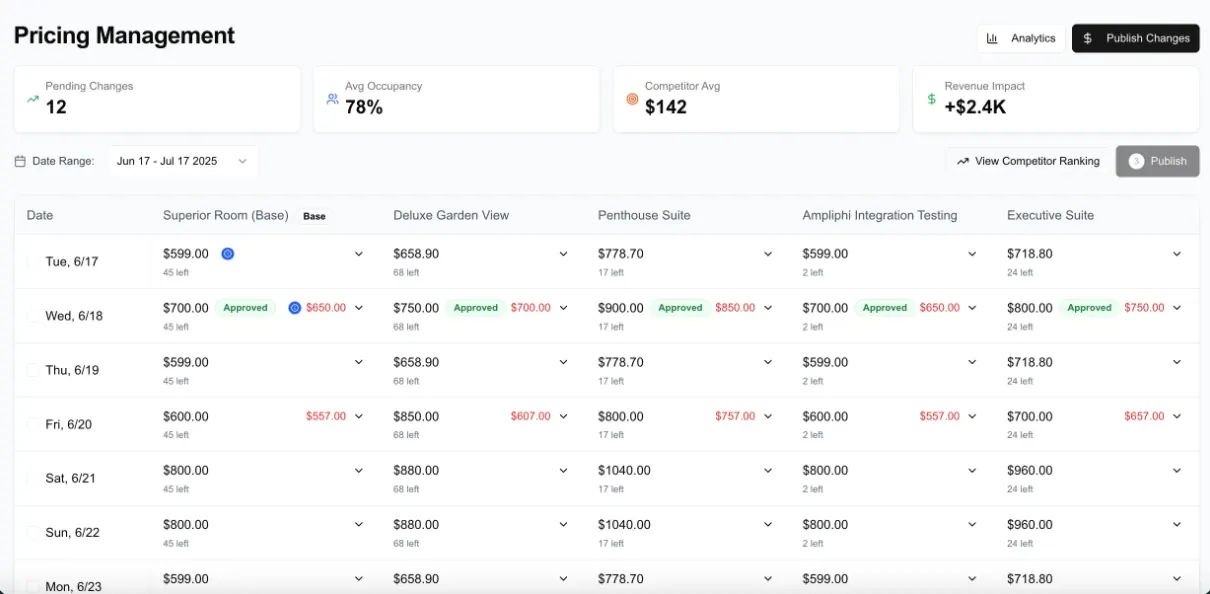
Manual rate adjustments waste hours that hotels just don’t have. Automation takes the repetitive work off your plate while keeping your strategy intact.
Here’s how dynamic pricing works:
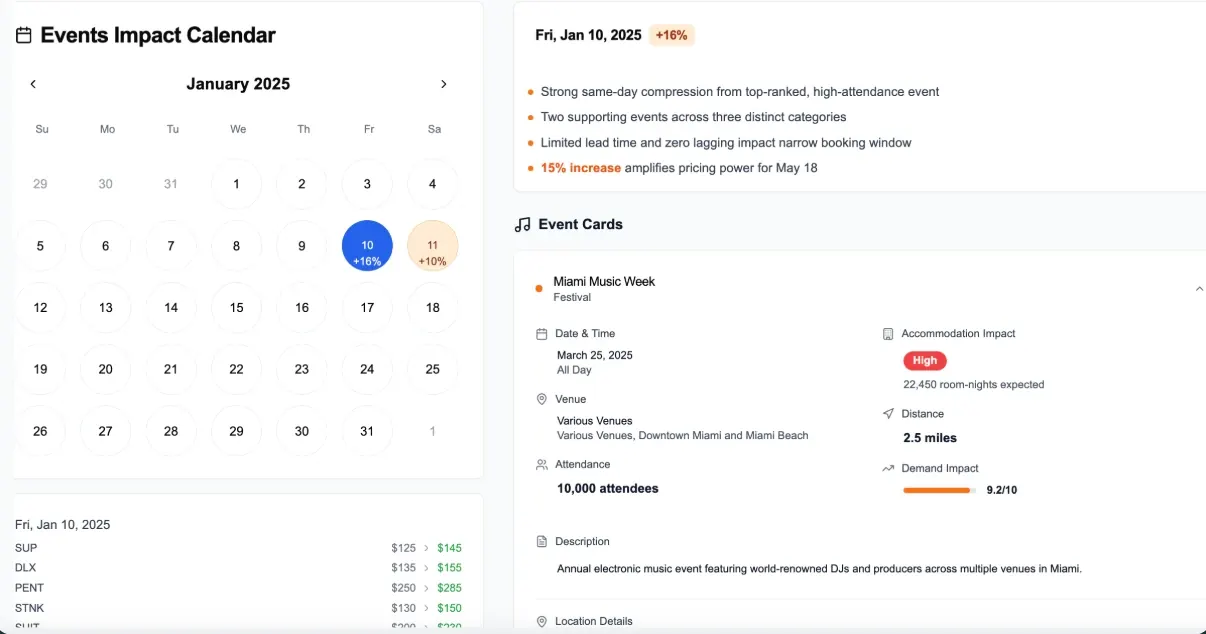
AI also connects insights directly to revenue strategy. By combining demand forecasting, competitor monitoring, and dynamic rate recommendations, hotels can make fast, confident decisions.
Here’s how:
Even the best forecasting methods work better when paired with smart strategies. By staying proactive and detail-oriented, you can improve the accuracy of your occupancy projections and make smarter revenue decisions.
Accurate occupancy forecasting is the backbone of smarter pricing, better staffing, and stronger revenue performance. As the hospitality landscape evolves, relying on historical data alone isn’t enough.
Modern tools, especially AI-driven systems like ampliphi RMS, transform complex data into actionable insights, helping hotels of all sizes predict demand, optimize rates, and react to market changes quickly. This way, your team can make confident decisions, reduce manual errors, and maximize revenue opportunities.
Ready to take your forecasting to the next level? Schedule a demo and see how predictive intelligence can grow your occupancy, RevPAR, and profitability.
Hotels forecast occupancy by analyzing historical performance, tracking booking pace, and monitoring market trends. They segment demand sources, factor in seasonality and local events, adjust for cancellations, and apply methods such as moving or weighted averages to predict rooms sold accurately.
To calculate hotel occupancy, divide the number of occupied rooms by the total available rooms and multiply by 100. This calculation gives the percentage of rooms sold, helping hotels measure performance, plan staffing, and set pricing strategies.
Hotels forecast accurately by following the seven steps:
Hotels calculate occupancy by dividing occupied rooms by total available rooms, then multiplying the result by 100. They use historical data, current bookings, and market intelligence to track trends, measure performance, and adjust forecasts and pricing strategies accordingly.
Hotel occupancy forecasting predicts the number of rooms a property will sell during a future period. Hotels combine historical data, booking trends, seasonality, and market insights to guide pricing, staffing, and revenue management decisions.
Hotels use historical occupancy, booking pace, cancellations, no-shows, segment trends, seasonality, special events, local market conditions, and competitor pricing. Combining these data points helps them produce accurate and actionable occupancy forecasts.
AI improves hotel forecasting by analyzing live bookings, historical patterns, and competitor rates in real time. Hotels use AI to accurately predict demand, automate pricing adjustments, and make faster, more profitable decisions with minimal manual effort.

About the author
Ampliphi TeamEditorial teamWritten by the team at Ampliphi, the revenue management system for independent hotels.
View full profile →Free tool · No email
Is your hotel underpriced?
Four quick signals that show whether your best nights are priced too low.
Run the free self-checkStrategy
RevPAR is the most important metric in hotel revenue management. Here are seven strategies that actually work.
6 min read
Strategy
Knowing what your competitors are charging is only half the battle. Here's how to use that data strategically.
5 min read
Strategy
Flat discounts leave money on the table. Smarter, AI-driven long-stay pricing rules turn extended-stay demand into sustained RevPAR growth.
6 min read
Book 30 minutes and see ampliphi on your own competitors, events and nights. No slides.
Not ready to talk? Try ampliphi Intelligence free for 30 days →