

TL;DR
|
Every hotelier knows how fast the market can shift when travelers start comparing rates and perks online. Guests decide in seconds, and that means your pricing and strategy must move just as quickly.
Hence, predictive revenue management has become the next big differentiator for smart hotel operators who want to stay one step ahead. With AI demand forecasting, teams can spot booking patterns early, predict demand shifts, and tweak pricing or promotions before competitors even react.
According to new research, hotels using AI-driven platforms report boosts in occupancy and more accurate demand prediction by up to 30%. This proves how powerful data-driven insights can be when used correctly. In this article, we’ll explore how these advancements are transforming hotel forecasting and reshaping long-term revenue strategies.

What Is Predictive Revenue Management?
Predictive revenue management is an advanced approach that uses real-time data, analytics, and machine learning in revenue management systems (RMS) to forecast future earnings with greater accuracy than traditional methods. It goes beyond simple forecasting by analyzing historical data, customer behavior, market trends, and economic indicators. These insights drive dynamic pricing, demand forecasting, and strategic decision-making, helping businesses maximize revenue and improve efficiency.
Some of the key applications of predictive revenue management include:
- Dynamic pricing for businesses that automatically adjust pricing based on real-time factors such as demand, competitor pricing, and occupancy levels. In fact, hotels using AI-driven pricing have increased total revenue by 20-30%.
- Demand forecasting that predicts future demand by analyzing historical data and external factors such as holidays and local events, enabling businesses to better plan inventory and resources.
- Personalized marketing that helps you understand customer behavior, so you can target campaigns more effectively to attract high-value guests or customers.
- Revenue optimization that identifies opportunities for cross-selling, upselling, and product bundling to boost profits beyond just baseline sales.
- Strategic planning that lets businesses use these insights proactively for budgeting, resource allocation, and investment, so they move from reactive to proactive decision-making.
From Reactive to Predictive: The AI Advantage
Traditional revenue management often depends on manual spreadsheets, past data, and instinctive decision-making. This outdated method limits accuracy, slows response times, and restricts growth opportunities. Predictive AI transforms this process through intelligent automation and real-time insights. With the machine learning in RMS, hotels can:
- Forecast demand with greater accuracy
- Respond in real time to market changes
- Optimize rates across multiple channels and segments simultaneously
To give you an example, the Nebula Urban Hotel in Manhattan took a bold step toward digital transformation. In 2023, the team introduced Aria, an AI-powered concierge designed to create a smoother and more personalized stay for guests. Through Aria, visitors can complete online check-ins, place room service orders, and receive instant assistance without waiting at the front desk.
The system continuously learns from every guest interaction, adapting to preferences and offering tailored suggestions for local dining and entertainment, as well as curated playlists for each guest’s room. With a smaller front desk team, the hotel now focuses on creating guest experiences that add warmth and value to every stay.
As an AI-driven revenue management system, ampliphi RMS applies advanced analytics to every decision. It studies booking behavior, competitor trends, and real-time market shifts to recommend the most profitable rate strategy. As a result, hotels move from reacting to predicting, gaining control and confidence over every pricing decision.
Key Predictive Models for Hotel Forecasting
Predictive revenue management relies on sophisticated models to forecast occupancy, ADR, and revenue per available room (RevPAR). Some widely used techniques include:
1. Time series models
These models analyse time-series data to support forecasting. For example:
- ARIMA (Autoregressive Integrated Moving Average) studies past data points and uses correlations to estimate future demand
- Exponential Smoothing and Holt-Winters assign a higher weight to recent data and track seasonal trends to anticipate upcoming demand swings
2. Regression models
Regression methods help uncover how multiple factors drive demand or revenue. Examples include:
- Multiple Linear Regression, which uses variables such as seasonality, pricing, promotions and economic indicators to predict hotel demand
- Causal Models that model direct relationships, such as how a drop in demand may trigger pricing adjustments or rate changes
3. Machine Learning Models
Machine learning offers powerful ways to capture complex patterns and adapt to shifting markets. These techniques include:
- Decision Trees provide precise rule-based forecasts using “if-then” logic
- Random Forests combine many decision trees to reduce error and improve predictive accuracy
- Neural Networks capture non-linear relationships across large datasets and adapt as market dynamics evolve
- Gradient Boosting builds a strong predictive model by layering simpler models and refining predictions iteratively.
Each model category supports more advanced forecasting and a better revenue strategy. Hotels that adopt these tools position themselves to respond proactively to market shifts with greater confidence and precision.
In fact, recent research shows that 82% of hotels believe AI will become essential for future revenue and operational models. The ability to view performance across every hotel, region, and brand means you can act as one coordinated team rather than many disconnected silos.
📌Also read: How To Calculate The ROI Of Switching To AI Revenue Management Software
Benefits: Pricing Accuracy and Labor Efficiency
When your team understands your market and guest dynamics well, you can plan for high, normal, and low demand periods more effectively. Predictive revenue management uses data insights to guide pricing choices, helping you capture maximum value without turning guests away. Here’s how:
A. Increase ADR without losing occupancy
Finding the right balance between occupancy and room rates can feel challenging, but data-driven insights make it much easier. Predictive pricing helps hotels capitalize on opportunities while protecting revenue.
Here’s how it works in practice:
- Avoid unnecessary discounts that shrink profits
- Recognize periods when the market supports higher average daily rates so revenue grows without scaring guests away
- Maintain competitive pricing to attract cost-conscious guests while maintaining stable occupancy
B. Maximize occupancy during low demand
Periods of soft demand do not need to result in empty rooms or lost revenue. Predictive insights reveal opportunities to attract guests even when traffic slows down, such as:
- Offer targeted promotions that bring in guests without affecting your hotel’s reputation
- Adjust rates dynamically to match competitor actions and market demand
- Fill rooms strategically so revenue flows steadily, even during slower periods
C. Enhance operational efficiency
Traditional revenue management often requires hours of manual data analysis, tying up teams in repetitive tasks. Predictive tools take over time-consuming tasks, allowing your staff to focus on key activities, such as:
- Create memorable guest experiences that leave a lasting impression
- Plan creative marketing campaigns that attract and retain more bookings
- Execute strategies that directly contribute to higher revenue and operational success
A pilot implementation at a hotel in Ubon Ratchathani Province, Thailand, showed that combining data insights with AI tools reduced average room turnaround times by over 50% and increased task completion rates to above 99%. In return, staff spent fewer hours on routine work and focused on delivering better guest experiences and planning marketing initiatives. This helped the hotel operate more efficiently and keep both guests and employees happier.
Example: Forecasting Demand Around Local Events
Local events, conferences, and holidays can dramatically influence hotel demand. Predictive revenue management enables hotels to:
- Anticipate demand spikes
- Adjust ADR ahead of competitors
- Optimize staff allocation and inventory
Suppose a downtown boutique hotel notices that weekend bookings are unexpectedly dropping, especially on Friday and Saturday nights during events like a concert. Traditional pricing methods might not flag those shifts until revenue already takes a hit.
Traditional pricing set-up:
- ADR: $180
- Average Occupancy: 75%
- RevPAR = ADR × Occupancy = $180 × 0.75 = $135
Using predictive revenue management and AI optimization, a software like the ampliphi RMS identifies a surge in booking pace and competitor rate increases two weeks before the event. Some of the recommendations include:
- Raise occupancy to 90% and ADR by 8% for high-demand days
- New ADR = $180 × 8% = 194.4 ≈ $194
- Offer targeted weekday discounts to maintain occupancy
- Promote package deals, including breakfast and parking, for direct bookings
Outcome:
- ADR climbs to $194 during peak days
- RevPAR increases by 30% compared with reactive pricing
- RevPAR = ADR × Occupancy = $194 × 0.90 = 174.6 ≈ 175
- Increase = [(175 − 135)/135] x 100 = (40/135) x 100 ≈ 29.6%
This scenario shows how predictive models, AI insights, and RMS integration drive revenue optimization while maintaining high guest satisfaction. The longer your property runs the system, the smarter it becomes:
Over time, the ampliphi RMS continues to learn from booking patterns and competitor behavior. Here’s how:
- Weeks 1 to 3: The system begins recognizing basic booking and occupancy patterns, leading to early improvements in pricing.
- Week 4 to 6: The RMS refines rate strategies and sharpens accuracy across booking channels.
- Week 7 and beyond: Predictive capabilities strengthen as the system produces deeper insights and forecasts while your team stays proactive rather than reactive.
With this consistent learning cycle, your hotel captures more revenue per available room, keeps rates competitive, and lets your team focus on guest experience instead of constant rate adjustments.
Integrating Predictive AI with RMS
Predictive insights are only valuable if they integrate seamlessly into daily operations. Revenue management systems (RMS) like ampliphi streamline this process in this way:
1. Anticipating demand fluctuations
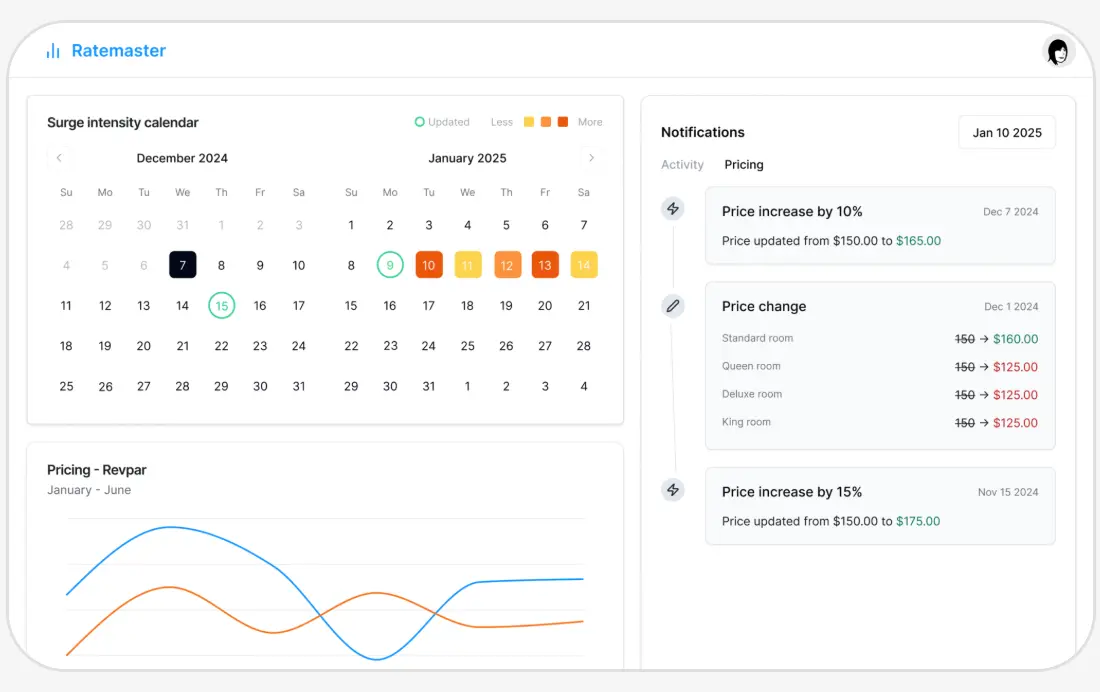
Understanding when demand will rise or fall is key to maximizing revenue and occupancy. ampliphi RMS integrates predictive insights from the AI Optimization engine with Competition Monitoring and Rate Calendar tools to give a clear picture of expected demand. The system highlights opportunities to proactively adjust rates or packages, giving your hotel a competitive advantage in the market. Hotels benefit in multiple ways:
- Quickly identifies days when demand is rising before traditional methods can detect trends
- Suggest pricing adjustments based on historical and real-time market signals
- Allow staff to focus on guest experiences while the AI monitors rates continuously
2. Optimizing multi-channel pricing
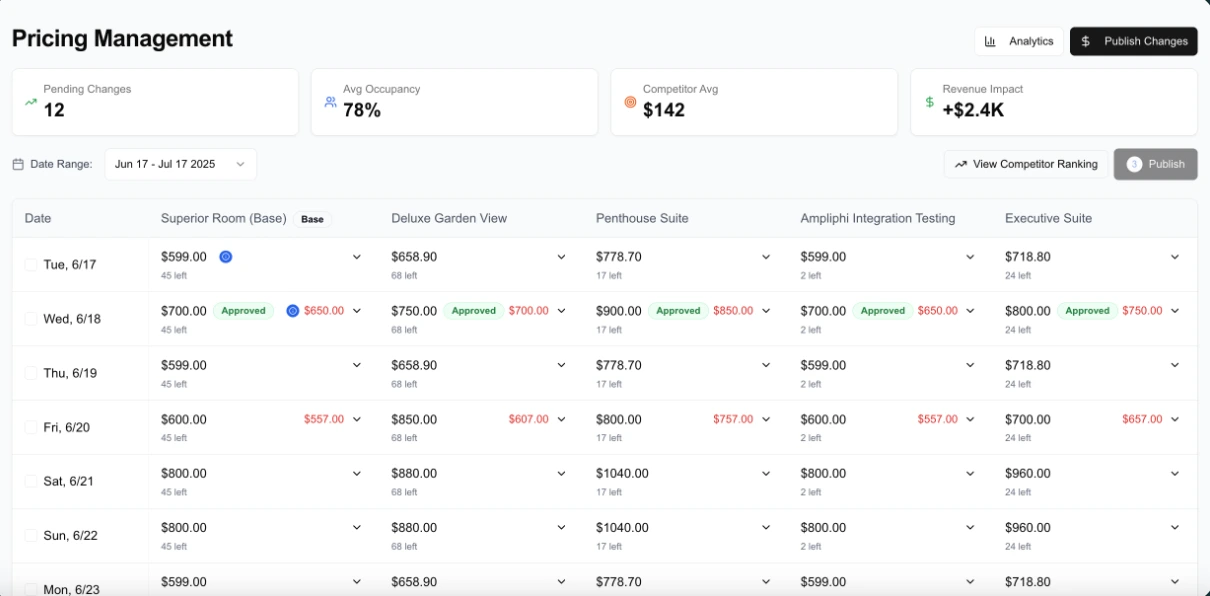
Managing multiple room types and online channels manually can lead to errors and missed opportunities. ampliphi RMS ensures that rates for all room categories and channels update dynamically without manual input. The platform monitors each booking source in real time and adjusts pricing intelligently. This allows you to:
- Keep all OTAs and direct booking channels updated simultaneously
- React to competitor and market changes instantly
- Reduce time spent manually adjusting rates and spreadsheets
Hotels that use this approach report faster adjustments and greater confidence in their pricing strategies.
3. Continuous learning and smarter decisions
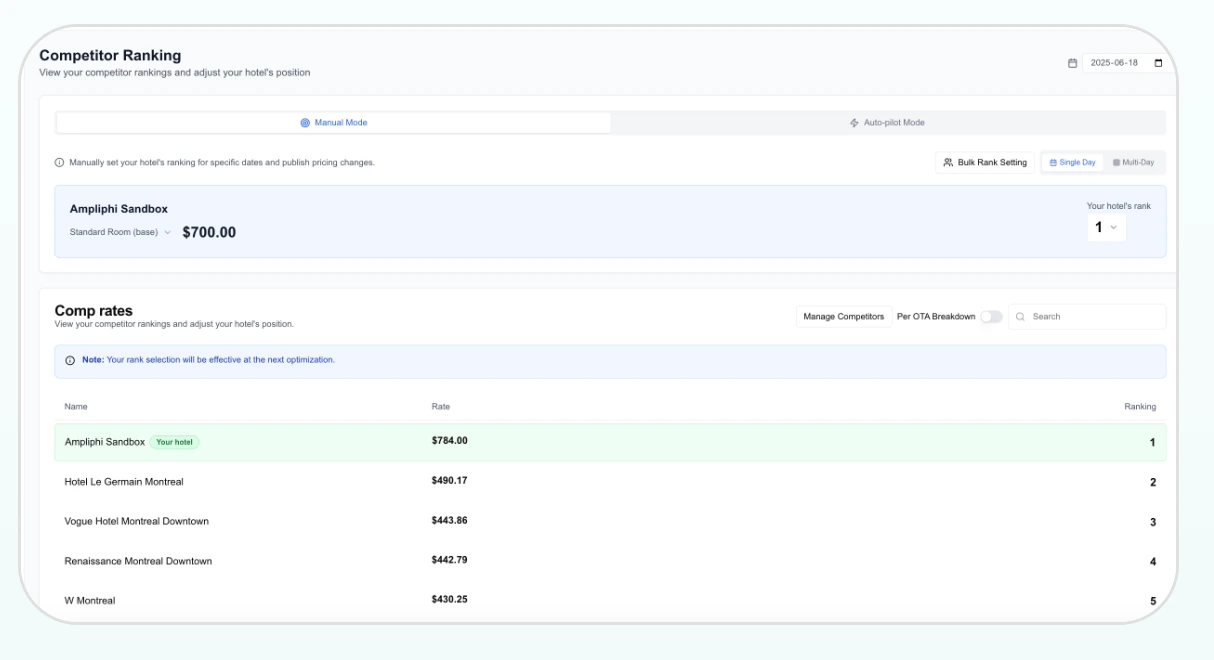
Unlike static pricing systems, ampliphi RMS learns from your hotel’s unique data. Every adjustment teaches the system which strategies work best, refining its recommendations over time. You can watch as the AI becomes smarter week by week, improving accuracy for demand forecasting and rate optimization.
- Recognize recurring booking trends and seasonal patterns
- Adjust strategies automatically as guest behavior changes
- Offer actionable insights that improve revenue per available room consistently
With these tools working together, your team can focus on guest experience while your rates are automatically optimized.
4. Turning insights into action

Finally, the predictive AI connects insights directly to your revenue strategy. By integrating demand forecasting, competitive monitoring, and dynamic rate recommendations, ampliphi RMS transforms data into decisions you can act on immediately. Hotels can:
- Reduce time spent on spreadsheets and manual rate updates
- Improve RevPAR by up to 35% by responding instantly to demand shifts
- Empower staff to prioritize marketing, guest experiences, and operational tasks
Using ampliphi RMS with its AI Optimization engine turns complex revenue management into a manageable, high-impact process, helping hotels grow revenue and improve operational efficiency without sacrificing quality.
Future-Proof Your Hotel Revenue Strategy
Revenue management in hospitality will increasingly combine artificial intelligence, customer lifetime value insights, personalized pricing, and loyalty-focused strategies to maximize long-term profitability. Hotels that embrace predictive AI gain:
- Accurate demand forecasting
- Dynamic pricing across segments and channels
- Reduced revenue leakage
- Greater operational efficiency
ampliphi RMS empowers hoteliers to implement predictive revenue management with ease. Its AI engine learns continuously, monitors market conditions, and delivers actionable rate recommendations that maximize revenue while maintaining competitive positioning.
Start optimizing your hotel revenue today! Book a demo and see predictive revenue management in action.
FAQs
What is predictive revenue management?
Predictive revenue management uses data and analytics to anticipate hotel demand, optimize pricing, and improve profitability. It helps hoteliers make proactive decisions rather than react to market changes, maximizing revenue opportunities across all booking channels.
How does AI forecast hotel demand?
AI analyzes booking pace, competitor rates, local events, and historical trends to predict occupancy and ADR across multiple segments. ampliphi RMS uses these insights in real time to automatically adjust rates, detect surges, and guide hotels toward smarter pricing decisions.
How can predictive analytics improve RevPAR?
Predictive analytics identifies demand trends, pricing opportunities, and booking patterns to increase revenue per available room. ampliphi RMS leverages AI-driven insights to optimize rates, manage inventory dynamically, and capture more value from every booking across all channels.