Before hotels could think beyond “rooms and rates,” revenue management was often seen as little more than setting seasonal prices and hoping for the best. Fast forward to 2026, and the basics of hotel revenue management aren’t so basic anymore, nor are they optional.
In simple words, hotel revenue management is about selling the right room, to the right guest, at the right price, through the right channel, at the right time, and doing it profitably. But with margins narrowing on all sides, that formula has evolved. In fact, global hotel revenues are projected to exceed $1 trillion, driven by costly online travel agencies (OTAs), shifting guest behavior, and rising operating expenses.
However, many hotels struggle to translate top-line growth into real performance. This is why:
- Occupancy levels that fail to keep pace with rising revenue pressure
- Shorter booking windows as travelers book closer to arrival
- Increased reliance on online intermediaries and price comparison platforms
- OTA commissions that can reach 30%, along with rising guest acquisition costs
As a result, modern hotel revenue management strategies focus on demand forecasting, real-time price optimization, and technology-driven decision making to protect margins and drive sustainable revenue growth. This 2026 guide breaks down what that shift means in practice and explains how owners, general managers, and revenue teams can build a stronger, more resilient revenue strategy.

What Is Hotel Revenue Management?
Hotel revenue management refers to selling the right room to the right customer at the right time and price through the right channel.
That sentence might sound familiar, but its meaning goes deeper than pricing alone.
Hotel rooms are a classic example of perishable inventory. Think of a small city hotel on a Tuesday evening. A concert gets announced nearby at noon. A strong revenue team reacts immediately by adjusting rates, availability, and channel exposure. That reaction alone can separate average results from outstanding ones.
Because of this, hotels must make daily decisions that affect revenue growth and profitability in real time. Those decisions extend beyond rooms and include:
- Food and beverage
- Meetings and events
- Spa services
- Add-ons and experiences
The Core Principles of Hotel Revenue Management
Strong revenue management rests on a few timeless principles. Technology may evolve, but these foundations remain steady.
1. Perishable inventory
Every night, your hotel starts fresh with the same number of rooms. Unsold inventory from yesterday does not carry forward, which is a simple yet powerful reality.
This fact forces hotels to act early and plan ahead. In 2025, U.S. hotels saw revenue per available room (RevPAR) fall 9% below budget to $119.22. However, many properties held gross operating profit margins at 37.7 %, just 1.2 percentage points below target, by focusing on forecasting and cost control.
This indicates that hotels did not sell as many rooms or at high enough prices as they expected. Hotels adjusted their forecasts and tightened their plans to protect profit even as demand softened.
2. Demand forecasting
Forecasting demand means predicting how many rooms you will sell, at what price, and through which channels. Hotels look at past booking data, monitor how quickly rooms are filling up, and watch external factors like local events or market trends. This helps revenue teams plan staffing, set promotions, and adjust pricing with confidence.
Hotels use past data, current bookings, events, and market signals to make forecasts. Good forecasting helps hotels plan staff schedules, set prices, and run promotions confidently. Many hotels now use advanced tools, too. In fact, about 86.1% of hoteliers say they already use artificial intelligence (AI) for forecasting and demand analysis. AI helps forecast demand more accurately than older methods.
When hotels guess wrong, they lower prices too soon or miss opportunities to raise prices when demand increases.
3. Dynamic pricing
Static pricing no longer works in modern hospitality.
Dynamic pricing adjusts room prices based on demand levels, seasonality, local events, and competitor pricing. When demand rises, rates follow. When demand drops, pricing adapts to stay competitive. Hotels using dynamic pricing report that it can increase average daily rate (ADR) by 10 to 15% compared to older pricing methods.
For example, a seaside hotel during a holiday weekend might raise rates slightly as rooms sell, rather than suddenly. Guests find this acceptable because they see value in the rate they pay.
4. Customer segmentation
Hotels know that not all guests behave the same. For example:
- Business travelers often book at the last minute and prefer flexible policies
- Leisure guests usually book earlier and respond to package deals
- Group travelers often book far in advance and expect special pricing
Hotel loyalty programs also grow this idea. For example, Marriott’s loyalty program grew to nearly 260 million members in 2025, a 18% increase from the previous year. Hotels use this member data to understand guest behavior and tailor offers.
5. Distribution optimization
Every booking channel carries a cost. For example:
- Direct bookings bring higher margins
- OTAs bring volume but charge up to 25% in commissions
- Corporate contracts bring stability, but cap rates
Why Hotel Revenue Management is Important
At a business level, revenue management protects both top-line and bottom-line performance.
It helps hotels:
- Avoid underpricing during peak demand
- Reduce losses during slow periods
- Improve forecasting for staffing and budgeting
- Support smarter marketing decisions
Hotels that treat revenue management as a core business function gain a sustainable edge in the hospitality industry. They react faster, price smarter, and make decisions backed by data instead of instinct.
Key Components of Hotel Revenue Management
Revenue managers can spend years perfecting their skills, but the core of revenue management comes down to just a few key components. These components rely on both logic and practical experience. Understanding the basics can make a significant impact on your hotel’s profit.
When planning your strategy, it helps to consider them in this order:
- Data & analytics
- Inventory control
- Pricing & rate strategy
- Distribution management
- Upselling & cross-selling
1. Data & analytics
Everything starts with numbers and patterns.
Hotels analyze booking pace, cancellation trends, and market demand signals to understand performance. Clean and real‑time data helps managers make confident decisions. In fact, AI tools for forecasting and demand analytics can improve forecast accuracy by about 20% compared with older methods.
These analytics systems also help hotels track competitor pricing and guest behavior. Predictive revenue management systems can show when demand will grow or drop, helping hotels respond faster and avoid revenue losses.
2. Inventory control
Inventory control means deciding how to sell your rooms. It includes setting stay restrictions, managing when to close or open availability, and using overbooking strategies safely.
For example, during a big event, a city hotel might close one‑night stays so it can sell longer, higher‑margin bookings. Many modern revenue systems include tools that help hotels manage inventory and rates simultaneously, enabling real-time decisions across all channels.
3. Pricing & rate strategy
Pricing includes your core room rates, discounts, packaged offers, and minimum length-of-stay requirements. This means rates change based on demand, market conditions, and competitor rates, and AI‑enabled pricing tools can help update them many times a day.
Around 74% of hotels say real‑time dynamic pricing drives growth in their revenue management software. Dynamic pricing can increase revenue by matching prices to what guests are willing to pay at the moment. It also ties into forecasting and inventory control because hotels set prices based on expected demand and booking pace.
4. Distribution management
Hotels sell rooms through many channels, and each channel affects both cost and profit. Online travel agencies (OTAs) bring bookings but charge high fees, often 30% or more of the room price. To protect profit, hotels balance OTA bookings with direct bookings on their own websites, which cost less and generate higher margins.
Hotels also use other channels, including metasearch engines, regional OTAs, and the Global Distribution System (GDS). A broad mix increases visibility and volume, but hotels must carefully manage each channel to protect profit and avoid relying too much on high‑cost partners.
5. Upselling & cross-selling
Upselling and cross‑selling let hotels earn more from guests after they book a room by offering extra value. While upselling gives guests options like a better room, a meal plan, or additional services, cross‑selling provides add-ons such as spa packages, tours, or transportation.
When hotels use AI for upselling, they report 10% to 20% higher revenue from personalized offers. By offering relevant extras, hotels increase total revenue without spending more to acquire new guests. These offers also enhance the guest experience by providing options that match their interests, making them more likely to say yes.
How the Hotel Revenue Management Process Works
Most hotels follow a repeating lifecycle. This cycle repeats daily, sometimes hourly, especially during high-demand periods. Let’s understand what actually happens.
Step 1: Collect data
The cycle begins by gathering data on bookings, cancellations, guest behavior, and market trends. AI tools organize and clean this information, creating a solid foundation that feeds directly into forecasting and planning.
With accurate data at hand, managers can make informed decisions at every step.
Step 2: Analyze demand and forecast
Using the collected data, managers predict future bookings, occupancy levels, and pricing opportunities. They combine historical trends, real-time booking patterns, and AI analytics to improve accuracy.
Hotels that apply AI to forecasting reduce revenue losses and prevent overbooking. Accurate forecasts set the stage for effective market analysis and pricing decisions.
Step 3: Review the market and competition
Forecasting naturally leads to evaluating the competitive landscape. Hotels compare their predicted demand with competitors’ rates, promotions, and occupancy levels to assess their market position.
This step aligns the pricing and inventory strategies with market realities and highlights opportunities to capture higher revenue without leaving rooms unsold.
Step 4: Make pricing and availability decisions
Once the market is assessed, hotels set base rates, apply discounts, define minimum stays, and manage overbooking. Dynamic pricing tools adjust rates in real time based on demand, seasonality, and local events.
These decisions directly tie into distribution strategies, as availability and rates must reflect the channels through which rooms are sold.
Step 5: Adjust distribution channels
With pricing and availability set, hotels distribute rooms across channels such as direct websites, OTAs, metasearch engines, and corporate contracts. Direct bookings generate higher margins, while OTAs provide volume but charge commissions.
By carefully managing channel mix, hotels ensure that rates and availability are aligned with each platform, protecting profit while maintaining visibility.
Step 6: Monitor revenue performance
After implementing pricing and distribution strategies, hotels continuously track key metrics like RevPAR, ADR, and occupancy. Monitoring reveals which approaches succeed and which require adjustment.
According to recent studies, year-to-date RevPAR grew by 0.2%, driven by a 1.0% increase in ADR but offset by a 0.8% decline in occupancy. Hotels that follow structured revenue cycles see better results, and AI further enhances performance.
Step 7: Optimize continuously
Finally, hotels use performance insights to refine forecasts, adjust pricing, reallocate inventory, and fine-tune distribution channels. They repeat this cycle daily or hourly, especially during peak periods, ensuring rapid responses to changes in demand, competitor activity, and market trends.
Continuous optimization closes the loop and sets up the next data collection cycle, keeping the hotel agile and maximizing revenue over time.
Common Hotel Revenue Management Strategies
When we talk about proven hotel revenue management strategies, we’re no longer just talking about theory. Let’s look at how these strategies play out in the real world.
1. Dynamic and data‑driven pricing
Hotels using automated dynamic pricing strategies backed by high‑quality data are seeing measurable gains in revenue.
Industry research shows that implementing dynamic, data‑driven pricing can unlock up to 35% more revenue compared to traditional pricing approaches because rates adjust faster to actual market conditions and booking patterns.
2. Demand‑based rate adjustments
In 2024 and 2025, global hotel demand rose sharply, with nearly 4.8 billion room nights booked. Plus, RevPAR grew by about 3.7% globally, driven by strong leisure demand and major travel events, including major sports tours and destination moments. [](https://www.hospitalitynet.org/news/4125973.html?utm_source=chatgpt.com)
This highlights why adjusting rates based on actual demand, not just calendar seasons, matters more than ever.
3. Event and local impact pricing
Hotels near major events, such as festivals, music tours, and international competitions, routinely see a spike in bookings. In 2025, markets that hosted events like global tours and destination expos showed RevPAR well above average.
This strengthens why event‑based pricing tied to local events is a strategy that drives real revenue upside.
4. Channel optimization across OTAs and direct bookings
Hotels are actively reshaping how they capture reservations because where a booking comes from now drives profitability just as much as how much it costs.
In 2024, direct bookings through hotel websites produced 60% more value per booking than bookings from traditional OTAs. On average, an online direct reservation generated about $519 per stay, compared with roughly $320 via OTAs. That means hotels keep more value, earn more from each guest, and avoid losing commission to third parties.
Despite this, OTAs still drive 55% of all bookings, with direct sites at 25%. For revenue leaders, this data translates into a clear opportunity:
- Direct reservations are more profitable
- Direct guests often spend more on upsells and upgrades
Tactics Hotels Use to Increase Revenue
Smart hotels focus on actions that compound over time. This includes:
- Reducing reliance on OTAs
- Improving direct website conversion
- Personalizing offers based on guest preferences
- Increasing ADR without hurting occupancy
Revenue Management Tools & Technology Explained
A revenue management system refers to a software tool that uses algorithms and data to recommend pricing and availability decisions. These tools analyze booking pace, demand signals, and market trends to suggest optimal room rates and restrictions in real time.
Manual revenue management still relies heavily on experience, which can work, but only up to a point. When demand shifts quickly or multiple channels need updates at once, manual processes struggle to keep up. Automated tools step in here and support data analysis at scale, helping hotels respond faster and more confidently.
This shift has changed how smaller and independent hotels approach pricing. Instead of reacting late, they now anticipate demand and act early.
This is where an AI-powered revenue management software like ampliphi RMS fits in. Here is how it supports modern revenue management in practice.
1. Anticipating demand fluctuations
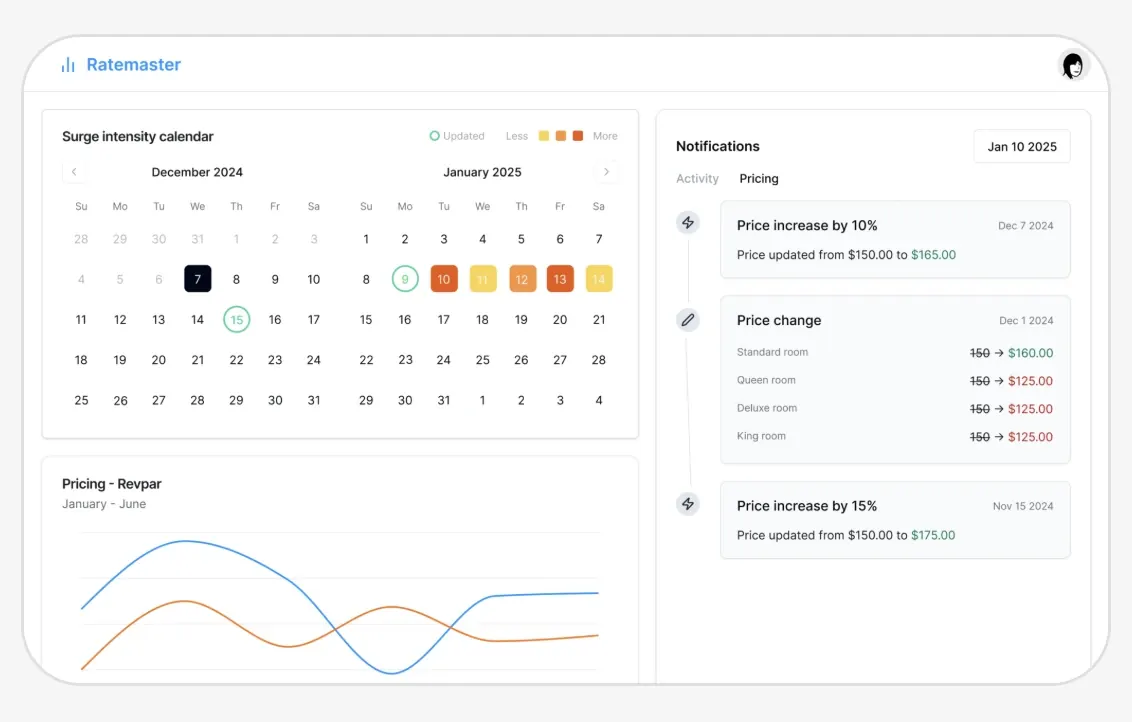
Hotels need early signals, not late surprises. ampliphi RMS combines an AI optimization engine with competition monitoring and a rate calendar to help teams spot changes in demand before they fully show up in bookings. Instead of waiting for pickup to spike or slow down, teams see trends forming and adjust rates or packages in advance.
For example, if demand starts rising quietly due to a citywide conference or travel surge, the system highlights that window early. Staff can respond calmly, protect rate integrity, and avoid rushed decisions later.
This approach helps hotels act with confidence, protect revenue potential, and focus more on guests rather than on constant manual checks.
2. Optimizing multi-channel pricing
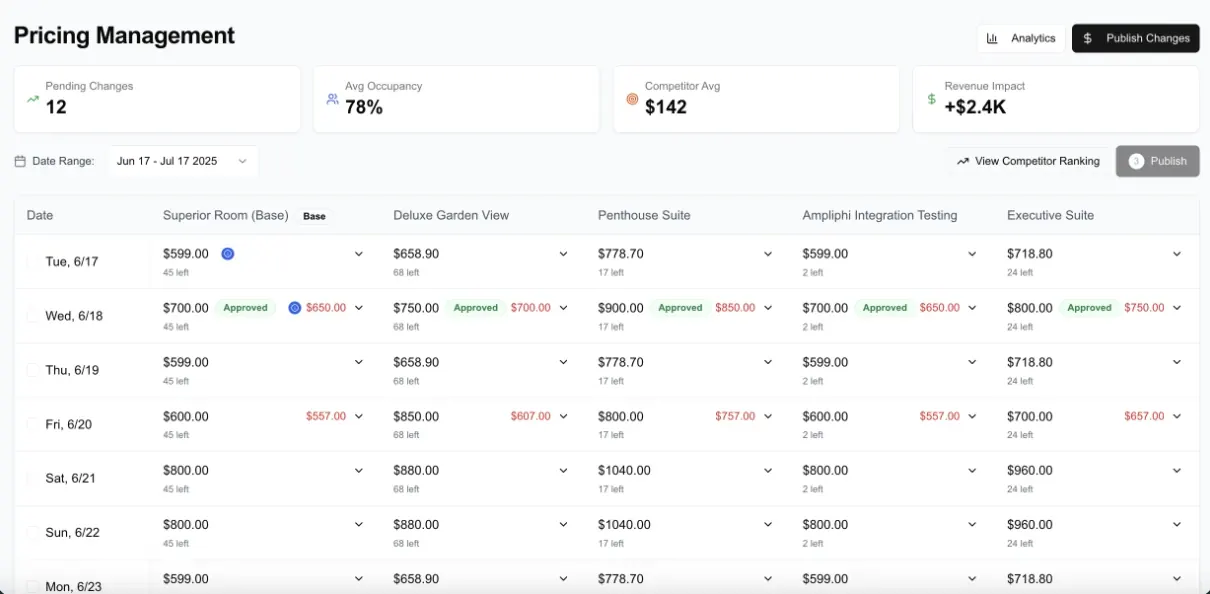
Managing multiple room types across many distribution channels creates daily pressure.
ampliphi RMS updates rates dynamically across all room categories and booking channels without manual input. The platform monitors each source in real time and adjusts pricing intelligently based on market movement and competitor behavior.
That means hotels can:
- Update the direct and OTA channels together
- React quickly to competitor changes
- Reduce time spent on spreadsheets and repetitive tasks
3. Transparent tracking and performance insights
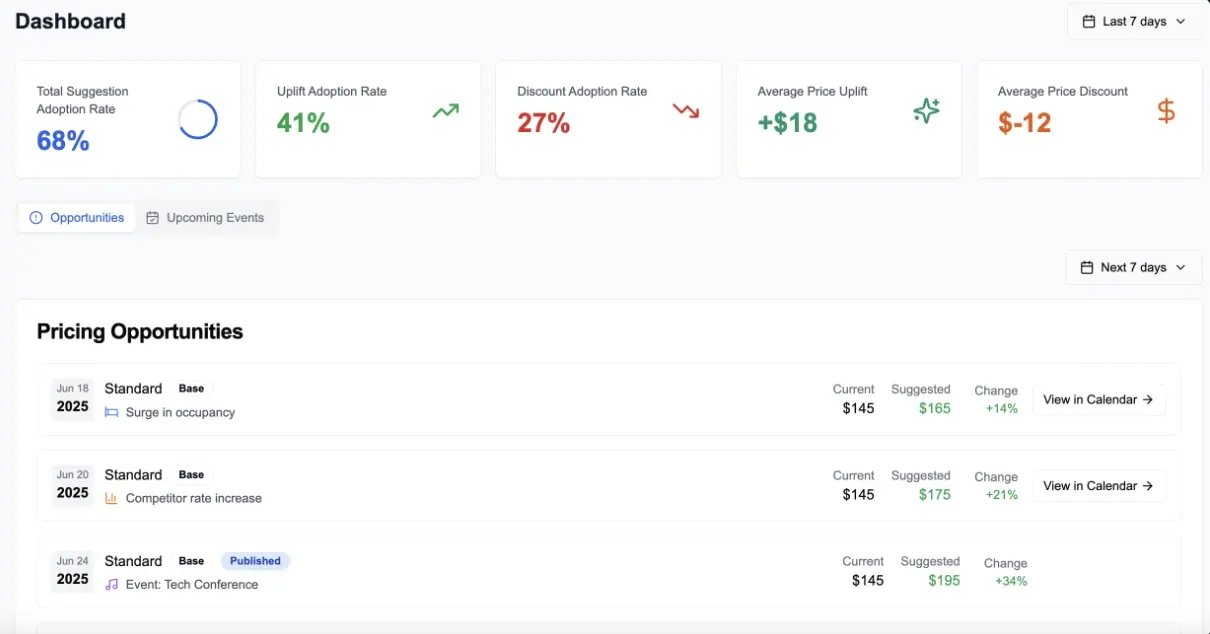
Automation only works when teams understand the impact. ampliphi RMS provides clear dashboards that show how pricing changes affect overall financial performance. Teams can track trends, compare outcomes, and review results without disrupting their strategy.
Every adjustment connects to visible results. That transparency builds trust in the system and supports better revenue management decisions throughout the year.
Ultimately, teams no longer guess what worked. They can see it.
4. Visibility and control across the portfolio
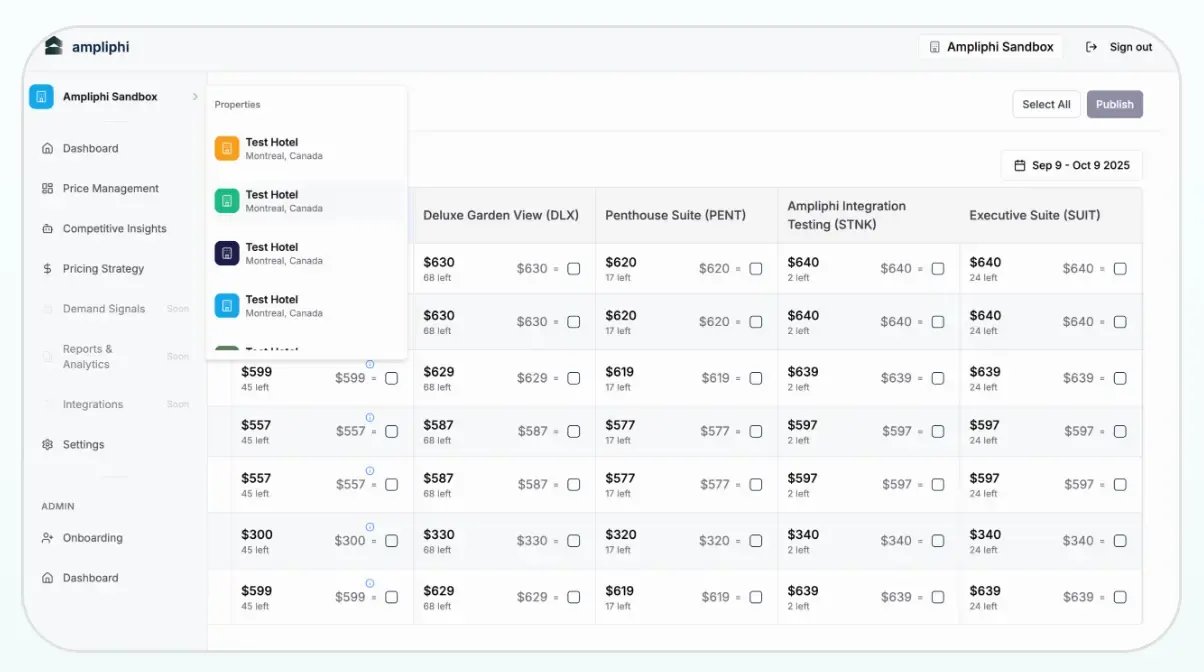
For hotel groups, visibility matters as much as flexibility. ampliphi RMS gives leaders a single place to track rates, occupancy, room types, and performance across all properties. Users can switch between hotels, review portfolio-level patterns, and apply broad rules when needed.
At the same time, each property retains the freedom to adjust pricing based on local demand and on-the-ground realities. This balance helps teams manage complexity while staying responsive to individual markets.
The Future of Hotel Revenue Management (2026 and Beyond)
The way hotels manage revenue management decisions is changing faster than ever before. What used to be a mix of experience, rules, and spreadsheets is now becoming predictive, automated, and fully data-driven in 2026.
Here’s what defines the future.
- AI-led forecasting becomes standard. About 82% of hotel brands use AI for revenue management and dynamic pricing, and most report stronger pricing performance as a result.
- Automation replaces manual rate checks. More than 72% of mid-scale to luxury hotels globally rely on automated revenue optimization tools to manage room pricing, demand forecasting, and distribution efficiency.
- Revenue data connects across systems. Hotels increasingly link PMS, CRS, and CRM data so pricing reflects real guest behavior, not isolated reports.
- Revenue expands beyond rooms. Hotels use smarter tools to optimize food and beverage, upgrades, and experiences as part of one revenue strategy.
Revenue Management as a Growth Engine
When done right, revenue management aligns pricing, inventory, distribution, and marketing into one clear, coordinated approach.
Teams stop making isolated decisions and start working toward shared goals. Rates reflect real demand. Inventory supports profitability. Channels work together instead of competing with each other. The result is stronger control over the hotel’s revenue and more consistent improvements in financial performance.
Tools like ampliphi RMS help make this shift possible. By combining AI-driven insights with clear visibility and practical control, ampliphi empowers hotels to move from reactive pricing to confident, forward-looking decisions.
Book a demo today and explore how ampliphi RMS can support smarter revenue decisions for your property.
FAQs
What are the basics of hotel revenue management?
The basics of revenue management include forecasting demand, setting the right prices, managing room availability, and choosing the most profitable distribution channels.
What is the main goal of revenue management?
The main goal is to sell the right room to the right guest at the right time and price. ampliphi RMS can help hotels achieve this by analyzing market trends and guiding smarter pricing decisions for better profitability.
How does hotel revenue management work?
Hotel revenue management works through a continuous cycle of data collection, demand analysis, pricing, inventory control, and performance monitoring. It ensures hotels respond effectively to fluctuating demand and changing guest preferences.
What tools are used for hotel revenue management?
Hotels use analytics dashboards, forecasting tools, and revenue management systems to guide decisions. ampliphi RMS combines AI forecasting, dynamic pricing, and competition monitoring in one platform, making these processes faster and more reliable.
Why is revenue management important for hotels?
Revenue management protects profitability during periods of high demand and limits losses when demand slows. It also helps hotels optimize distribution channels and maintain competitive positioning.
What is the difference between pricing and revenue management?
Pricing focuses on setting room rates, while revenue management integrates pricing, inventory, and channel strategy. This approach ensures maximized revenue growth rather than just adjusting rates.
How does AI improve hotel revenue management?
AI improves accuracy, speed, and consistency by analyzing large data sets, forecasting demand, and suggesting optimal pricing. It helps revenue managers make data-driven decisions that improve both occupancy and revenue per available room.

Written by the team at Ampliphi, the revenue management system for independent hotels.
View full profile →Put a number on the nights you sell out too early and the nights that sit empty. Prefer someone to look at it with you? The revenue audit is free, and if your pricing is broadly right, we will say so.