

Education
What Is Revenue Management Software? A Complete Guide for Hoteliers
Revenue management software helps hotels optimize pricing, forecast demand, and maximize revenue. Here's everything you need to know.
7 min read
Price
Watch
By property
Learn
The market for hotel RMS is on track to nearly triple by 2031. Here is what it is, why hotels need it, and how to choose.
Revenue pressure has increased for hotels as demand patterns shift quickly across all markets. Hotels now need faster pricing choices that use market data and clear signals from guests. In fact, the global demand for hotel revenue management systems reached $10.50 billion in 2024 as operators adopted automation. Research shows the market may reach $29.43 billion by 2031 as more hotels adopt smarter tools.
Modern revenue management hotel software uses internal and external data to support stronger pricing strategies for every property. A revenue manager gains clearer visibility, quicker decisions, and tighter control over room revenue across channels. These tools support dynamic pricing and give hotels a reliable management system to maximize revenue each day.
This guide explains how a strong revenue strategy platform works and how ampliphi RMS supports these needs.
A hotel revenue management software is a system that helps hotels forecast demand, automate pricing, and manage room inventory across seasons, channels, and room types. The system draws from market trends, booking history, occupancy patterns, and competitor data points to set optimal rates.
It extracts data from multiple sources and applies data-driven decision making to recommend ideal pricing strategies. The software then pushes rate changes automatically to all booking channels and supports effective revenue management.
Many hotels see revenue growth of up to 35% after using such systems because they adapt quickly to demand fluctuations. This form of hotel revenue management gives staff time back and strengthens overall pricing control.
The RMS market grows at an 8.7% CAGR as AI and machine learning reshape revenue decisions, which makes it important to know what strong systems must deliver. Here are the core features you should expect in modern revenue management software for hotels:
Hotels often struggle to match room rates with shifting guest demand and competitor pricing. A hotel revenue management software helps them set smarter prices and improve overall results.
Here’s how:
Hotels using modern RMS can lift their average daily rate (ADR) significantly by analyzing market demand and competitor pricing continuously. A 2025 study shows properties that applied AI-driven pricing tools increased ADR by 10-15% compared to traditional methods.
RMS allows revenue teams to set optimal pricing daily, forecast demand, and capture peak pricing opportunities, ensuring that each room contributes maximally to overall revenue.
Revenue systems also help hotels manage bookings and occupancy efficiently across different channels and seasons. In fact, recent reports indicate that properties integrating forecasting demand tools improved occupancy by up to 15%.
The system helps revenue teams analyze booking trends, adjust rates in real-time, and allocate rooms strategically. This allows independent hotels to compete with larger chains without sacrificing revenue, while maintaining a steady flow of guests during low-demand periods.
A modern RMS automates pricing updates and inventory management based on real-time market demand, reducing manual errors and workload. Revenue teams receive actionable insights instantly, allowing them to focus on revenue strategy instead of routine tasks.
Hotels using automation report faster reactions to competitor pricing and enhanced operational efficiency. Automation also provides consistent pricing across all distribution channels, helping to maximize profitability without constant human intervention.
Integrating a revenue system with booking engines and a channel manager reduces time spent on daily price adjustments, reports, and occupancy tracking. Operators report saving several hours per day, allowing staff to focus on guest satisfaction and strategic initiatives.
Hotels can then dedicate time to improving guest experiences, marketing, or other operational priorities.
AI-powered revenue systems improve forecast accuracy for bookings, market demand, and competitor pricing trends. In 2025, hotels using AI tools reported a 20% improvement in forecasting accuracy, helping revenue teams make more informed pricing decisions and plan promotions strategically.
This system allows hotels to dynamically adjust room rates, optimize revenue, and maximize profitability with minimal human error, giving smaller properties the advantage to compete effectively in the hospitality market.
Now that we have a fair understanding of the revenue management software and its benefits, let’s take a look at how it operates:
To begin with, the system gathers historical data on past bookings, occupancy, and room rates. Revenue teams analyze this data to identify trends and predict peak demand periods accurately.
This step helps hotels understand guest behavior and anticipate future booking patterns across all sales channels.
Next, the software collects external data such as competitor rates, local events, and market demand changes. Combining this with internal data gives a full picture of the market, allowing hotels to adjust pricing quickly.
Revenue teams use this information to respond effectively to shifts in the hotel industry.
The system evaluates all revenue streams, including rooms, dining, and services, to prioritize high-value areas. Hotels can identify underperforming services and make data-driven decisions that improve the hotel’s profitability.
This analysis helps managers allocate resources efficiently and target strategies for maximum return.
The software then produces actionable insights on bookings, cancellations, and occupancy trends. Revenue teams use these insights to make informed decisions immediately, adjusting pricing and promotions across multiple sales channels.
Quick responses help capture revenue that might otherwise be lost.
The tool provides suggestions for smarter pricing based on trends, competitor rates, and historical performance.
Hotels can apply these recommendations directly to room rates, improving revenue per available room and maintaining competitiveness across all channels. This step simplifies complex pricing decisions for staff.
Then, the system updates rates automatically across all sales channels in real time.
Revenue teams can react instantly to market demand and competitor pricing, maximizing occupancy and overall profitability without manual intervention.
Revenue teams track performance and adjust strategies using dashboards and alerts.
This step helps hotels turn data into actionable decisions that capture additional revenue opportunities and maintain high profitability.
Finally, the software generates business intelligence reports that show trends, revenue successes, and areas needing improvement.
Teams use these insights to refine pricing strategies and optimize overall performance consistently.
📌Also read: How To Calculate The ROI Of Switching To AI Revenue Management Software
Maximizing revenue doesn’t have to be complicated. Here’s how ampliphi RMS is redefining how independent, smaller hotels approach pricing and profitability:
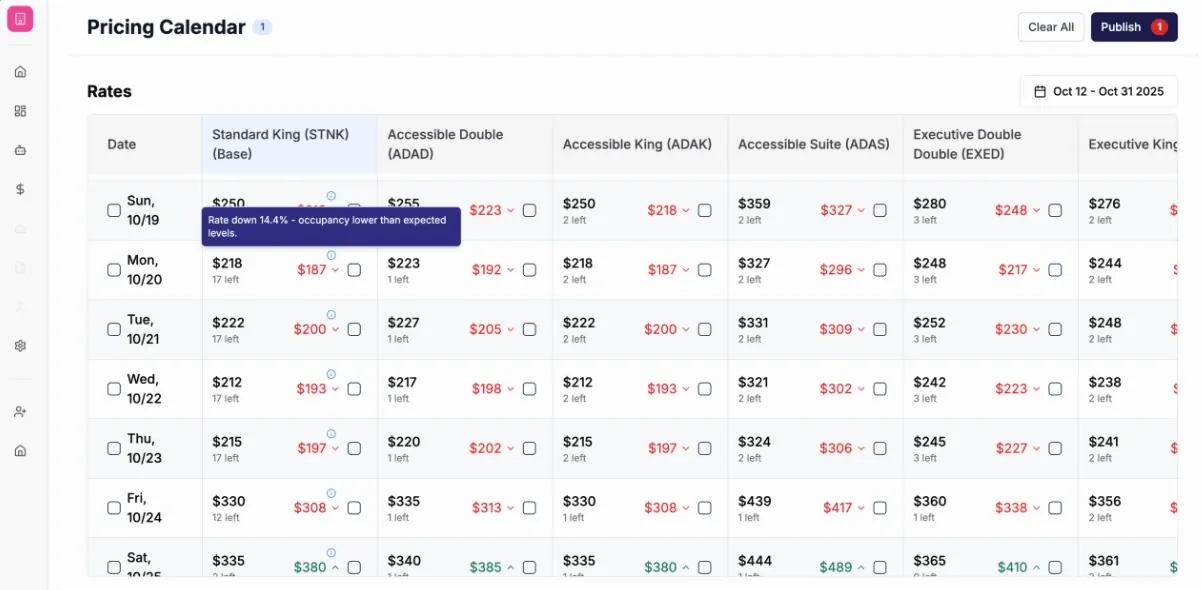
Artificial intelligence (AI) is transforming how hotels approach revenue management, turning complex data into actionable insights. ampliphi RMS uses predictive forecasting and demand intelligence to improve occupancy forecasts and revenue consistency.
The system analyzes booking data, historical patterns, competitor rates, and occupancy trends, and recalculates prices as often as every three hours. Independent hotels report over 33% higher forecast accuracy. AI gives revenue teams actionable insights for informed pricing decisions and optimal pricing strategies.
This allows properties to react to market demand quickly and capture revenue opportunities efficiently.
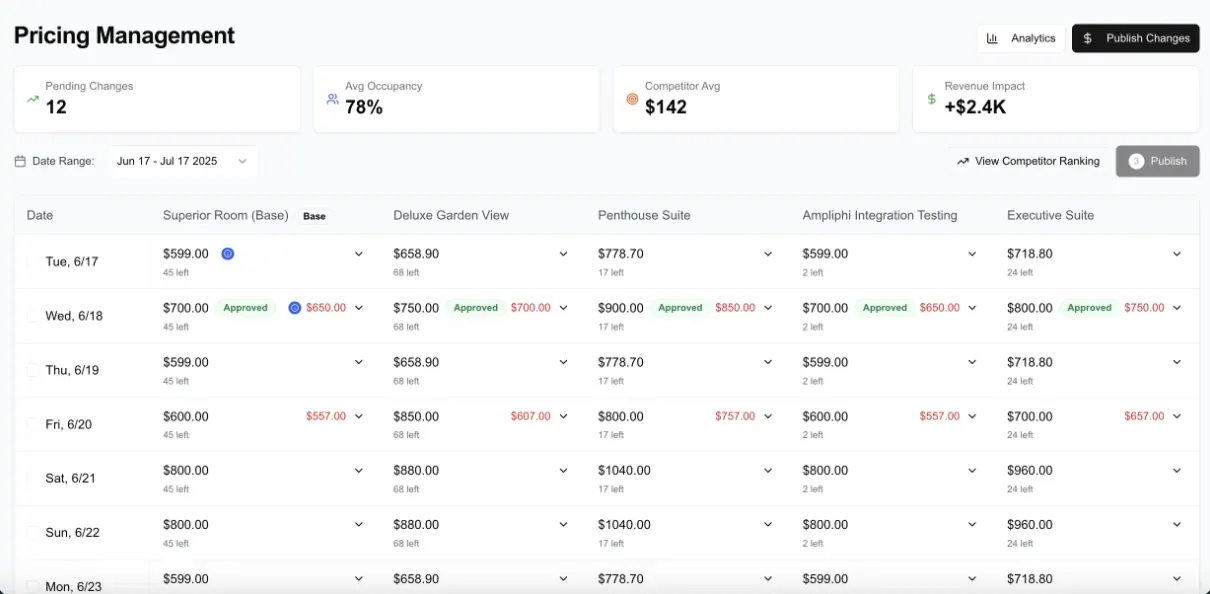
Manual pricing adjustments consume hours smaller hotels cannot spare. ampliphi RMS applies dynamic pricing automatically based on occupancy, pacing, and competitor movements. The system:
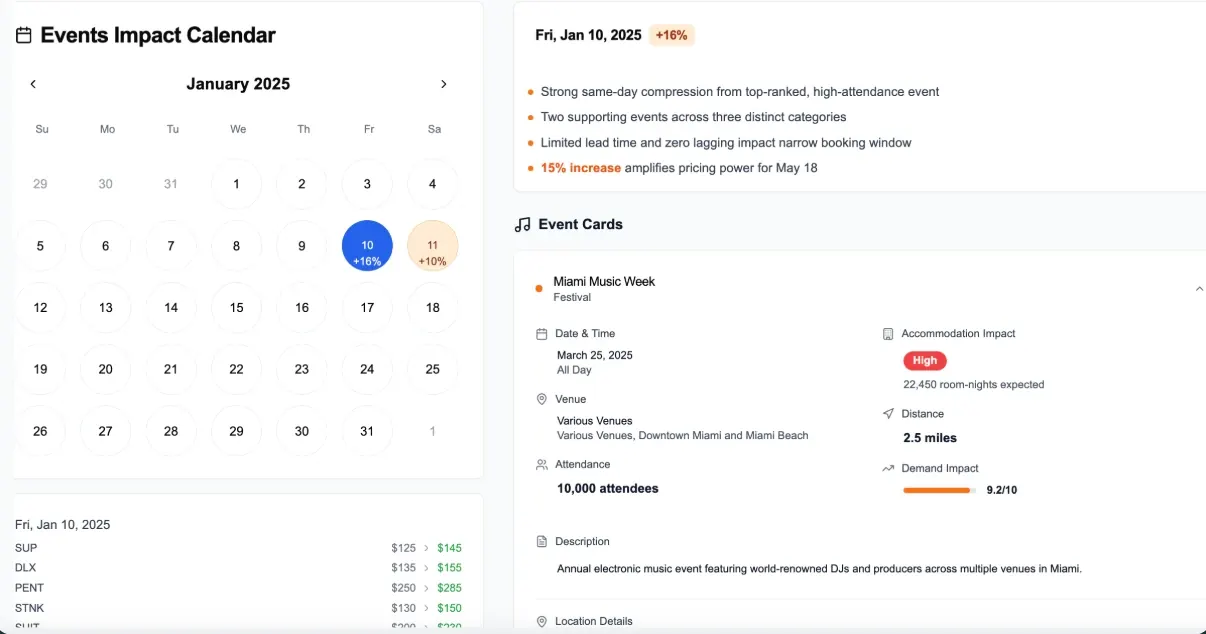
ampliphi RMS integrates with your PMS in minutes and starts pulling in your data right away. As a result, you can:
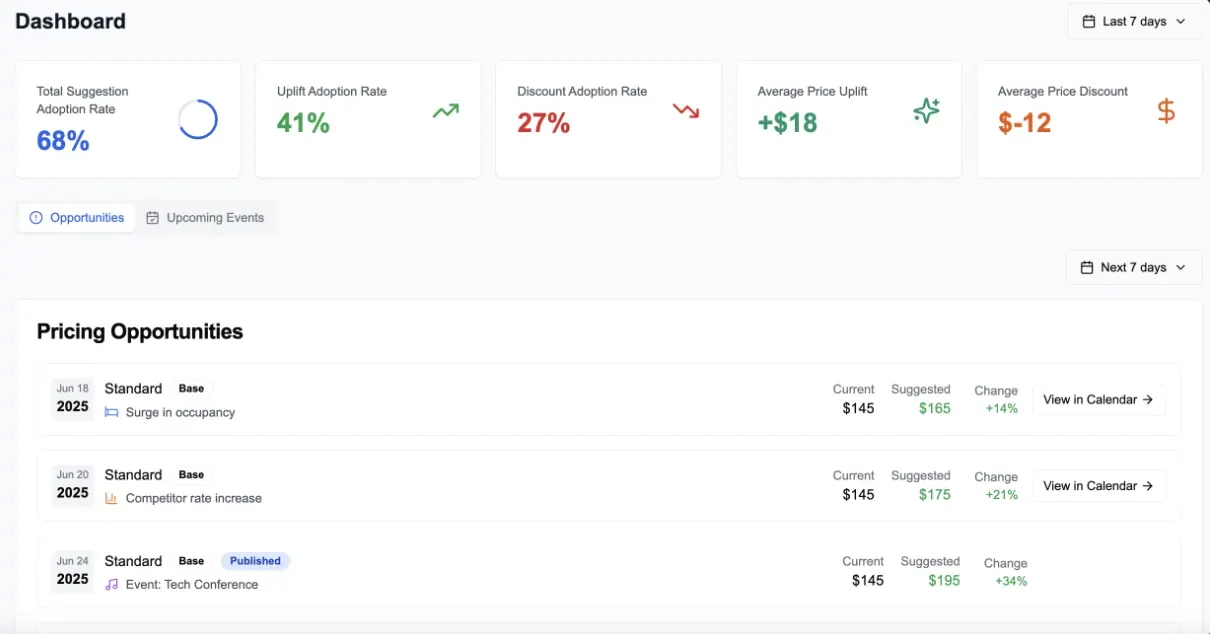
Hotels cannot monitor local events, competitor activity, and demand spikes as large chains do. ampliphi RMS provides full visibility by gathering market intelligence every night and translating it into actionable insights. The system helps hotels:
ampliphi RMS integrates with hotel management software, channel managers, and other hospitality tools to provide seamless workflow. With this platform, you can:
Selecting the best revenue management software can significantly improve occupancy, pricing decisions, and hotel profitability. Focus on features that impact daily operations and long-term revenue performance:
According to a recent industry report, over 68,000 travel and hospitality businesses implemented RMS solutions in 2024 to respond to shifting demand and pricing volatility. Meanwhile, hotels using modern RMS platforms reported average revenue improvements between 15% and 22%, along with higher occupancy accuracy.
These statistics represents a growing window of opportunity. On the other hand, market surprises happen often, including last‑minute cancellations, sudden demand spikes, or unexpected local events, which can either empty your rooms or fill them fast. A system like ampliphi RMS reacts quickly, recalculating prices automatically as often as every three hours to suit demand changes and safeguard your bottom line.
However, your judgment stays central. You can decide how aggressively to set pricing rules and when to intervene to preserve your hotel’s brand identity and guest promise. ampliphi RMS equips you with powerful tools so you can compete with large chains while maintaining your unique charm.
Schedule a demo today and discover how ampliphi’s AI‑powered RMS can transform how you manage revenue.
Revenue management software is a system that helps hotels optimize pricing, occupancy, and revenue streams effectively. It analyzes historical data, market demand, and competitor pricing to guide informed pricing decisions and maximize profitability across all rooms and sales channels.
A hotel RMS software should include predictive forecasting, real time pricing, competitor rate monitoring, and automation. It must also provide actionable data analysis and integrate with PMS and channel managers for complete revenue optimization.
The best revenue management software adapts to market changes and improves operational efficiency. ampliphi RMS offers AI-driven insights, dynamic pricing, and automation to maximize occupancy and revenue for independent hotels effectively.
RMS increases hotel profitability by adjusting prices based on demand, occupancy, and competitor activity. It captures missed revenue opportunities, improves forecast accuracy, and helps revenue teams make smarter pricing decisions consistently.

About the author
Ampliphi TeamEditorial teamWritten by the team at Ampliphi, the revenue management system for independent hotels.
View full profile →Free tool · No email
See how much guesswork is costing you
Put a number on the nights you sell out too early and the nights that sit empty.
Use the Pricing Guesswork CalculatorEducation
Revenue management software helps hotels optimize pricing, forecast demand, and maximize revenue. Here's everything you need to know.
7 min read
Education
A modern primer on hotel revenue management, what's changed, what hasn't, and the disciplines that drive RevPAR in 2026.
6 min read
Education
Why revenue management is now central to hotel profitability, and how AI, real-time analytics, and dynamic pricing are reshaping the discipline.
8 min read
Book 30 minutes and see ampliphi on your own competitors, events and nights. No slides.
Not ready to talk? Try ampliphi Intelligence free for 30 days →