

TL;DR
|
Do you feel in control of your pricing decisions each day? Or does it feel like market trends keep shifting faster than you can respond?
As a hotel revenue manager, you likely recognize both sides. There are days when room rates align with demand, and your revenue strategies feel solid. Then, there are moments when competitor pricing changes overnight, and your plans need a second look before the day even begins.
This is where things start to change. Hotel revenue forecasting automation helps revenue managers move from constant reaction to a clearer direction. Instead of piecing together data manually, you begin to see patterns, adjust more quickly, and make decisions with greater confidence. In fact, hotels using advanced analytics are steadily improving pricing accuracy and demand forecasting. At the same time, industry studies show AI-driven systems can lift RevPAR by up to 35%.
In this guide, you’ll learn how hotel revenue automation works, how they help hotels increase RevPAR, improve operational efficiency, and unlock smarter revenue strategies.

What is Hotel Revenue Automation?
Hotel revenue automation refers to the use of automation, artificial intelligence (AI), and advanced analytics to manage pricing, demand forecasting, and inventory decisions. It transforms hotel revenue management from a manual process into a data-driven system.
Instead of guessing which rooms will sell, revenue managers can see patterns in historical bookings, market trends, competitor pricing, and local events. The system then provides recommendations for room rates that fit each moment of demand.
As a revenue manager, you might hear the terms “hotel revenue automation” and “revenue management automation” used almost interchangeably. They are closely related, but they are not exactly the same.
Hotel revenue automation is a broader, more descriptive term that explains how technology helps manage pricing, forecasting, and inventory decisions. Revenue management automation (RMA), on the other hand, is a formal, industry-style label that highlights the use of advanced technology to handle complex, data-driven tasks aimed at maximizing hotel revenue.
Why Manual Revenue Management Holds Hotels Back
Manual revenue management worked when demand patterns stayed predictable. That reality no longer exists.
Today, the hospitality industry faces constant fluctuations, with daily demand changes, guests instantly comparing prices, and competitors updating rates in seconds. These limitations affect hotel profitability, occupancy levels, and total revenue.
Here’s why clinging to manual processes can seriously hold your hotel back:
1. Slow decision-making
When your team has to analyze market data by hand, it can take hours or even days to decide on pricing. And every hour of delay is a missed opportunity. By the time a price is updated, demand might have already shifted.
Automated revenue management systems eliminate that lag. They handle the number-crunching instantly, letting revenue managers focus on strategy, growth, and smarter pricing decisions.
2. Missed opportunities
Ever had a sudden spike in bookings, only to realize your rates didn’t move fast enough? That’s lost revenue that could have been captured with timely adjustments.
Automated systems help independent hotels avoid missed revenue opportunities by ensuring timely adjustments to pricing and inventory management.
3. Human errors
Manual updates are risky. One typo, one overlooked rate, and suddenly a room is underpriced.
Or worse, the room is suddenly unavailable when you could have sold it. These mistakes eat into your occupancy and profit. Automated revenue management systems can reduce human errors in manual processes.
How Hotel Revenue Automation Works

Think of a revenue automation system as your hotel’s invisible helper. It pulls information from everywhere, including your past bookings, current occupancy, competitor rates, local events, and market trends.
Then, it looks at all that data and tells you the best price for each room at that exact moment.
Most systems can even update your rates automatically on your website and connected OTAs. You set simple rules, like the lowest and highest prices you want to offer, and the system follows them while you focus on running the hotel.
Some platforms, such as the AI-powered ampliphi RMS, take it further. It forecasts demand and shows dashboards that help you plan staffing, promotions, and room availability. Instead of staring at spreadsheets for hours, you can make smart decisions without getting lost in numbers.
For example, a 120-room city hotel notices more midweek bookings during conference season. The system spots the trend early and raises rates automatically. The hotel earns extra revenue without anyone having to rush through manual updates.
The Revenue Benefits of Automation
The effects of revenue automation reach far beyond pricing alone. When a hotel begins using modern systems that act on real-time data, the results show up all over the business.
Here are some of the top benefits of using hotel revenue automation:
1. Higher profitability
One of the clearest ways automation helps is through higher profitability. Hotels that use AI‑powered revenue management tools regularly see noticeable improvements in key revenue metrics.
In fact, recent industry research found that properties deploying dynamic pricing strategies reported RevPAR increases of 12 to 18% compared with hotels still using manual methods. That’s a real difference in profit at the end of the month and year.
2. Faster growth
Automation also opens the door to faster growth. When pricing moves with the market instead of after it, revenue per available room tends to climb steadily. In a global study of nearly 600 properties using automated revenue systems, average revenue grew by about 19% after implementation, with both ADR and occupancy improving together.
Additionally, 93% of hoteliers reported that advanced analytics were “effective” or “very effective” at optimizing market mix and driving revenue growth. These tools help hotels grow steadily while making smarter, faster decisions.
3. Better guest experience
More than just numbers, these systems often help hotels deliver a better guest experience. Smart revenue platforms can integrate guest data to make offers feel personal rather than generic. That means recommending room upgrades or add‑ons that fit the kind of stay a guest really wants.
In broader digital transformation statistics, AI‑driven personalization efforts have been shown to increase guest satisfaction scores by 24%, helping hotels connect more deeply with their customers.
4. Increased ancillary revenue
Another benefit comes from increased ancillary revenue. Today, incremental revenue growth from sources beyond rooms is at an all-time high.
Recent industry reports show that 30 to 40% of additional revenue growth comes from dining, spa, wellness, and other guest services when supported by automated insights that coordinate pricing, packaging, and promotions.
5. Time savings
As automation takes over repetitive updates and data calculations, teams can redirect their energy toward better guest engagement and strategic planning. For example, advanced revenue systems can significantly reduce the hours spent on routine tasks, allowing hotel staff to focus more on welcoming guests and improving service.
More specifically, 96% of hoteliers said advanced systems reduce the time and cost associated with traditional pricing tactics, giving teams more space to focus on welcoming guests and improving service. Staff spend less time buried in spreadsheets and more time creating experiences that keep guests coming back.
Hotel Revenue Automation and RevPAR: Why the Link Matters
RevPAR might seem like a simple number, but it tells a story about more than just rooms sold. It measures how well a hotel fills rooms at rates that actually make money. When a hotel sells more rooms at better prices, RevPAR rises.
Revenue automation systems help hotels do exactly that. They track real-time demand, competitor pricing, and booking patterns so managers can adjust room rates quickly, rather than relying on outdated data or gut instinct. That responsiveness directly impacts RevPAR, helping properties earn more from the same inventory.
Hotels using automated pricing report occupancy gains alongside higher average daily rates. Operational costs also fall, sometimes by as much as 25%, and guest satisfaction climbs when AI-powered systems handle repetitive tasks efficiently.
Investments in hospitality technology are booming. Over the past 18 months, venture capitalists have quietly invested more than $1.2 billion in technology companies reimagining how hotels operate.
At the same time, the hospitality AI market itself has grown from $15.69 billion in 2024 to a projected $20.47 billion this year, reflecting rapid sector growth.
All of these point to one clear link, that revenue automation strengthens RevPAR, giving hotels a healthier, more balanced revenue picture.
Key Use Cases for Hotel Revenue Automation
Here are some of the most important use cases that show how hotels are putting revenue automation to work in their day-to-day operations.
1. Dynamic pricing optimization
Dynamic pricing means adjusting room rates in response to real‑time demand, market trends, and competitor rates. Modern systems analyze all this data every second, and hotels that use them report noticeable revenue improvements. Properties with AI‑driven pricing often see increases in ADR, occupancy, and overall revenue compared with static pricing models.
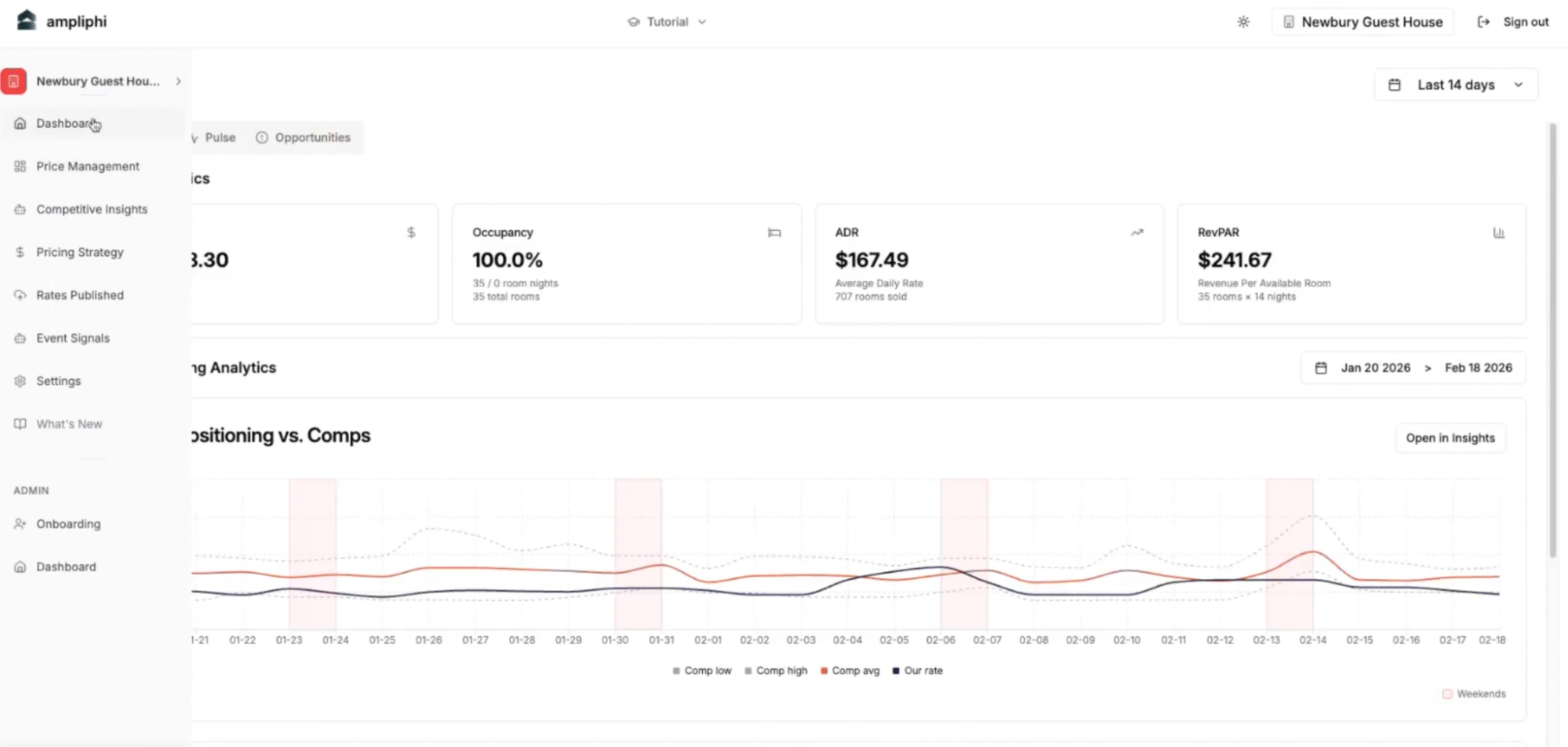
With ampliphi, this process becomes far more structured. Instead of guessing when to adjust rates, you rely on pricing recommendations surfaced through the Opportunities view, which highlights high-impact changes that can actually move revenue. At the same time, real-time competitor insights and smart alerts ensure your pricing stays aligned with market shifts without constant manual updates.
2. Demand forecasting
Demand forecasting uses machine learning to predict future booking patterns more accurately than old‑fashioned methods. It looks at past bookings, local events, seasonality, and time‑of‑day trends.
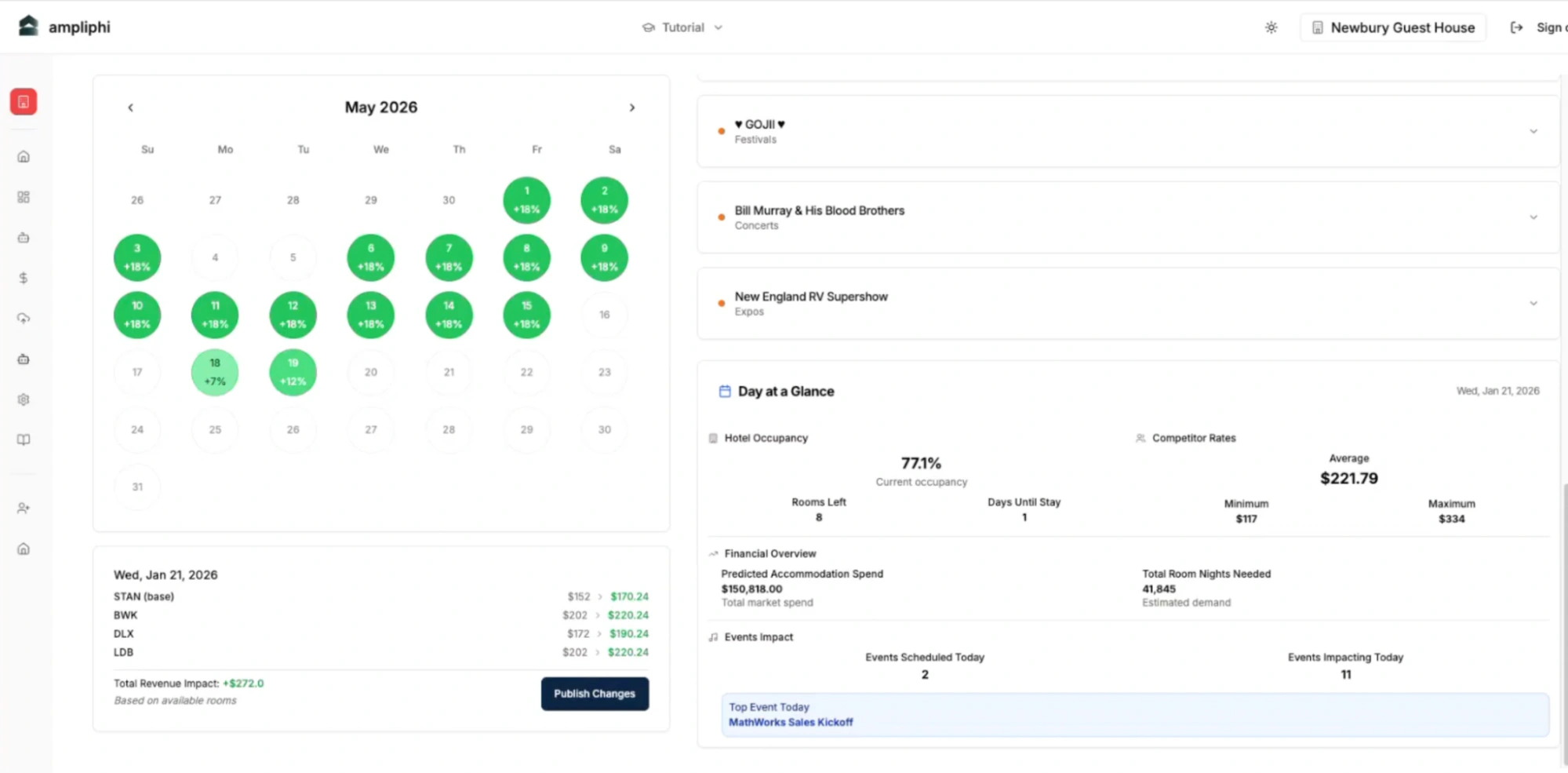
ampliphi strengthens this by connecting forecasting directly to real-world demand drivers. Through the Events module, you can see upcoming events along with their expected impact on room nights and revenue. Instead of waiting for demand to show up in bookings, you get a clearer picture earlier.
The Day at a Glance view then brings this together into a single summary, helping you quickly understand how upcoming demand may affect occupancy and pricing decisions.
3. Competitor monitoring
Competitive pricing tools are another big win for hotels. These systems monitor how other hotels are pricing rooms and adjust rates within minutes rather than hours. Hotels that use real-time competitor insights often outperform those that don’t, simply because they can align pricing to market conditions faster.
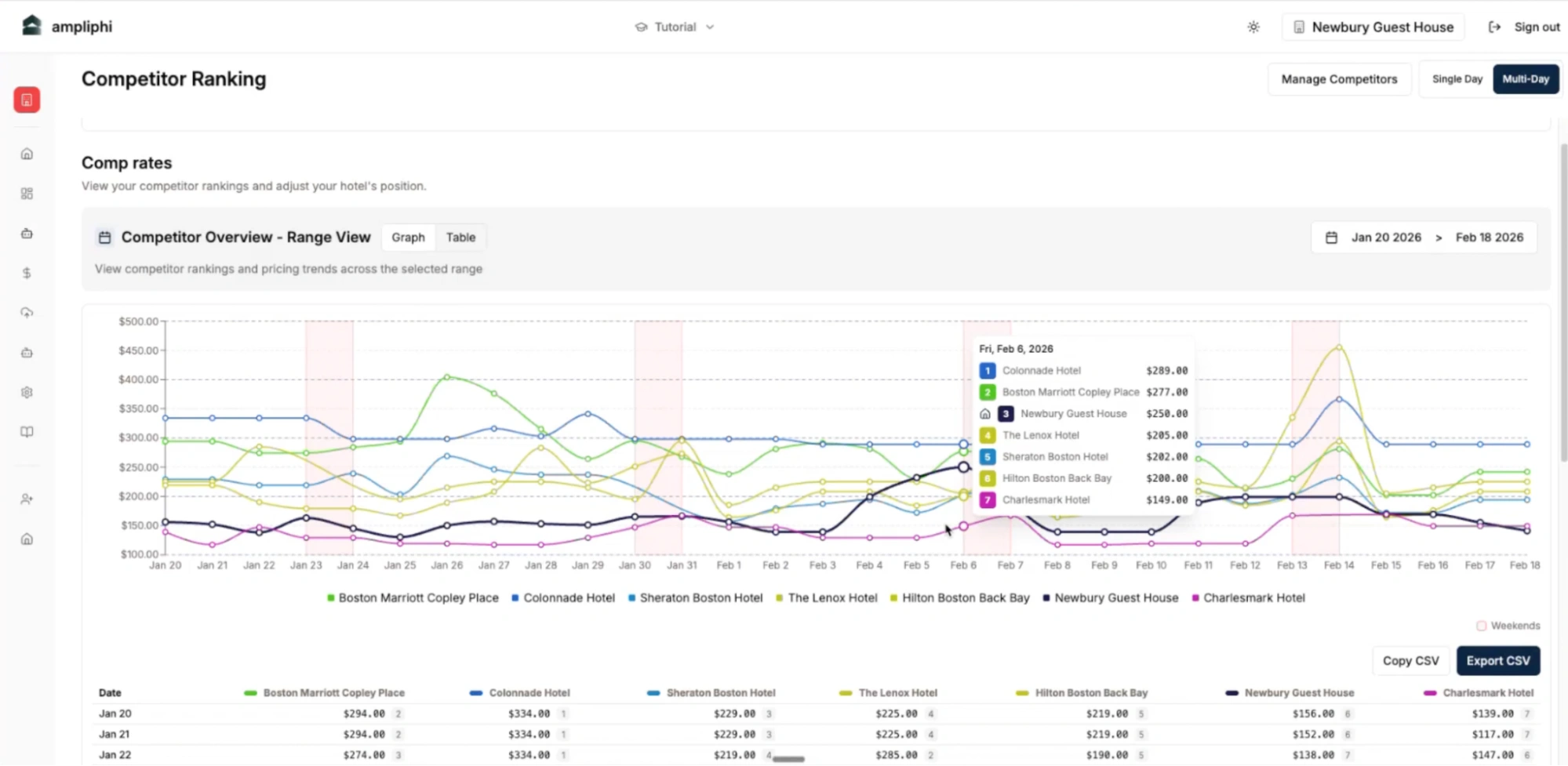
ampliphi simplifies this with its Competitor Insights view, where you can see exactly where your pricing sits relative to the lowest and highest competitors. When you switch to the multi-day view, you move beyond single-date checks and begin to understand how competitors behave over time.
The Pulse view, with market snapshots and smart alerts, further reduces manual effort by highlighting important pricing changes as they happen.
4. Inventory control
Revenue automation also helps with inventory management across all distribution channels. It keeps inventory synchronized everywhere at once, reducing overselling and mismatches. Some platforms can even anticipate which room types are likely to sell first, helping hotels allocate inventory more effectively.
While ampliphi focuses primarily on pricing and market intelligence, its integration with your PMS keeps all pricing decisions consistent with your system. When rates are adjusted based on market insights, they reflect in your PMS environment, helping maintain alignment between strategy and execution.
5. Guest engagement
Automation doesn’t stop with pricing and rooms. Hotels are using automated messaging and engagement platforms to connect with guests at key moments, from pre‑arrival offers to upsell suggestions and post‑stay follow-ups.
AI‑powered guest messaging can increase booking conversions and ancillary revenue, and, in some cases, automated guest tools have helped boost add-on and service spending significantly.
What to Look for in Hotel Revenue Automation Tools
Choosing the right revenue automation tool can feel overwhelming at first. There are plenty of options out there, and most of them promise similar results.
What matters is finding a system that actually fits how your hotel operates day-to-day. To make the process easier, here are some of the important aspects to look for:
- Seamless integration with your existing systems: Start by assessing how well the system connects to your existing tech stack. It should work smoothly with your property management systems (PMS), CRM, and distribution channels so your data stays consistent and reliable.
- Strong forecasting and real-time pricing: Next, look at how the system handles hotel forecasting and budgeting. A good platform helps you act on the pricing data in real time.
- Easy to use for your team: Ease of use matters more than most teams expect. If a system feels complicated, people avoid using it. The best tools present clear insights and simple recommendations that your team can trust and act on quickly.
- Automation that still keeps you in control: Automation should take work off your plate, not take control away from you. Look for systems that handle repetitive tasks while still letting you set rules and make final decisions. When done right, this balance saves time and keeps your pricing consistent without constant manual effort.
Measuring Success: Metrics to Track
Once revenue automation is in place, the next step is knowing what to track. To evaluate success, track these key performance indicators:
- RevPAR
- ADR
- Occupancy levels
- Total revenue
- Guest satisfaction
These metrics give you a clear picture of how your hotel is performing. Together, they show not just how many rooms you sell, but how well you price and deliver the experience. Hotels that actively track and act on these metrics tend to perform better.
When you can clearly see what’s working and what isn’t, decisions feel easier, and performance becomes more consistent.
Turn Data Into Revenue Growth
The gap between manual processes and automation continues to widen. Hotels that rely on traditional revenue management systems struggle to keep pace with modern market signals.
AI revenue management systems (RMS) help hotels transition from reactive to proactive revenue strategies. With ampliphi, you can help hotels manage pricing strategies, optimize inventory levels, and respond swiftly to market demand, thereby improving financial performance.
As a result, you can unlock more revenue, improve hotel profitability, and build a strong competitive edge.
Ready to take the next step? Book a demo with ampliphi RMS and start transforming your pricing strategy today.
FAQs
How to improve revenue in a hotel?
Hotels improve revenue by optimizing pricing, increasing occupancy, and enhancing guest experience. Revenue management systems analyze demand patterns and competitor pricing. Automation enables faster decisions, better forecasting, and personalized offers that increase both room revenue and ancillary revenue.
What are the 4 Ps of revenue management?
The 4 Ps of revenue management are Pricing, Positioning, Pace, and Performance. Pricing sets optimal rates, Positioning targets the right market segments, Pace manages booking or sales timing, and Performance evaluates results to improve strategies and maximize revenue.
What is the best revenue management software for hotels?
The best software depends on hotel size, budget, and complexity. Leading tools offer AI-driven forecasting, dynamic pricing, and seamless integration with existing systems. Solutions like ampliphi RMS provide advanced analytics and automation capabilities for modern hotel operations.