For years, hoteliers relied on spreadsheets, historical reports, and a constant race to match their competitors. They reacted to changes rather than anticipating them, worked in silos, and often left hotel revenue management strategies to big brands with big budgets.
The hotel industry has changed. Traveler behavior shifts constantly. Booking patterns grow less predictable. Margins tighten. Hotels cannot wait to make decisions.
Modern hotel revenue management gives revenue managers the clarity, speed, and confidence they need to act decisively. The pricing strategy combines AI, automation, and real-time insights to transform how hotels manage their rooms, demand, and operations. In FY 2024, the Indian hospitality sector recorded a 14% increase in revenue per available room (RevPAR), surpassing pre‑pandemic levels, showing how effective modern revenue strategies can drive real results.
In this article, we’ll explore what is hotel revenue management, how revenue managers use dynamic pricing and inventory management to maximize revenue, and the top hotel revenue management tips that drive revenue growth and boost gross operating profit.

What is Revenue Management?
In the hospitality industry, revenue management is the practice of maximizing revenue by selling the right hotel rooms to the right guest at the right time and price. It goes beyond simple rate setting. Modern hotel revenue managers use data, analytics, and AI technology to make smart decisions about pricing strategy, inventory management, and yield management.
At its core, revenue management involves several key actions:
- Pricing optimization: Hotels adjust room rates in real time based on demand signals, competitor pricing, and historical trends. For example, a resort may increase rates during holiday weekends while offering discounts midweek to fill rooms.
- Forecasting: Accurate predictions of future demand allow hotels to plan staffing, promotions, and pricing. Independent hotels in cities might forecast high business travel in a convention month and adjust availability and rates accordingly.
- Segmentation: Hotels categorize guests by booking behavior, travel purpose, or spending patterns. For instance, corporate travelers may receive different offers than leisure guests, allowing revenue managers to target pricing more effectively.
- Demand-based rate decisions: Hotels change room prices based on current and expected demand. Using AI dynamic pricing, a boutique hotel may raise rates as occupancy approaches full capacity to maximize revenue without losing guests.
What Is Revenue Management in Hotels?
Revenue management in the hotel industry uses distribution strategies and pricing tactics to attract, secure, and retain guest bookings. It now sits at the center of every profitable hotel operation. Hotels can access more data than ever and track and analyse it with greater precision. This environment creates powerful opportunities for businesses to improve performance and increase revenue.
To understand why revenue management matters, it helps to look at the hotel-specific challenges it addresses. Here are the most common factors:
- Seasonal fluctuations that change demand throughout the year
- Market volatility that affects booking pace and traveller behaviour
- Competition from online travel agencies (OTAs) that influence visibility and pricing
- Shifting traveller patterns that require constant adjustments to strategy
Why Revenue Management Matters: The Strategic Importance
Effective revenue management drives profitability and smarter hotel operations. It supports key strategic advantages for hoteliers by turning data and demand into stronger financial results.
Below is the importance of revenue management in the hotel industry:
1. Profit maximization
Hotels that apply effective revenue management strategies convert fluctuations in visitor demand into gains in total revenue by adjusting room rates at the right time. Global data from 2024 shows that 77% of hotel markets delivered higher RevPAR compared with 2023.
This kind of performance shows that hotels worldwide can increase both occupancy and average daily rate (ADR) through smart pricing and room inventory control using modern methods.
2. Accurate forecasting
Good revenue management leverages historical data and booking trends to predict market demand in advance. Hoteliers can anticipate periods of high demand, for example, during holidays or major global events, and adjust pricing and availability accordingly.
In fact, dynamic pricing platforms, built on demand forecasting and competitor pricing inputs, boosted overall revenue by roughly 22%. This forecasting helps avoid overcapacity or underpricing and supports stable performance across seasons.
3. Market competitiveness
Hotels that track competitor pricing and broader market trends remain competitive across global destinations.
In 2024, many markets, including Europe, the Middle East, and Asia, saw increases in ADR and RevPAR, with Singapore, Greece, Switzerland, and France among the top performers. For example, Greece’s ADR reached $389 with occupancy over 83%, even before the summer holidays began.
Using global demand signals and competitive benchmarking, hotels can set room rates that reflect actual value while attracting guests over rivals.
4. Better decision-making
Using advanced revenue management systems gives hotel teams actionable insights into booking patterns, cancellations, and demand surges from local events or business travel spikes. Those insights drive smarter decisions about pricing, inventory release, room availability, and discounts.
When hotels implement these systems, they see a 17% improvement in pricing response time, allowing them to respond quickly to changing demand. Such data-driven decision-making reduces guesswork and helps hotels optimise their revenue streams.
5. Improved ADR, RevPAR, and occupancy
Effective revenue management lifts all three core performance metrics: ADR, RevPAR, and occupancy.
For example, hotels in Spain achieved an ADR increase of about 33% over 2019 levels in 2024, while RevPAR jumped by 33.6%, supported by an occupancy of 74.6%. This kind of balanced performance, with strong room sales and healthy occupancy, demonstrates the real impact of applying successful revenue management across varying global markets.
Modern Revenue Management in 2026
Hotels gain real value when technology supports clear decisions that improve performance across every channel. Here’s how modern revenue management software like ampliphi RMS shapes practical outcomes for hotel teams that want to lift their revenue:
1. Anticipating demand fluctuations
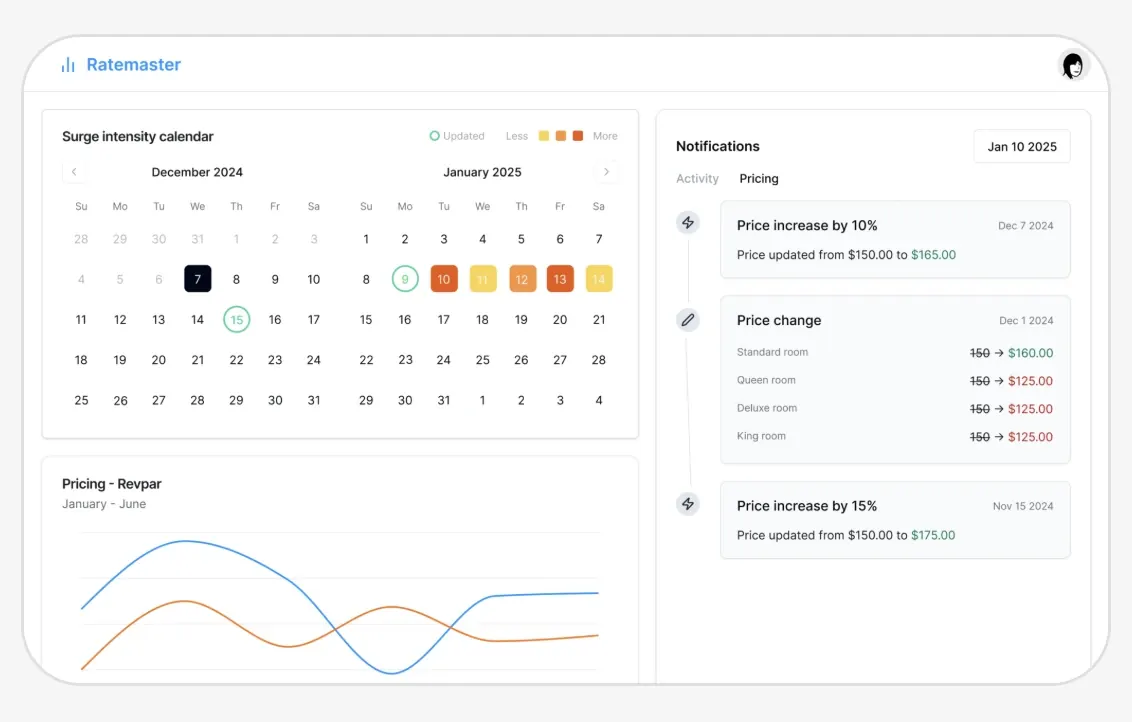
Hotels need accurate foresight to handle periods of high and low demand with confidence, and strong modern revenue management systems give teams the visibility they need to act early rather than react late. ampliphi combines an AI optimization engine with Competition Monitoring and Rate Calendar to help teams spot rising demand before it becomes evident in raw booking numbers.
The system highlights periods that require rate adjustments or new packages, giving staff room to focus on guests rather than on manual checks. As a result, hotels gain a clear advantage because they watch demand form in real time, respond to market trends, and protect their revenue potential with steady, confident decisions.
2. Optimizing multi-channel pricing
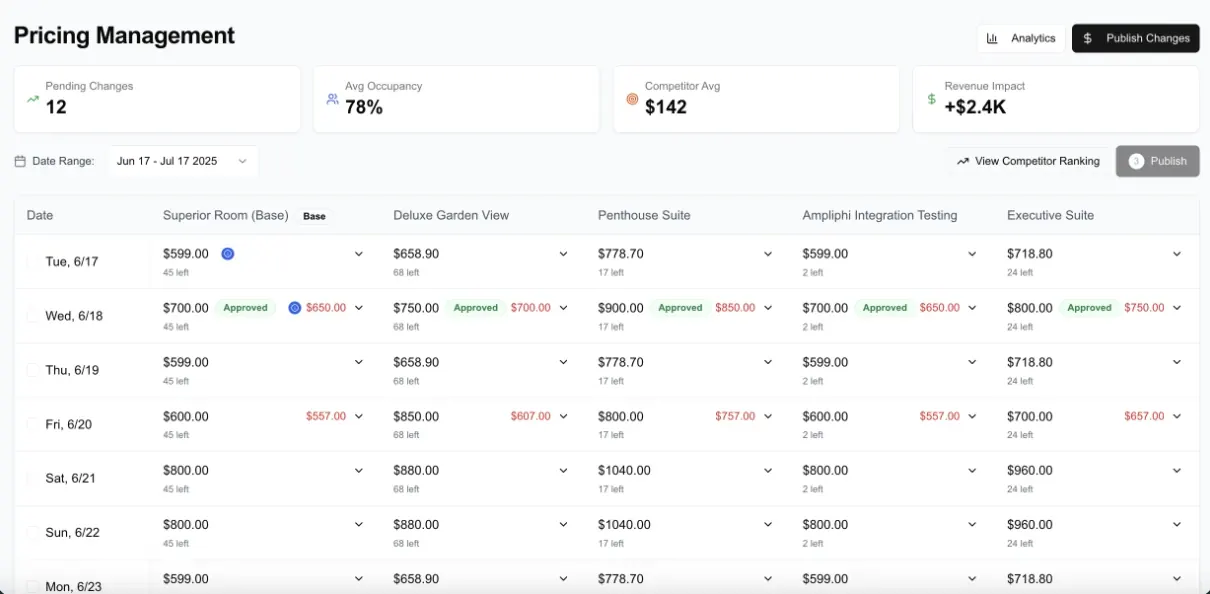
Handling multiple room types and many distribution channels creates pressure that can easily lead to missed opportunities. ampliphi RMS ensures that rates for all room categories and channels update dynamically without manual input. The platform monitors each booking source in real time and adjusts pricing intelligently.
This allows you to update all OTAs and direct booking channels, react to competitor and market changes, and reduce time spent manually adjusting rates and spreadsheets. In turn, you reduce manual effort, protect pricing logic, and implement reliable tools that support strong pricing and distribution strategies every single day.
3. Transparent tracking and performance insights
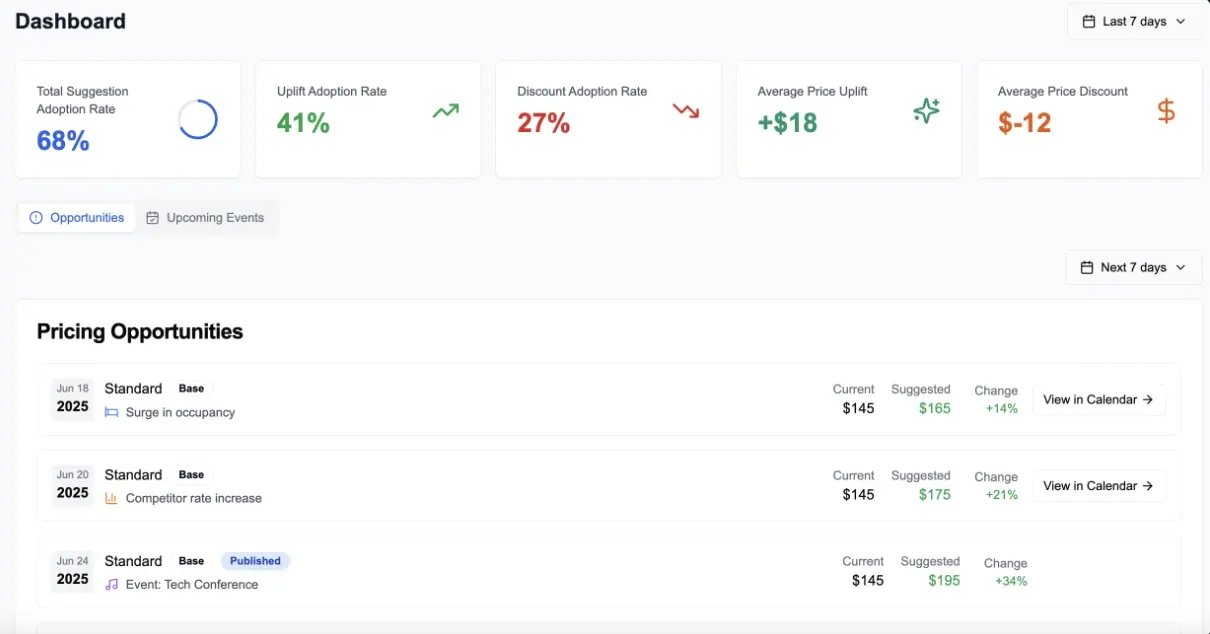
Automation only helps when teams can see what it accomplishes, and ampliphi provides clear dashboards that show how each adjustment shapes overall financial performance. Teams watch trends, check results, and compare outcomes without disrupting their core plan, which makes every step easy to understand.
Hotels gain confidence because every action is backed by clear evidence, and every metric supports better revenue management decisions that drive strong performance throughout the year. With this level of visibility, your team can see the full ROI of switching to an AI revenue management system and make confident business decisions.
4. Visibility and control across the portfolio
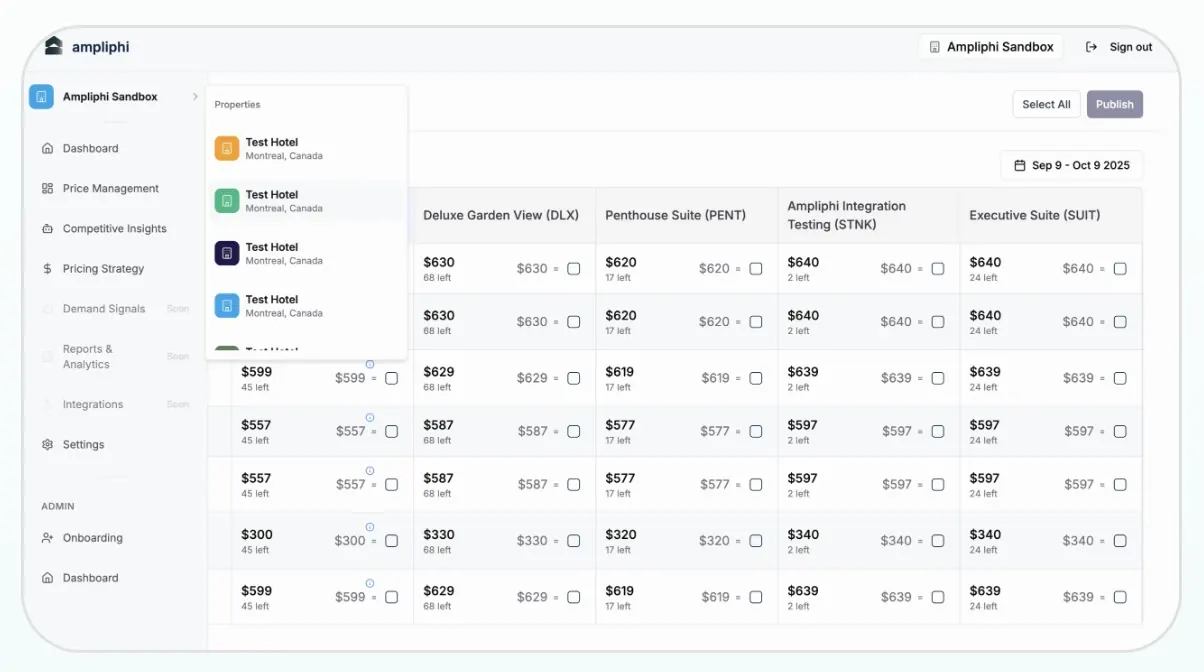
Hotel groups need tools that support property-level action and regional oversight. ampliphi RMS provides a single space where leaders track rates, occupancy, room types, and performance across all properties. Users can switch between hotels, review portfolio patterns, and apply broad rules when needed.
Each hotel still has the freedom to adjust based on local demand. This structure helps teams respond to distribution channels and on-property needs while maintaining control.
Revenue Management vs Traditional Pricing Models
Hotels faced a clear evolution in pricing as demand patterns grew more complex and competition increased. Each stage pushed operators to overcome the limits of the previous one. This change shaped how they protect margins and drive revenue growth.
1. Static pricing
It gave hotels a simple structure. It locked them into fixed rates that ignored real market dynamics, seasonal surges, and competitor behaviour. Hotels often missed strong opportunities during periods of high demand. They could not adjust quickly or act on clear signals from hotel guests across customer segments.
2. Dynamic pricing
It emerged as markets grew more competitive, and hotels began using early indicators to adjust rates more frequently. Recent research shows that hotels using dynamic pricing systems improved their overall room revenue by 15–30% compared with traditional static models. These models helped teams and marketing and sales teams react faster, although they still relied heavily on manual checks.
3. Predictive pricing
It created a significant step forward because systems began to forecast demand patterns with real accuracy. Hotels that used predictive tools achieved faster speed-to-market and steadier pickup, since forecasting reduced delays that had once blocked more innovative strategies.
4. Autonomous pricing
It now represents the next jump in hotel business strategy. Advanced systems automatically update room rates based on real-time market data, occupancy trends, and competitor pricing. In fact, AI-driven systems increased total revenue by an estimated 17% in hotels that adopted them, showing clear gains over legacy pricing approaches.
How to Implement Revenue Management in Your Hotel
Effective revenue management helps hotels capture demand, optimize pricing, and maximize profitability. Follow these steps to implement a system that delivers measurable results.
1. Understand your market and guests
The first step to effective revenue management is understanding your market and your guests. Study market demand, seasonal trends, competitor pricing, and guest behavior.
Identify high-demand periods and local events that influence bookings. This insight will guide your pricing decisions.
2. Segment your inventory
Once you’ve done this, classify rooms by type, view, and amenities to capture maximum room revenue. Apply separate rates for studios, suites, and ocean-view categories.
Segmentation enables targeted pricing across customer segments and lengths of stay, maximizing revenue per booking.
3. Choose a revenue management system
The next step is choosing the right revenue management system. Tools like ampliphi RMS combine dynamic pricing, real-time price optimization, and AI-driven insights.
Once integrated with your property management system (PMS), the system automatically updates rates across all distribution channels, saving hours of manual work.
4. Monitor competitors and market trends
After setting up the system, monitor your competitors and market trends closely. Follow local events that influence booking demand, like concerts or holidays.
Quick responses to these trends protect revenue and improve hotel revenue performance.
5. Implement dynamic pricing
Once you understand the market and set up monitoring, implement dynamic pricing rules. Adjust rates automatically based on occupancy, seasonality, and market shifts.
Dynamic pricing improves RevPAR while keeping rate parity consistent across direct bookings and OTAs. Then, adjust strategies regularly to reflect changing market dynamics.
6. Leverage AI optimization
The next step is letting AI optimize your strategy. ampliphi RMS learns from historical patterns and guest behavior.
The system continuously refines pricing strategies, capturing opportunities without adding extra workload for your team.
7. Track performance and refine
Finally, track performance and make adjustments. Use dashboards and rate calendars to review trends, occupancy, and revenue streams.
Over time, refine your strategy to improve financial performance and maximize your hotel’s total revenue.
The Future of Hotel Revenue Management
Looking ahead, the future of revenue management depends on automation, data intelligence, and faster decision-making. Hotels that adopt modern revenue management systems can respond instantly to market shifts, maximize RevPAR, and improve overall financial performance.
ampliphi RMS supports hoteliers with automated dynamic pricing, AI optimization, and centralized dashboards. It monitors local events, competitor rates, and booking trends, enabling smarter revenue management decisions. With features like rate calendars, market intelligence, and multi-property support, ampliphi helps hotels increase total revenue while freeing staff to focus on guest experience.
Take the next step in optimizing your property’s revenue. Book a demo with ampliphi today and see how automated revenue management can transform your hotel’s profitability.
FAQs
What is hotel revenue management?
Hotel revenue management is the practice of optimizing room pricing and distribution to maximize revenue. It uses data on demand, market trends, and guest behavior to adjust rates strategically, capturing more bookings and increasing overall profitability.
Why is revenue management important for hotels?
Revenue management helps hotels respond to market changes, manage inventory, and price rooms effectively. It allows properties to capture high-demand opportunities, improve RevPAR, and maintain competitive positioning while reducing manual pricing effort and increasing overall financial performance.
How does revenue management improve RevPAR?
Revenue management improves RevPAR by optimizing room rates based on demand, seasonality, and guest patterns. Strategic pricing ensures higher occupancy during low-demand periods and higher rates during peak periods, maximizing revenue per available room efficiently and consistently.
What tools help automate revenue management?
Automation tools like RMS platforms simplify rate updates and competitive monitoring. ampliphi RMS provides AI-driven insights, real-time price optimization, and dynamic pricing, helping hotels save time, maximize total revenue, and make smarter, faster revenue management decisions.

Written by the team at Ampliphi, the revenue management system for independent hotels.
View full profile →See where your pricing has room to move.
A free revenue audit reviews your rates against your comp set and shows you where the gaps are. No obligation, and if your pricing is broadly right, we will say so.